Sunday, September 24, 2006

All about Tags

We keep hearing about them. Tags I mean.
There are XPRL tags, Technorati tags, Social Media tags, bar coded tags, part of speech tags, and they all mean something. This article in New Scientist offers a spooky insight into where all this might lead us.

Social media tags are all over the place and here are some social media vendors that use them:

  • Del.icio.us - A social bookmarking site that allows users to bookmark many sites and then tag them with many descriptive words, allowing other people to search by those terms to find pages that other people found useful.
  • Flickr - A service that allows users to tag images with many specific nouns, verbs, and adjectives that describe the picture. This is then searchable.
  • Gmail - A webmail site that was one of the first to allow categorization of objects using tags, known as "labels" on emails.
  • LibraryThing - A social book cataloguing and community website, tags feature heavily here.
Practitioners might want to make sure that tags used about a client, product, service, brand or key employee is most associated with content that aids the PR strategy.

Most PR consultants are small busineses in a global world

Most PR consultancies are small businesses.

Is the Business Week description familiar:

Small businesspeople today have to deal with the same issues big businesses do—global markets, complex supply chains, and fluctuating currencies—and they have to do it without an army of MBAs to support them. Gone are the days when the business owner could walk out back to talk to his local production crew before knocking off early to sneak in a round of golf or go fishing. Many small businesspeople today are the business equivalent of fighter pilots—hurtling around the globe at breakneck speed as larger competitors leave them little room for error.

If a PR consultant is not involved in considering global issues there is a pretty good chance that they have been locked out of opportunities, are paying too much for services and have not got adequate tools for the job.

For example. Their name could be used in another country, they will not be visible to people looking for their services from out of town and there is a load of great software and tools available from other countries. Of course, they are not able to advise their clients, have no handle on the international effect of their media campaigns and cannot use social media much because of its international nature.

As
Toni Muzi Falconi points out We all now work on an international stage.

Byting the bullet

In PR we sometimes want to send a file to an editor or journalist. Sometimes we want to make an audio comment of a video comment available.

Of course we want to keep it short and to the point and put the news first and then fill in the background.

What, then are the limitations. Is it words? Time? Or megabytes.

And how would you know how many megabytes is acceptable?

A megabyte per second is good.

The Dark Side Returns

If you buy a Zune player from Microsoft then you'll be able to share your songs with your friends using its built-in wireless link.

However Microsoft, clearly worried about what the record companies will think, has decided that you'll only be able to listen to a transferred song three times, and that after three days you won't be able to play it at all. Says the BBC's Bill Thompson.

Zune could have been a deal competitor in the digital audio player market but Microsoft has not yet learned the lesson. It is described here and the outcome will be more expensive wars and another alternative on the market that will hack to monopolies.

I just do not understand why normally rational people cannot see that the market has changed.

Understanding that disintermediation is a major issue for companies is advice that the Public Relations manager must put before the board.

In the meantime, I will remove IE from my computer again.

Saturday, September 23, 2006

Bebo gets tough

The music social-networking site announced a new feature on Thursday that allows Web page owners to pre-vet all posts to their pages. The change enables owners to preview all responses, and delete or permit them based on their own discretion. They can also delete previous posts they do not like and ban specific posters altogether, reports cNet.

This puts even more control into the hands of the community... not a bad thing. It also means that badly pitched ideas and promotions will get no play time.

Linking up with a broadcaster to campign blog

Pakistan rape victim Mukhtar Mai has been in the international spotlight as a result of her campaign to seek justice for herself and other women in Pakistan.

She has been writing a blog for the BBC's Urdu website with the assistance of the BBC's Nadeem Saeed.

Is this a new breed of activism an campaigning? Are there opportunities to tie your blog to a high exposure we/news site like the BBC.

Food for thought and creative campaign ideas.

Good blog pitch

George Bush Snr is at the Ryder cup this week and is pictured on the BBC Ryder Cup Blog with glamoutous Ryder Cup WAGs. A well pitched story to the BBC bloggers the.

Sunderland Football Club seeks bloggers

Sunderland Football club is looking for Sunderland fans in Ireland to become resident bloggers here on safc.com.

The interest in Sunderland from Ireland has escalated in recent months, for obvious reasons.

Chairman Niall Quinn heads a consortium of predominantly Irish businessmen, Roy Keane, from Cork, is the club's manager and his squad features many Irish players.

Everyday Sunderland is on TV, radio and in the papers in Ireland.

Safc has had a stream of emails in recent weeks - from Dublin to Donegal - from fans wanting to know how they can set up an official Irish branch of the Sunderland Supporters' Association. The interest is huge.

To help with this initiative, safc wants some more blogging. Applications to safc

Alliance and Leicester gets e-prizes

Financial Services Forum has recognised effectiveness rather than merely awarding good copy or a creative advertisement in its awards scheme this year. Alliance and Leicester won twice, for e-commerce and integrated campaigns, as did Scottish Widows, which won in the public relations and new product, service or innovation categories.

Rider Cup chic

Cathy Martin, a fashion public relations consultant, said the golf WAGs knew how to look classy and chic but without taking attention away from their partners.

"With the golf WAGs (wives and girlfriends), they don't want to be the centre of attention.

"It's about their husbands and their sport," she said.

Sensible PR for the girls and thier golfing husbands

Social Text explained

IWR reports the Social Text upgrade and explains how this blog/wiki combo works.

The Sun Shines

I am often asked to explain social media in simple terms. I am defeated. But along comes the Sun Newspaper... great journalism and today.... How to download podcasts. As easy on the brain as Page three is on the eye.

Friday, September 22, 2006

Copyright or copywrong

Cory Doctorow's website is Craphound.com, and he is co-editor of Boing Boing: A Directory of Wonderful Things. He also has some interesting views about copyright.

He says:
Science fiction is a genre of clear-eyed speculation about the future. It should have no place for wishful thinking about a world where readers willingly put up with the indignity of being treated as "licensees" instead of customers.
It may be worth the while of a Public Relations manager to ask if the company copyright statements are for the company or consumers and if the company - why?

Are your stakeholders Licencees?

Read the full article here.

Attribution Rules

Over at Media Orchard, they are debating attribution.
They are finding the newspapers are no longer quoting sources:

Matt Duffy, a college journalism instructor, has noticed that pubs as esteemed as the Wall Street Journal are running quotes directly from press releases without citing the source.

Is this how bloggers should behave - nope. Is it how we should reference work in other PR activities - Nope.

And if you do... chances are you will get exposed as a fraud online.

Ethical and practical reasons not to follow the hacks.

How Much is YouTube worth?

Michael Arrington at Techcrunch is saying that YouTube is looking for $1.5 billion.

He makes these points which are relevant to a potential purchaser:

YouTube is serving over 100 million videos per day, with 65,000 or so new videos uploaded daily.

These 100 million daily video views aren’t people watching kittens fall aleep. Most of the popular videos on YouTube contain copyrighted material that YouTube shouldn’t be presenting in the first place.
But it is a very useful service for the PR industry, allowing you to make your company videos available on line for everyone to see (and share with friends).

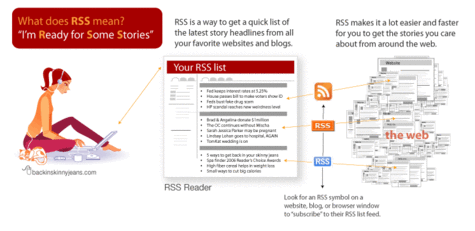
A really Good description of RSS


Back In Skinny Jeans has a great explaination of RSS, that essential that makes social media , well, social media.

For those of us who want a simple explaination, its really good.

Cross Channel communication

One of the issues Public Relations people face is being able to generate content for more than one communication channel. Bloglines has answered this issue with integrated Skweezer technology to optimise web pages for personal handheld mobile device's.

When you click on a link while reading a blog post in Bloglines Mobile, Skweezer will compress and reformat the content so you get it faster and better looking on your small screen. As you surf, the content will continue to be skweezed.


When disintermediated, disintermediate

Microsoft is planning free-web based versions of its word processing and spreadsheet programs reports the BBC.

The online versions of the programs will lack many of the features found in the full versions found in Microsoft's Office suite of applications.

Google recently bought Writely to do just this (I used it to write and share my XPRL paper last week). It is an online word processing package that includes a co-authoring and sharing capabilities.

Writely, offers a range of services that competes with Microsoft. Gamil, calendar, spread sheets etc.

These capabilities are useful in PR practice but are also a lesson for us all to learn about how the Internet disintermediates existing business models.

Bloggers, as citizen journalists, have undermined the role of newspapers in a big way and this means they have also undermined the press relations communication models that is the predominant practice of many PR agencies and in-house departments.


Bloggers 'Sad' or 'Brilliant'

There is the Athur Strain description of bloggers which is: ... - almost always unfair - that they are sad people sitting in their underwear rooted in front of a computer all day writing about how much worse their fungal nail infection is getting to an audience of three friends. - He does back off a lot when discussing political bloggers.

Why should a person of a 'certain' type, who may well not have used bulletin boards or usenet a decade (OK two decades ago) understand the idea of online social media?

Without that grounding and the time one really needs lurking in this space, Blogs are astonishing and bewildering. You see, I fall into the trap... lurk, space, 'social media' .... I use the jargon without a thought and, in the process widen the gap.

I get the impression that there is body of opinion that thinks that a blog is some form of rambling inconsequential chatter, no doubt this is true in many cases, but not true for most.

A serious blog such as 'CorporatePR' is a genre many middle and senior managers do not come across by chance, or have time to read because they are complex and most posts require time as with most worthwhile literature.

For many, understanding that a person, in the midst of their more serious occupation, might divert to an aside about an incident in their lives, is a difficult concept.

They see a comment, and without looking back at the blog topic, assumes every post is on topic, a serious, focused journal.

They forget that Gibbons, Chaucer, Lao Zi, Amis, Belloc, Eliot, Johnson in fact almost every philosopher and essayist also wrote asides even in the margins of their most serious works.

They cannot translate this into what we, with our jargon, would call an 'off-topic' 'rant'.

Thus, some seek to engage in conversation outside the prime interest (topic) of a blog, perhaps ignorant a wider and more profound contribution and the thrust of a blog.

What sort of 'sad' person would make comments like these on a blog:


Re:Symbiosis And Living Machines 2006-08-10
Re:Healthy Lurking 2006-05-01
Re:New study on altruistic punishment: people prefer groups that punish free-riders, if punishment increases profit to members 2006-04-13
Re:Computing 2020 - The Internet as Architecture of Cooperation 2006-03-23

Sort of kinky stuff for the average middle manager..... Untill of course you see who the author is and the read the posts (articles).

There are several things we can take out of this:

1 It is not well understood by a section of society that Blogs are a medium. Blogs have many applications. They are akin to the 'blank sheet of paper' upon which the author can write, originate, say, paint, videocast. There are other features (comment, trackback, RSS etc but these just complicate my argument).
2 That the marginal notes, the 'rants', add interest and a human voice, even insights into the character of the author. They have been included in literature since before Simonides. But in this new medium they tend to be visible as any other contribution.
3 Those of us who are involved have moved a long way from those who are not, we can no longer understand their (lack of) understanding. We can be offended when really we need to be sympathetic, understanding and educative.
4 Sometimes, our rants stir indignation and other emotions among our readers - but we know that and often we do it to achieve just such ends.
5 Our work is just beginning and we have to work hard at bridging the divide not least because our world, the digital world, is evolving at an ever growing rate.

Is 'Reputation Management' Hype?

Hack Anthony Hilton commenting on the HP debacle poses the question:

What is fascinating is that for all the yapping of the dogs the caravan moved serenely on ­ the Hewlett Packard share price which had been at a three-year high before the eruption, continued to test new high ground throughout.

The share price said that the damage to the company's reputation did not matter as long as it continued to do good business.

It raises the question of whether boards worry too much about reputation and its associated risks. It has become a cliche to say that reputation is the major risk to today's global corporation and this fear has fuelled a mighty expansion in spending on public relations to put a suitable gloss on corporate behaviour. Is it money which needed to be spent? The Hewlett Packard experience would suggest not.


Well, a simplistic view. But very close to home. Hilton, of course, has a shabby mind and can't grasp the role of Public Relations, imagining it as the sort of spin he puts into his stories and which he calls 'Journalism'.

We can start off with how to define an organisation is it the nexus of contracts (Coarse) or Nexus of conversations (Sonsino) or the nexus of relationships (Phillips)?

If of contracts, the contract between the board, shareholders and employees is all that is holding the company together when the simple contract of trust is brocken. If of conversations then for some stakeholders these must be trivial and irelevant to their needs now and trivial does not seem to matter to the shareholders or does it. But if of relationships then they are more powerful than the board might believe and the company can survive.

So this is more about relationship management that reputation management.

Among the values attributed to an organisation are elements of trust which are among many more. Some are brand values (owned by people not companies), some are about needs fulfilment, some are social and the most powerful are emotional. It is a treasure trove of many values.

The Relationship Value Model makes it clear that reputation is about what the organisation does not what it says.