In reporting this paper by Thomas Ritter and Achim Walter one hopes to make it obvious that the PR industry has to get a bigger and better handle on the use of digital communication. If they fail to do so, thier clients will be ill served.
The paper presents a case study of a service-orientated group of social businesses in the not-for-profit sector, where a triangulated approach is employed, a three-factor model of effective e-mail use is proposed. Using focus groups, diaries and survey, the impact of e-mail was investigated on four key dimensions of internal communication at Parkside Housing Group.
Whilst overall e-mail was found to be less influential than face-to-face communication, e-mail was found to positively and specifically influence: the communication climate, where it provides a mechanism for staff to feed their views up the organisation; shared objectives and goal alignment, where it helps staff to understand the overarching goals of the organisation (the 'bigger picture'); and perceived external prestige; the construed external image of the organisation by helping the organisation to share positive publicity, and its successes, amongst staff."
Title: Matching high-tech and high-touch in supplier-customer relationships
Author(s): Thomas Ritter, Achim Walter
Journal: European Journal of Marketing
ISSN: 0309-0566
Year: 2006 Volume: 40 Issue: 3/4 Page: - 310
DOI: 10.1108/03090560610648066
Publisher: Emerald Group Publishing Limited
Tuesday, April 11, 2006


This is self promotion
"The concept of organisations with values that extend from physical assets, intellectual property, process, know-how, knowledge brand and reputation attributes is understood as being part of the value of companies. Stakeholder relationships are intangible assets and there is a significant body of opinion that identifies intangible assets as a major driver in the global economy, corporate survival and success. There is a pivotal management role in relationship management which is the lever by which value from intangibles is optimised.
The paper describes how, for companies in the twenty-first century, the creation of value increasingly depends on intangible assets such as knowledge, systems, data, intellectual property, brands and relationships. This opens up a new area of public relations practice whereby public relations managers take responsibility for the creation of value through relationships throughout organisations.
Title: Relationships are the core value for organisations: A practitioner perspective.
Author David Phillips
Journal: Corporate Communications: An International Journal
ISSN: 1356-3289 Year: 2006 Volume: 11 Issue: 1 Page: - 42 DOI: 10.1108/13563280610643534
Publisher: Emerald Group Publishing Limited
The paper describes how, for companies in the twenty-first century, the creation of value increasingly depends on intangible assets such as knowledge, systems, data, intellectual property, brands and relationships. This opens up a new area of public relations practice whereby public relations managers take responsibility for the creation of value through relationships throughout organisations.
Title: Relationships are the core value for organisations: A practitioner perspective.
Author David Phillips
Journal: Corporate Communications: An International Journal
ISSN: 1356-3289 Year: 2006 Volume: 11 Issue: 1 Page: - 42 DOI: 10.1108/13563280610643534
Publisher: Emerald Group Publishing Limited
dynamics of public relations
The dynamics of public relations:
There are, again, arguments about the nature of public relations, I thought an an academic reserach perspective would offer light insteadof heat. Carmen and Lyndon's research paper offers a view in European Journal of Marketing
"Public relations is variously defined: those within the PR sector tend to view their activities as having strategic and corporate impact, while many marketers classify PR as little more than a tactical ingredient of the promotional mix. This contrast is important, given marketers are heavy users of PR activity. This confusion has hindered the development of the PR profession and added to the blurring of exactly what constitutes PR. Contributes to this discussion by identifying the core constituents of public relations and the underlying driving forces. Through a holistic approach, examines PR-ness? at three different levels. Survey data were gathered from public relations consultancies in the UK. Exploratory factor analysis and confirmatory factor analysis were used to examine the responses of 297 public relations consultancies in England. As a result, the many driving forces within the PR domain have been identified and grouped into nine measurement scales of PR-ness?. These findings provide PR practitioners with a set of issues to address in order to progress the perceived professionalism of their activities and they offer a framework for assessing subsequent progress in this respect."
Extract from: The dynamics of public relations: Key constructs and the drive for professionalism at the practitioner, consultancy and industry levels by Carmen Lages and Lyndon Simkin published in: European Journal of Marketing Volume 37 Number 1/2 2003 pp. 298-328 Copyright © MCB UP Ltd ISSN 0309-0566
There are, again, arguments about the nature of public relations, I thought an an academic reserach perspective would offer light insteadof heat. Carmen and Lyndon's research paper offers a view in European Journal of Marketing
"Public relations is variously defined: those within the PR sector tend to view their activities as having strategic and corporate impact, while many marketers classify PR as little more than a tactical ingredient of the promotional mix. This contrast is important, given marketers are heavy users of PR activity. This confusion has hindered the development of the PR profession and added to the blurring of exactly what constitutes PR. Contributes to this discussion by identifying the core constituents of public relations and the underlying driving forces. Through a holistic approach, examines PR-ness? at three different levels. Survey data were gathered from public relations consultancies in the UK. Exploratory factor analysis and confirmatory factor analysis were used to examine the responses of 297 public relations consultancies in England. As a result, the many driving forces within the PR domain have been identified and grouped into nine measurement scales of PR-ness?. These findings provide PR practitioners with a set of issues to address in order to progress the perceived professionalism of their activities and they offer a framework for assessing subsequent progress in this respect."
Extract from: The dynamics of public relations: Key constructs and the drive for professionalism at the practitioner, consultancy and industry levels by Carmen Lages and Lyndon Simkin published in: European Journal of Marketing Volume 37 Number 1/2 2003 pp. 298-328 Copyright © MCB UP Ltd ISSN 0309-0566
Monday, April 10, 2006
Stakeholder Analysis for Systems Thinking and Modelling
Stakeholder Analysis for Systems Thinking and Modelling: "The importance of stakeholder concept is growing in management literature. Since Freeman published his landmark book, 'Strategic Management: A StakeholderApproach' the concept of stakeholders has become embedded in management scholarship and in managers thinking," Suggest the authors of this paper.
About a dozen books and more than 100 articles with primary emphasis on stakeholder concept have appeared in management literature following Freeman's book. This paper presents stages through which the stakeholder concept developed in the management literature. Using a chronological map it explores and classifies stakeholder literature for a better understanding of the stakeholder concept.
It also examines the relevance of stakeholder analysis in systems thinking and modelling. We suggest that a systematic analysis of stakeholders could enrich the problem structuring and scenario planning.
About a dozen books and more than 100 articles with primary emphasis on stakeholder concept have appeared in management literature following Freeman's book. This paper presents stages through which the stakeholder concept developed in the management literature. Using a chronological map it explores and classifies stakeholder literature for a better understanding of the stakeholder concept.
It also examines the relevance of stakeholder analysis in systems thinking and modelling. We suggest that a systematic analysis of stakeholders could enrich the problem structuring and scenario planning.
A 21st Century Survey?
 Two recent surveys with very different results show us how important it is to find monitoring and evaluation organisations that can help Public Relations decision making.
 One should not be too distressed to see two surveys with almost diametrically opposed findings as was the case in research finding Microsoft 'World's Most Valuable Brand' - Digital-Lifestyles.info:
"Two new studies into branding have produced two very different results, with a UK study declaring Microsoft the strongest brand in the known universe, while research in the US saw consumers slapping Microsoft down to near-bottom of their 'most trusted' list.
Microsoft topped the list, with the study showing most consumers held positive feelings about the brand. Andy Farr, executive director at MBO commented, 'When you look at what customers and consumers say to us, they do hold Microsoft in high regard.'
Across the pond, a brand study by Forrester Research saw Bose, Dell and Apple Computer being declared as technology brands trusted by U.S. consumers, with users warily eying the likes of Toshiba, Hitachi, Microsoft, Gateway and LG.
With Microsoft's brand scraping in at a lowly 20th spot out of the 22 companies included in the poll, Forrester's warned that Microsoft faces big a consumer defection risk.
With a deft turn of marketing-speak, Forrester analyst Ted Schadler observed that, 'A decline in trust causes brand erosion and price-driven purchase decisions, which in turn correlates with low market growth.'"
Well, now we know what nonsence much marketing is based upon and what trite conclusions can be drawn by 'experts'.
The trouble is that the marketing companies are not interested in values. The values people hold and the values of the organisations they are investigating. It is the dissonance that is the issue not a fired from the hip answer to a question.
Picture: All femail survey crew

VoIP calls up 2million Brits
VoIP calls up 2million Brits "Around two million Britons have used computer-to-computer VoIP packages to place calls over the internet in the last 12 months, with the same number of newcomers to the technology expected by this time next year."
Nearly everone I know uses Skype.
But I expect we will find out when Media Research Inc include VOIP in their surveys. I have to say, it is unlikely. There are far too many channels for communicatuion to asses and no one can remember which ones they used for what more than a day ago.
Nearly everone I know uses Skype.
But I expect we will find out when Media Research Inc include VOIP in their surveys. I have to say, it is unlikely. There are far too many channels for communicatuion to asses and no one can remember which ones they used for what more than a day ago.
UK publishers embrace free content trend
UK publishers embrace free content trend: This snippet comes just in time to save the UK publishing industry.
There is every case for charging for content if you have the unique capability or content that someone wants. But sooner or later the technology will catch up. People will pay for values that are a fair exchange. Information has been disintermediated. It looks like the publishers have now begun to find out:
"The 2006 census by UK trade group the Association of Online Publishers (AOP) found that only 37 per cent of members now charge for branded online content, down from 63 per cent in 2005.
Publishers' major income source is display advertising, which accounts for 41 per cent of revenue. Paid content makes up 18 per cent, of which 78 per cent is from subscriptions and 22 per cent from one-off payments, and sponsorship accounts for 9 per cent.
But for those Association of Online Publishers' members that do charge, subscriptions form a significant part of their overall income. More than a third (37 per cent) of publishers who charge for content earned more than £1 million in subscription revenue alone in 2005; 26 per cent earned more than £5m.
More business publishers charge for content than consumer publishers: 40 per cent compared with 34 per cent.
The recent consensus on paid content has been that the majority of web users will only pay for content that is unique, such as specialist business information or opinion and comment that cannot be found elsewhere on the web for free."
Wherever that may be. If its worth it it will be out there.
There is every case for charging for content if you have the unique capability or content that someone wants. But sooner or later the technology will catch up. People will pay for values that are a fair exchange. Information has been disintermediated. It looks like the publishers have now begun to find out:
"The 2006 census by UK trade group the Association of Online Publishers (AOP) found that only 37 per cent of members now charge for branded online content, down from 63 per cent in 2005.
Publishers' major income source is display advertising, which accounts for 41 per cent of revenue. Paid content makes up 18 per cent, of which 78 per cent is from subscriptions and 22 per cent from one-off payments, and sponsorship accounts for 9 per cent.
But for those Association of Online Publishers' members that do charge, subscriptions form a significant part of their overall income. More than a third (37 per cent) of publishers who charge for content earned more than £1 million in subscription revenue alone in 2005; 26 per cent earned more than £5m.
More business publishers charge for content than consumer publishers: 40 per cent compared with 34 per cent.
The recent consensus on paid content has been that the majority of web users will only pay for content that is unique, such as specialist business information or opinion and comment that cannot be found elsewhere on the web for free."
Wherever that may be. If its worth it it will be out there.
News and jobs for journalists :: Times claims traffic boom up to 8 million users
Times claims traffic boom up to 8 million users: "Times Online's audience has increased from 1.5 million to 8 million unique users in just 18 months, according to online editorial director Peter Bale.
Speaking at the Blogging4Business conference yesterday in London, Mr Bale said that a quarter of Times Online's content is now commissioned specifically for the website and that comment and opinion is what differentiates Times content from rival news sites."
Amazing what happens when you peek out from the firewall.
Speaking at the Blogging4Business conference yesterday in London, Mr Bale said that a quarter of Times Online's content is now commissioned specifically for the website and that comment and opinion is what differentiates Times content from rival news sites."
Amazing what happens when you peek out from the firewall.
Intellectual PR – that's not too hard is it?
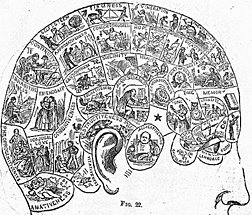
There is a some debate about the future of PR as it moves away from the agentry model to do more by way of contributing towards corporate value and monetisation of Intellectual Capital.
The disintermediation of the value chain and the consumerisation of information is challenging for all organisations. In particular, it is a challenge for PR.
We deal in intangible assets. If you like, it is the new market. It is a bigger market than all the usual markets such as the LSE and there is a lot of sense in getting out of such old model institutions.
This dramatic change will need PR expertise that understands the nature of values that are relevant to 'stakeholders' which in turn means that there is a need to be able to map stakeholders, their interests and their relative significance.
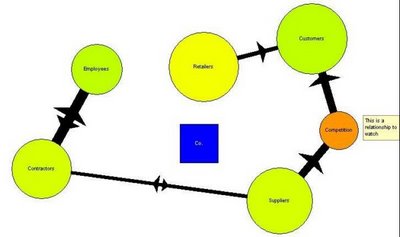
It also means that there is a need to be able to identify the values that such stakeholders hold dear and, using a range of tools including communications tools, a capability to marry client values with their significant cultural partners.
Its not hard.
Here is how to find, map and evaluate stakeholders.
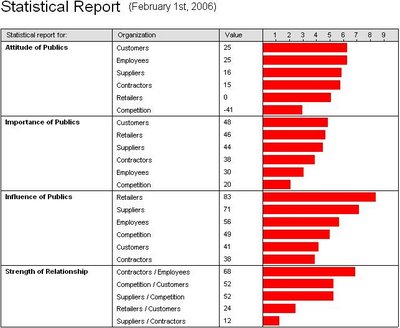
Here is how to identify their values (and benchmark them against the organisation)
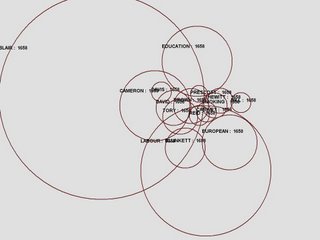
Here is how to respond to stakeholder concerns
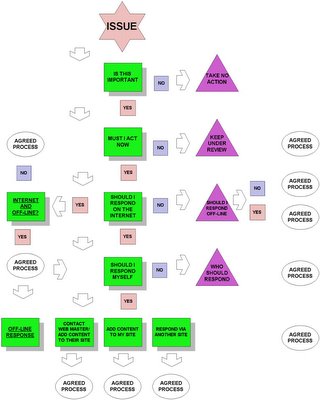
Here are the range of skill sets needed to implement campaigns.
And here are the communications channels available to do it.
Now, that was not too hard was it?
Web site relationships

I tend to follow the work of Lynda Hon because it tends to have an edge to it. Her latest research study with Eyun-Jung Ki, Linda published in the Journal of Communication Management looked at how organizations display use of relationship maintenance strategies through their web sites.
The results revealed that openness was the strategy used most frequently.
The quality of the openness dimension also was rated more highly than it was for any of the other strategies.
The second research question explored whether industry type made a difference in organizations' use of the relationship maintenance strategies.
A statistically significant difference among industry type was found for three of the strategies – positivity, openness, and access.
It will be interesting to see how this changes as social media really begins to bite and i have no doubts there will be a sea change for some.
Picture: Image Relationship Marketing
Sunday, April 09, 2006
Dysfunctional PR
 There may be many domains of PR practice and many description for PR but how many 'models' of PR are there. If one works froward from a form of practice that emerges from Rhetoric, the art or technique of persuasion, we progress through a range of practices that attempted to change relationships either directly or through the mediation of third parties.
 In her post 'The end of PR as we know it' Katie Payne points us to Carl Botan and his recent paper about a model of cocreationalism. In the paper, Carl makes the point that there is a debate and that it passes most practitioners by because the trade papers (Notably PR Week) don't follow what is happening in academia.
Its rather like the Medical Journals not knowing about fundamental medical research and debates about palliative cures.
For many practitioners, this is not a problem and not a big issue. They have a form of practice that my colleague Richard Bailey would describe as collecting the 'low hanging fruit'. An example of which is provided by Julia Hobsbawm, whose practice is predicated on media contacts and is pretty well described by The Independent and the Observer. Julia was singed because she offered a 'mates rate' for writing and networking.
Compared to some of the ideas offered in the book and papers on Relationship Management by Ledingham & Bruning over some years years or the Accommodation Theory (Cancel, Cameron, Sallot, & Mitrook which has offered a continuum view for some time with a range of case studies.
and Carl Botan's latest view.
I accept there are issues. Elizabeth Toth in the current edition of Journal of Communications Management says: “New scholars find themselves in university communities that will not reward them for publishing public relations theory unless this theory is positioned as communication, management, ethics or history.” For some of us who are able to stand outside such imperatives, is, to an extent, a luxury but it has not prevented some excellent work.
But as Professor Toth says, “both practitioners and scholars have legitimate complaints about the communication between them” and, as a new PR mag hits the streets in the UK, there is no need for the trade media to be so badly informed and to do so little justice to excellence among both practitioners and academics. It makes the industry dysfunctional.
Picture: Dysfunctional media
Friday, April 07, 2006
A reminder to me - what has the Internet done?
 There are many economic implications that stem from the digital tsunami.
 We are now seeing empirical evidence of how relationship management using digital relationship building is changing the value and trading advantage of companies. An Empirical Investigation of Net-Enabled Business Value by Anitesh Barua, Prabhudev Konana, Andrew Whinston, and Fang Yin. MISQ Dec. 2004 is but one example and there is a much more evidence.
Information and Communications Technologies (ICT) have wrought many changes. And the pace of change is accelerating.
We have seen many exmples of Internet driven disintermediation. This change was well established in the PR literature half a decade ago. We see it web sites like Amazon.com and eBay.
Google disintermediates the print and distribution of newspapers with Google News. In response newspapers have gone direct to thier markets and in some cases very profitably. In the Guradian's case the return on discounted real term investment in year to February 2006 is quite acceptable (5%).
This is an economic and marketing shift that relevant to the practitioner with an interest in newspaper publishing, press relations and reach of message.
How far disintermediation will affect retailing is uncertain. What we know is that it is a lot with implications for retailers, rents for city centre and out of town malls, the pension funds that own them and civic urban renewal and economic planners. This affects jobs, investment, transport and much more. The chain reaction is already noticed and soon enough will be dramatic.
For the practitioner involved in any of these sectors, this change is significant. Old relationships need to be managed and new relationships built and sustained. Some of these relationships will be personal and local others will be global. One of the important issues is that a local issue in Leeds can have an effect in California. The ability to to develop relationship (stakeholder)strategies that recognise these fast changing influences and deploy public relations objective setting and strategies is a management function that will become, progressively more important.
Rockwell Automation in ten years has created technologies that embed in mechanical processes that are, in their own right 'intelligent'. They can make decisions. They are so good that they are embedded in the engines of aircraft taking you on holiday. Most aircraft can do the whole trip without a pilot! In Afghan airspace, most aircraft do not have pilots! The cost of filling supermarket shelves is continually being reduced through more efficient technologies. The cost of food production in both the developed and developing worlds is dropping because of better ICT systems. This in important because it shows how even the fundamentals of primary production are affected. It is not just the 'weightless economy' that is being affected. ICT efficiencies throughout the supply chain are sought all the time.
In 2006, a software programme was taught to identify the extent to which a number of press clips were favourable from any number of human perspectives. It also identified issues that were of concern to millions of bloggers by reading and assessing millions of blog posts. Add Web sites, on-line media, discussion boards and Usenet and other communications technologies to this mix and there are two problems. Finding all the relevant stuff which can be hidden in the 'long tail' is one and reading it is the other. Neither can be done by a human, but this is content that offers competitive advantage and corporate protection from unhelpful issues.
Such developments will be commonplace and in use before the 2006 intake of PR students finish their final dissertation.
Key in all this is an ability find and process the content (and have an open mind about developing technologies and their deployment) and the ability to advise the client in such a way that the effect is as near as possible two-way symmetrical relationships.
As things stand, there is no way that such students can be taught about these advances. After four years of study they will not be competitively competent. But the most successful organisations will be using such tools and will be gaining confidence in their abilities.
They will need to. The market and issues intelligence derived from these capabilities will determine who wins in the market place and which organisations are most in tune with their constituents.
There is a need to develop this thesis and there is plenty of evidence to help make the case.
This is the kind of hard fact that is important for corporate affairs managers seeking both corporate commitments and a reason for pursuing digital strategies.
In addition, we are used to a process of market disintermediation. This is where the value chain is broken down when the consumer circumvents one or more elements in the supply chain. It is is great significance to marketing.
Picture: "Creating Meaningful Communities" by Nita Tiffaha Jawary
Tuesday, April 04, 2006
Transparent Politics
 Corporate transparency, and Internet agency came together for an American politician last week. He lost.
It is an example of how a person (or corporation) can create values that are positively damaging.
PR 3.0 makes it quite clear that in any relationship values are exchanged. In building relationships one offers tokens with values that can be appreciated by the other party.
Here we see an offer of a photograph implying endorsement of his tale of being in Iraq and working for an end to the confrontation.
These are values designed to build a relationship with voters that included a photograph of the politician in Iraq.
A token to demonstrate values inherent in the politician. Internet agency, quickly found that the photo was of a Turkish street (a very long way from Iraq). All those positive values have now turned negative.
Picture: Canvassing for a vote
Intel outside
 Intel to roll out wireless internet across UK - Industry sectors :
"Intel, the world's biggest computer chip maker, is investing $25 million into a project to roll out wireless broadband services across Britain's cities as part of a joint venture with Pipex, the British internet group."
Times summary by: Webpagesummariser
Studios Miss Opportunity
 Studios Take First Step In Movie Downloading
 "Warner Brothers, Universal Pictures, Sony Pictures, 20th Century Fox, Paramount Pictures and MGM will put films up for sale on a web site co-owned by the group for between $10 and $30. The name of the site is Movielink.com and the average price of a DVD is around $20.
All of the available films will be packed to the gills with copy-protection software dubbed DRM. This will limit the number and types of copies consumers will be able to make with their purchases. In some cases, the movies can be burned to DVD for playback on a specified computer or set-top DVD player, but in other cases the digital versions will have to stay put on a customer's computer. These restrictions are an attempt to curb the illegal pirating of content on the Internet, a scourge of movie makers and theaters."
This is just dumb. Useing a PR 3.0 approach, the jast number of Intelectual Properties locked into the films could be released in so many ways to a huge range of Stakeholders in long and rewarding conversations.
Forbes summary by: Webpagesummariser
Picture: Marilyn Monroe brings a bag of Bell brand potato chips to a champagne party in the Seven Year Itch.
The science behind the desire to communicate
 Over the past few decades, philosophy of science has switched from general features of scientific practice to concepts, issues, and puzzles specific to particular disciplines. Philosophy of neuroscience is a natural result.
 While this may seem to be an academic issue, it has significant implications for Public Relations.
Whereas in the past, PR was founded in the social sciences and business schools its assumptions are now subject to deeper and more profound study.
We now know that the desire to communicate is fired by endorphins. We are beginning to understand why people relate to 'brands' and the differences between nature and nurture.
There are few hiding places for the past practice of inventing theories based on just historic data. Soon we will know how and why the brain understands things like relationships, reputation, favour ability and much more. Favoured 'isms' will soon be held up against a much harder and more robust science and the sensible practitioners will learn how to ask searching questions about the provenance of research that is being offered to aid management decision making.
This emerging area is spurred by remarkable recent growth in the neurosciences.
Cognitive and computational neuroscience continues to encroach upon issues traditionally addressed within the humanities, including the nature of consciousness, action, knowledge, and normativity. Empirical discoveries about brain structure and function suggest ways that "naturalistic" programs might develop in detail, beyond the abstract philosophical considerations in their favour.
Stanford article summary by: Webpagesummariser
Picture: The Endorphin Collection
Monday, April 03, 2006
Wi-fi trains arrive nine months early - Mobile
Wi-fi trains arrive nine months early - Mobile : "Currently the operator of the East Coast Line, which runs from London Kings Cross through cities such as Peterborough, York, Newcastle and Edinburgh, offers wi-fi on a number of services. The further rollout will see all of its rebuilt Mallard trains fully equipped for wireless internet access by August 2006, a full nine months earlier than the previous scheduled completion date of May 2007.
About time!
About time!
Scream marketing
 Netimperative report that UK marketers still prefer to scream at customers in the b2B sector.
Reporting a survey, from trade body the Internet Advertising Bureau (IAB), revealed that only 39% of b2b marketers use display ads, while 39% use pay per click search and 29% use online classifieds.
However, b2b advertisers have readily taken to email marketing with 83% of respondents using it largely for product promotion (54%) and company newsletters (49%).
Less than half (47%) use email for customer acquisition, the survey found.
The IAB said b2b marketers plan to increase their online advertising budgets in the next 12 months with 63% of respondents saying that the Internet ‘will take more of their marketing budgets in the future’. Furthermore, almost a third (29%) pledged to increase spend by up to 20% in the next 12 months, with 13% saying they will increase spend by more than 30%.
Guy Phillipson, chief executive of the IAB, said: “These results suggest that b2b advertisers still have much to learn about online advertising. Email marketing has proved effective for the majority of businesses but it’s our job to educate them further on everything else the Internet has to offer.
“Online has revolutionised the way we do business and during the next 12 months we’ll see b2b companies wake up to the true potential of the internet as a sales and customer relationship tool,”
Other results show that nearly all (93%) b2b marketers use the Internet for business on a daily basis, and a further 96% believe that online marketing is appropriate for a business audience.
Interestingly, only 12% believe that the majority of their business activity will eventually be conducted online.
Come on Guys It is time the PR department took over all painting by numbers games including marketing.
Sentient conversations?
 Almost 23 million people in the UK visited a search engine in January 2006, representing 84% of the Internet population.
This means that the population has a form of 'conversation' with the Internet. Not a person but a series of machines. They try to persuade the machines that make up the Internet to provide them with information. They try to get the Internet to respond to specific and personal need.
This is a two way 'conversation' but only one person involved and half of the UK population do it every month.
The figures, from Nielsen NetRatings, indicates that the retail sector benefits most from search engines, garnering the greatest number of people clicking-through from the likes of Google, Yahoo, MSN and Ask. The UK Internet population clicks on over half a billion links on search engines every month. Mass merchandisers received the greatest number of people clicking-through, 7.6 million, which represents 33% of the search audience and 28% of the entire UK Internet population. Alex Burmaster, European Internet analyst at Nielsen NetRatings said: “Retail, government, broadcast media and universities are sectors particularly benefiting from search. The staggering percentage of people using search engines and clicking on links show how deeply ingrained the search experience is in today’s Internet. For many search has become the lifeblood that flows through the Internet body. “Different sectors have been successful in terms of benefiting from or utilising the leading search brands.” Burmaster continued. “For example, universities are the most popular destinations for Google searchers whereas broadcast media sites are the most popular destination for MSN searchers. "It shows that despite Google’s overwhelming popularity there are other viable options. For example, if you provide a web service such as file-sharing or music software you’ve got a greater probability of driving visitors through a smaller search engine such as eWoss,” he added.
Picture: Sentient
Sunday, April 02, 2006
PR 3.0
 In a debate about public relations with Richard Bailey I am aware that I have made a lot of assumptions in explaining my view of the practice. Time to come clean!
In the past, I have called it the 'Relationship Value Model'. I suppose that this is quite right but is easily confused with 'Relationship Marketing' which, in true Marketing fashion is a euphemism for 'Direct Marketing' or, more accurately Stalinist persuasion by spam (a euphemism for a large part of advertising).
The Model is all about relationships and creating value. It follows from the practices of Public Relations that are as old as Aristotle, as recent as Bernays and as new as the Interactive Internet. It is about these three elements as well and so can be justifiably called 'PR 3.0'.
A fair warning, if you think PR is akin to 'Sex and the City', this will put you off a lot. But to explain a little, there are many and varied tactical activities that fall in under the PR umbrella many approches to practice and so there is some confusion. Its rather like being a medical doctor but only practising in Cytopathology.
Drawn from Pierce, the Relationship Value Model posit that actors hold tokens that are explicit, personal and can be tangible as well as intangible. It is the basis of the concept described here. I offer up that these tokens are to a greater or lesser degree held in common with other actors and that such tokens have implicit and tacit values. The proposition is that these tokens are material in creating relationships when both commonly held and having similar values that are mutually recognised by actors. The condition for commonality to be recognised by actors is through a culture that aids actors acquire common knowledge of tokens and the values ascribed to them by the actors.
From time to time the extent of material values is such that people come together to form social groups. Some social groups are organisations we recognise as companies. They are, in themselves cultures and they influence culture.
The role of the Public Relations expert is this about managing value.
At the heart of any public relations process is an understanding of the organisational landscape. Those actors, tokens and material values must be at the core of the process. Through a process of landscaping tokens shared with other actors (such as competitors, customers, regulators and the like) and where their values may not wholly coincide with those of the organisation, the potential for changing value is revealed. A mismatch (spin?) will eventually fail.
Picture: Vertical Three
Subscribe to:
Posts (Atom)