Monday, January 16, 2006

Advertising has to play the relationship game too

It is said that one of the strengths of Public relations is that it has an approach that depends on third party acceptance and endorsement. Thus a press release provides the background needed by a journalist to make a story and thereby offers an 'unbiased' report to readers.

Other forms of PR are similar and depend on this 'two-step' communication process.

Advertising, on the other hand, was much more blunt and presented brand 'messages' in paid for slots.

But this is changing. The idea of placing brand and brand message is now riding on the back of relationships. It is not new in concept but today is exposed to a wider range of critical activists.

As people go to areas of the internet and mobile telephony for information, they are faced with brand exposure advertisements.

Google's Adsence is an example and Google is experimenting with plotting local advertisers' locations on its Maps product, giving marketers a visual and spatial accompaniment to their locally targeted ads.

Brand advertising on userpics - avatar-like images on many blogging sites that provide a tiny (100x100 pixels) window for expression of user's “individuality” is another form of advertising using communities to spread the b rand message.

Film publishers offer skins for Narnia, Corpse Bride, Batman Begins and Troy among others that seem to be commissioned by the studios. Pepsi and Powerade seem use the technique. Most of other branded skins - very good ones, too - are made by fans. There are skins styled after iPod nano, Pioneer, Sony, Puma, Pizza Hut, Nokia.

This means that for modern advertising to work it has to be evident among interacting communities.

At the same time the conversations in these communities, each of which give a licence to users as well as commercial entities to participate, are being interrupted by the advertising.

If you upset such communities that take away the licence and, often, savagely. This would result in a failure to lever wealth through relationships where there are many values beside marketing demands at stake.

It would be good for the advertising communities to take some advice from PR colleagues before going to far down this route because, as we have seen so often in the past, it can hack-off the consumers really quickly.


Picture: Chronicles of Narnia's

PR is what it says on the tin

So, Public relations is “…. what it says on the tin” says professor of Public Relations, Anne Gregory. “It is about organisations building relationships with its publics……… to build positive relationships in both directions” she said on the BBC Radio 4’s The Message programme on 14th January 2005.

Ledingham,& Bruning, (2000) explore a view of PR as a relationship practice. Their view is limited because they did not see the value of relationships as a primary asset or as a primary actor for in changing the value of assets. Their view is limited to an unspecified benefit:

“At the theoretical level, simplistic dissemination models gave way to the normative two-way symmetrical model that envisions public relations functioning in such a way as to generate mutual benefit for organizations and for their key publics.”

Evaluation work has also been explored further by Grunig and Hon (1999) and Jo, Hon & Brunner (2004) which help to develop the Grunig Hon view with empirical research. Here we see a deeper insight into the nature of relationships and a movement towards their measurement.

It is clear that relationship management and the management of relationships is an area of management that enthuses the PR industry.

Differentiation is one PR objective.

“In a mature economy it is increasingly difficult to find tangible resources of differentiation and it is the reputation and relationships which organisations establish with their stakeholders which are the drivers of corporate success,” suggests Danny Moss (Moss in Theaker 2004 pp. 328).

PR as a business driver is suggested by White and Murry: PR… “Inclusivity in relationships with all stakeholders is seen as correlated with company performance. The things that really drive a company – these are all around relationships – are not seen as of interest to financial commentators” (White & Murray 2004).

The IABC Research Foundation, concluded that in order for organizations to achieve the most value from their intangible assets they must encourage systematic relationship-building and boundary-spanning behaviour by everyone in the organization. The challenge for communication managers is to understand how they can contribute to this process.

The concept of relationship management being significant in its ability to contribute to worth also comes from outside the public relations industry. British Secretary of State for Trade and Industry, Patricia Hewitt MP called for corporations to have "successful relationships with a wide range of other stakeholders" because they "are important assets, crucial to stable, long-term performance and shareholder value".

In a paper to be published next month I argue that “without effective relationships all other corporate assets are at risk. Sources of capital, raw materials and services, valuable intellectual assets, markets, customers and processes throughout the value chain are completely dependent on relationships between people within organisation and their counterparts without.” Once again, the argument favours a range of relationships, internal and external and a range of different forms of PR practice relevant to relationships along the extent of the value chain to influence value.

The practice of Public Relations is regarded as a practice of Relationship Management by a wide body of opinion.

Sunday, January 15, 2006

Influencing culture


It is time that we re-considered Public Relations practice and the measures we seek more in its nature to of cultural influence and change.

As an agent for cultural change, Public Relations has a role in creating an environment for organisations to thrive.

The return on this investment is an asset that can be relied on by the organisation in its present and future doings.


We might see examples in the extent to which press relations changes the culture of the press and is measurable in its extent; one might view the lobbyist changing the culture of the political establishment and its is measurable extent and the competence to which internal PR changes the culture of an organisation and its measurable extent.


Furthermore, one may ask of the many domains of public relations practice 'to what extent do your activities change the culture of your publics?' Or, to what extent do these activities create a culture enabling the organisation to thrive now and in the future – does it create an improved licence to operate in and among relevant cultures?


It is then not unreasonable to review the domains of interests of practitioners and the rapidly changing realm of practices to be as bold as Coase in seeking measures for evaluation.

The question these views pose is: to what extent is the practice of public relations equipped to affect relationships, transpose relationship assets from profit and loss to the balance sheet, engage with economics, influence cultures, to affect relationships and behaviours and where necessary use relevant channels for communication
?


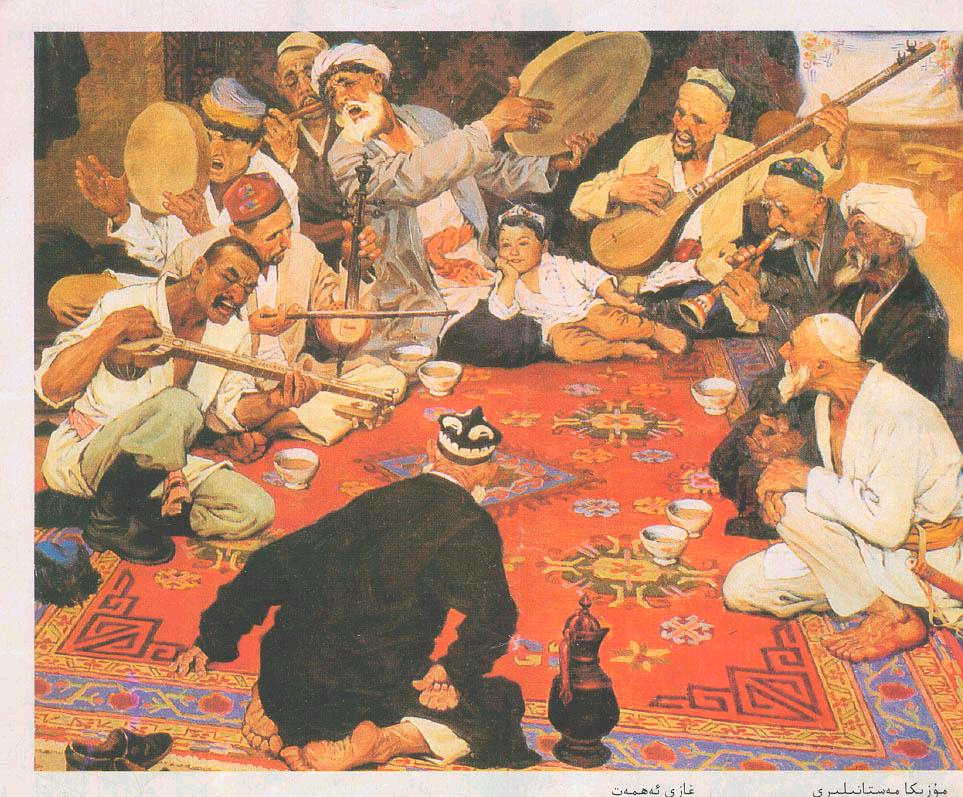
Picture: Uyghur culture has evolved as a result of significant confluence of geographical, historical and religious factors over a two thousand year period.

Saturday, January 14, 2006

A question of confidence

All the communications professions are going through a sea change.

Marketing, advertising, public relations have now come to a position where they have to build long term relationships, some call it conversations, with stakeholders. All of us have realised that we have to understand the cultural needs and aspirations of our publics. We all know that, to have a competitive impact, we need to use a wide range of communications channels. The biggest brands once had power to dominate the media and now compete with the 'citizen journalist, communicator and marketer'. And now it's quite quite clear that there is serious competition for attention from people in society at large who can, because they know of, are members of and communicate within cultures, have levelled the cultural and communications playing field.

This means that all the people involved have to examine what and how they can remain in the market place to purvey their brand of creating consumer interactions. To achieve this there is a need to engage with people across a wider of their interests.

Pick any area of commerce. A surf board manufacturer has to be aware of the environmental impact of making foam boards, the effect of surfers on the ecology of our beaches, the fashions of their customers and so many more aspects of life where they operate.

Pick any area of politics. A politician that cannot opinion about life on an international scale will find that common but transnational issues affect her standing locally, in the political hot-house and among influencers.

And so on.

This is not just a matter of making Corporate Social Responsibility policies clear on a web site, it involved interaction with communities across the piece.

This is not a matter of presenting products it is a matter of exposing products and being ever more transparent about provenance, use and application.

This is not about messages, it is about context.

This is not about where but in which context 'where' is.

The Public Relations Industry has the background but lacks the self confidence to rise to the challenge.

Fearful of the historic big budget clout of Advertising and marketing and a lack of skills in these two sectors, they are fearful of treading on toes. Nice people.


Advertising and marketing sectors have a bigger problem. The whole idea of being of a culture instead of trying to make a culture is out with their historic mandate.


The idea that organisation may want a 'Chief Conversation Officer' or a 'Chief Reputation Officer' is, of course, a nonsense. Such people would have to respond to the people in the coalition empowered to identify the extent to which relationships between employees and business partners and external constituents are significant.

The reason is this. To have a reputation, you must first have a relationship. To have a conversation you must first have a relationship.

The part of Public Relations practice that is about Relationship Management is the senior practice in resolving the issues facing PR, Advertising and Marketing.

Picture: Confidence vs. Arrogance Amanda Kuehl

Friday, January 13, 2006

Notions of Practice and Ballance sheet assets

Changing notions of practice. Notions of Public Relations practice have tended to be narrow (media relations, corporate affairs etc). But we have seen it is broad and covers a wide range of roles and activities. The practice of Public Relations in the mould of relationship management is an area of PR practice with both a long provenance and considerable support in Public Relations circles and it has the virtue of explicating a very broad concept of Public Relations practice and there is a need for more research into what such practice really entails. However, it is a means by which the many practices of Public Relations can be brought together under a single umbrella concept to offer researchers a broad top-down approach to encompass the many domains of practice and to aid identification of the competencies and their effectiveness in the creation, maintenance and development of organisational relationships. The notion that relationships are pivotal to the success of organisations has considerable currency. It is reflected in the recent comments by Coase (2002 ibid) and in the writing of Manjak and Wimmeri, (Manjak & Wimmer 2003), Wilson and Swatiii (Wilson, & Swati 1995) Phillipsiii (Phillips, D 2006/1) and many others and Mar and Moustaghfiriv (Mar and Moustaghfir2005) grapple with notions of PR in their latest work on Intellectual Capital suggesting that there is a need to consider a range of Public Relations elements in considering the values considered Intellectual Capital:
  • organisational culture;
  • relationships with stakeholders;
  • organisational image and reputation;
  • “influence behaviour” which comprises the roles of monitoring progress and rewarding or compensating behaviour; and
  • “external validation” which comprises the roles of internal and external communication, benchmarking, and compliance with regulations.
Goodwill or asset, Ballance sheet or P&L?
Relationship management as a form of practice is infrequently audited in such a manner that it contributes to valuing effort except in the very narrow sense that some companies in Australia, the USA and UK (and most of the European Union from 2006) are required to report on 'Stakeholder Relationships' with the narrowest, and almost inconsequential, of interpretations. A more robust approach returns us to the concepts how, and to what extent, Public Relations changes cultures both among 'stakeholders' and, more usefully, among publics. It suggests that there can be an overarching approach and many methodologies for evaluation. One can postulate that this will tend towards a form of balanced scorecardv (Kaplan & Norton 1996) reporting and the growing movement towards intangible asset valuation. The merit of taking this approach is that it can take the cost of Public Relations effect and replace it as a relationship asset for organisations. In the business world, this has many advantages. It offers a view that Relationships have a balance sheet value and are an asset. For example, the Australian Statement of Accounting Concepts 4 (SAC 4) 'Definition and Recognition of the Elements of Financial Statements', states that ‘assets’ are future economic benefits controlled by the entity as a result of past transactions or other past events. Thus 'Reputation' moves from the accountant's view of 'goodwill' and becomes an asset that can be accounted for on a balance sheet. The Public Relations manager is thereby responsible for an asset and the PR budget is translated into an investment in development of the corporate asset. The domains of Public Relations practice can thereby be measured in terms of investment in corporate assets and return on investment need not drop to the bottom line but is vested in sustaining the balance sheet.

iMandjak,T and Wimmer,2003 “A Business Relationships as Value Drivers ” 18th Annual IMP Conference,http://www.impgroup.org/uploads/papers/469.pdf accessed May 2004

ii Wilson,David T. and Swati Jantrania. (1995)“Understanding the Value of a

Relationship.” Asia-Australia Marketing Journal 2 (1):55-66.

iii Phillips, D. (2006) Relationships Are The Core Value for Organisations Corporate Communications: An International Journal ISSN:1356-3289 vol 11 no 1

iv Marr, B and Moustaghfir, K (2005) Defining intellectual capital: a three-dimensional approach Management Decision Volume 43 Number 9 2005 pp. 1114-1128

v The Balanced Scorecard (1996) Robert S. Kaplan and David P. Norton Harvard Business School Press 1996


Picture: Intangible Asset PWC

Thursday, January 12, 2006

With all its Interrelationships

The Nobel Laureate and leading economist, Ronald Coasei (pictured left) made the case for the study and application of economics to change in his lecture to University of Missouri, (Coase 2002). He said “We do need empirical work, but we need something additional: empirical work which actually changes the way we look at the problem.” This thinking can also apply to considerations of Public Relations and its evaluation and there is a case for countering, what can be termed, in the style of Coase 'PR Imperialism'. There is a need to look beyond the current boundaries.

I choose Coase because he opened the door for public relations to become part of the the new thinking in economics. He said: “What I think is important is that economists don’t study the working of the economic system. That is to say, they don’t think they’re studying any system with all its interrelationships.”

The inclusion of the word interrelationships is significant. We see a distinguished economist, reflecting the Henley Centre view by extending economics into the wider cultural context. The cultural environment is a domain where Public Relations, in its many guises, is practised.

Obviously, an economist, whose biggest claim to fame is his assertion that organisations are a 'nexus of contracts' and whose new interests extend to interrelationships of organisations in terms of : “ large firms and small firms, differentiated firms and narrowly specialized firms, vertically integrated firms and those single-stage firms; you have in addition non-profit organizations and government entities – and all bound together, all operating to form the total system,” does not have a brief as wide as the apparent interest in relationship management found among Public Relations academics and practitioners. Never-the-less his assertion goes a long way towards the nature of Public Relations in its role of managing relationships by extending economics into this wider cultural context.

Such a consideration is becoming important as the practice of Public Relations becomes wider in its scope and responsibilities.

i Coase R (2002) Why Economics Will Change, http://coase.org/coaseremarks2002.htm sourced January 2006

Pulling Together

Continuing my foray into the breadth and depth of Public Relations and as part of a proof that it is really a practice of Relationship Management. I offer some more thoughts.

It is important to us all and especially practitioners entering the profession as this industry expands into new areas and applications of modern communications. It is importnat for the PR industry so that its practitioners as a sector all pull together in areas like PR strategy, education, institutional support and investment.

In addition, and taking the view of CIPR that the practice includes "“..Effectivee management of relationships and communications..."”. the papers emerging from the Henley Research Centre (http://www.henleymc.ac.uk) with its 'Sprite' approach extends practice by evaluating the strengths of organisation's relationships with a wide range of stakeholders including customers, suppliers, employees and investors.

The epitome of the breadth of Public Relations is provided by Rex Harlow (quoted in Wilcox et al 2003)i who identified 472 definitions for public relations and Theakerii provides an academic's guide to the main activities for public relations practice.

PR, as practised, is as diverse as medicine.


  • i Wlicox, D. L., Cameron, G. T., Ault, P. R., Agee, W. K. 2003 Public Relations Strategies and Tactics 7th Edition Allyn and Bacon

  • ii Theaker, A. 2004 The Public Relations Handbook 2nd Edition Routledge

Wednesday, January 11, 2006

What we do is now important

Until now, it was not of more than passing interest to know what PR people do and what potential there is for Public Relations.

In a time when Public Relations is growing very fast and when there are so many practitioners active a variety of ways this it becomes important.

It is important for many organisations.

In most countries and especially in the UK Government has an interest. There are Departments of State that sponsor specific industries. When a sector becomes large enough it attracts the attention of these departments who like to know what they are dealing with and what the sector does.

The PR associations such as the Chartered Institute of Public Relations has an interest in what its members do, and to the extent that such practitioners look to and join the Institute. Then there are practices and organisations that cross over with PR. In addition, the CIPR needs to know what services it need to meet its members expectations and needs.

What if one is designing training courses or degree courses in PR? What do you put in the curriculum.

These are all investment decisions and so now it is time to look at what is involved. What will practitioners need to know about, how can they draw on best practice? How can they evaluate their work? If the educators are not sure what PR is about, its quite hard.

If one just looks at communication, the range of channels is now astonishing and for a PR person with a role in communication, knowing about each and all of them is a matter of simple good practice.

The wider context is found by seeking the effect of Public Relations in our cultures reflecting the concept espoused by Cutlip, Center & Broomi (Cutlip, Center & Broom, 1993). Additionally, there is an argument that suggests that there is an economic impact, and corporate financial evolution which are convergent with the practices of public relations described in the literature and by practitioners as 'Relationship Management'.

In the joint report between the Institute of Public Relation and the UK Department of Trade and industry “Unlocking the Potential of Public Relations: Developing Good Practice” (CIPR 2003) Public Relations is defined as: “influencing behaviour to achieve objectives through the effective management of relationships and communications.”

In a paper, 'The Economic Significance of Public Relations' (CIPR 2005) prepared for the Chartered Institute of Public Relations, The Centre for Economics and Business Research ltd (CEBR) provided a list of 19 activities performed by practitioners. It identifies practice as diverse.

I have empirical evidence of practitioners claiming to work in the Public Relations domain, through membership of the CIPR with 75 different job descriptions.

Breadth of practice is evidenced elsewhere with a movement in the USA centred on electronic communication which claims the high ground of symmetrical public relation practice in the use and application of two way or 'citizen' relationship building using technologies such as Blogs, Wiki's and RSS feeds. Evidence of this movement is found at the NewPR web site (http://www.thenewpr.com/wiki/pmwiki.php) and in the discussions in the Global PR Week events (http://www.globalprblogweek.com/).

The practice of Relationship Management – err Public Relations is very broad and here is the rant.

The industry has a wonderful opportunity but where is the real evidence that the Institutions are aware of the changes happening around them. Their research is does not help a lot. Would you believe that the Chartered Institute of Public Relations research shows that PR people spend more time running parties that on-line PR?

i Cutlip, S. M., A. H. Center and G. M. Broom. 1993. Effective Public Relations. 7th ed. Englewood Cliffs, N.J.: Prentice Hall.

Picture: Lunch at the Boating Party Pierre Renoir

Tuesday, January 10, 2006

To CIPR and PRCA - an expectation

The New Year's resolution for the Public Relations Associations one might expect.

Medium sized companies experienced a huge surge in on-line demand over the Christmas period in the UK. Retail Bulletin reported a poll conducted among a sample of small and medium businesses showing respondents reported an average 80% increase in turnover for November and December 2005, compared with 2004.

The BBC reported a survey showing UK demand among supermarkets of £3.3bn in the week before Christmas - a rise of 17% from the same week last year.

The UK Chancellor of the Exchequer announced nil growth. Which means some parts of the economy are suffering.

I just thought that this may mean the associations are commissioning a new books and new courses available about on-line public relations. No doubt we will also see a raft of seminars on how members can take advantage of the part of the economy that is growing

Friday, January 06, 2006

The media money model

I hate to get drawn into the Blogs v Newsprint debate or the newsprint v other communications channels for that matter but The post by Cynthia Typaldos Online Content Business Models is just too good to miss and the follow up Please Newspapers, charge for online content! From Blog Herald is not too far from the mark.

The issue is where is the consumer value.

Where value is high, people will pay. This does not always mean money of course but its helpful for many organisations.

People like to build relationships and they do this by becoming aware of the things they are interested in, that is, that are part of their personal culture, and seek to find out more. In this quest they look for common values first and then values that add to their personal wealth (tangible, intangible and, most often tacit).

This opens up a huge range of possibilities for both not-for-profit and commercial organisations.

The problem is that most organisations have a fixation about their products and services and not the values they have inherent in their organisation which are valued by their people and their potential consumers.

Most of these values are intangible, are not in the P&L or on the balance sheet and so are invisible to most managers.

Most of us will have found that just chatting to people inside companies is fascinating. Many times its valuable and often so valuable we would like a slice of the action at a price. That is when the shutters come down and the opportunity for both parties is rudely shut off.

Friday, December 30, 2005

How PR could have given BT a Milch Cow

The date was August 22 2002. This day showed quite starkly that patents are a liability unless they are exposed to the processes of Public Relations.

It is etched in the minds of British Telecom, the UK communication giant, when it lost its court case against Prodigy. BT was taking Prodigy to court for royalties it claimed it was owed as the inventor of the hyperlink. BT tried to prove that a patent lodged with the US patent office back in 1980 was still valid. The company claims that every US hyperlink was its intellectual property and therefore subject to a licensing fee. If successful, every internet service provider in the US would have been liable to pay BT for the use of the technology.

There is no doubt that patent 4,873,662
was lodged by BT and was a protocol we now recognise as a hyperlink and The Register outlined the technology with a copy of the short abstract about the "Hidden Page" patent.

BT developed the technology itself in the 1970s, applied for the patent in 1980, and received it in 1989. It next stumbled upon the patent during a routine update of its 15,000 global patents in the summer of 2000.

As milch cows go, being the 'owner' of hyperlink technology does not come better than this but BT fluffed it.

The missing link was that the investment in the patent was lost because its features and benefits were not exposed to those people who could translate it into financial return.

Bearing in mind the cost of gaining a patent both in time and financial cost, there will have been considerable internal communication inside BT about this spiffing idea. What was lacking was the process of Public Relations.

Public Relations has a role in exploring the values inherent in a brief such as ideas and products (tangible and intangible assets). It reviews the landscape for the brief in a range of social and cultural contexts. Its practice includes the planning and execution of engagement (internal as well as external) among publics such that they relate these value to their knowledge, understanding and interests. In turn, such publics can (through their own public relations processes) spread the values to a wider public.

The difference between communication and Public Relations becomes clear in this example. Creating relationships with publics, goes beyond (but may include) the communications processes required but it is in the relationship management process that we see the role of Public Relations at its most effective.

What this case shows is that the management of public relations in BT, that is the process of empowering BT employees with PR skills or engagement of PR professionals in support of employee activities, was missing.

Public Relations is a process of relationship management and at its most effective has to be a management practice as ubiquitous as financial management for companies to be successful.

This approach is essential for a modern company.

In the first instance, it is the means by which productivity is enhanced, especially among those valuable employees whose jobs cannot be automated. Employees whose role it is to create new ideas, products, processes and services are better deployed when added value is levered from their work through effective relationships that engage colleagues in their exploitation.

This relationship value model is the means by which an organisation can have and sustain unique competitive advantage because its develops a capability in which teams of people with a common interests are engaged in adding value throughout the organisation and beyond.

Finally, the application of the public relations process offers high value returns because this is the process that speeds product to market.


Picture: Milch Cow


Wednesday, December 28, 2005

Flopsy Failed Again

The Times reports that British Chancellor of the Exchequer, Gordon Brown's eight-year crusade to boost Britain’s productivity performance suffered another heavy blow yesterday when official figures showed that growth in productivity collapsed to zero in the third quarter. It was an announcement that follows on from my last post (Flopsy, Mopsy and Cottontail). Flopsy failed again.

Contrast this with Federal Reserve statement on Dec. 13 which reports "robust underlying growth in productivity" alongside a view that productivity may be evidence supporting Alan Greenspan's speculation about a new economic paradigm.

The simple fact is that HM Treasury is so locked into its narrow view on money that it cannot understand the value of intangibles.

Whereas, in the USA, there is a value attributed to enterprise, initiative and wealth creation, the present British Government does not give credence to culture and especially the culture of of wealth creation.

Like Marxists governments before them, New Labour has attempted to put a glossy spin on centralisation and control with a pretense common good only to be found out by the reality that wealth extends beyond the factory and producer to the enterprising and visionary.

In a global, knowledge rich and citizen enfranchised era this will not do. There is a need for a new era of economic management based on how this new franchise where relationships lever value from tangible and intangible assets.


Picture: économie-finance

Tuesday, December 20, 2005

Flopsy, Mopsy and Cottontail

China upped its numbers on the growth of its economy today. Including Hong Kong's wealth, it is now on the fourth largest economy.

This is an issue for the UK – it just went down to fifth.

How soon Germany, Japan and .....the USA? What are the checks and balances? As long as the USA can fund its debt.... the debate continues but an economy, a population and a social structure of such huge influence affects us all.

Sir Digby Jones, director general of the CBI, reaction to the news was to call on companies in the UK to see China's growth as an opportunity. "It has always been a matter of when, not if, the Chinese economy will eventually eclipse the UK's in size," he said. "These figures for growth in 2004 highlight just how rapidly China is growing and what an amazing success story it is now becoming."

Opportunity? Yes. Inevitable? no.

Sir Digby, you accepted failure with such acquiescence, it is time you retired. The CBI is a rabbit held in the headlight of competition. It is not a matter of when it is a matter of competitive competence.

So now it is time to do something about it.

Here is a hint on how this can be done by Bradford Johnson, James Manyika, and Lareina Yee in the McKinsey Quarterly Review.

In reporting the latest research, they observe:

  • As more 21st-century companies come to specialize in core activities and outsource the rest, they have greater need for workers who can interact with other companies, their customers, and their suppliers.

  • Thus the traditional organization, where a few top managers coordinate the pyramid below them, is being upended.

  • Raising the productivity of employees whose jobs can't be automated is the next great performance challenge—and the stakes are high.

  • Companies that get it right will build complex talent-based competitive advantages that competitors won’t be able to duplicate easily—if at all.

So,Confederation of Business and Industry, get to work on the new model. Get shot of the inconsequential thinking on Corporate Reporting and put something robust in its place.

Start looking as value in the round instead rigged Balance Sheet, P&L and pretence at 'Stakeholder management'.

To begin with managers have to take a different view of their organisations and how they are run and this is a Public Relations process (by what ever name you want to call it) I don't care what it is called and I accept that, based on the findings of the recent CIPR study, you can be forgiven in believing PR is event and party planning (that is what the report's statistics say).

We have to be focused on creating wealth in both broad terms (tangible and intangible assets – including relationship assets) and on the relationship mechanisms that lever wealth from such assets.

It is no longer enough for people with ideas about using the public relations process to create wealth to call out in the dark. Now is the time to act.

Floppy eared government has to get realistic. It is using pathetic measures to find out how to compete in the real world. To measure the intangible productivity of the country it uses measures of references to academic papers. This is sheer buffoonery. It takes months, even years to get papers published in many disciplines including the social sciences in the UK. It measures the number of patents applied for. It takes years to get a patent accepted and few reflect the capabilities of organisations to create wealth from Intellectual Properties. Indeed, the Treasury compounds this nonsense by allowing patents to be included as assets when really they are costs (it is the application of patents to process and relationships with consumers to lever wealth from patents that is the asset). It measures the proportion of enterprises with co-operation arrangements on technological innovation activities with other enterprises or institutions and yet uses no measure of the effectiveness of relationship creation, sustenance and development. It looks at the proportion of sales accounted for by new or improved products and yet has cotonttail views on how the relationship value is achieved.

With massive increases in student numbers, it hopes that first degrees are going to show that it is increasing the level of qualification of the workforce and yet knows that most students spend 30 hours each week working their way through college instead of studying and that many universities are driven by numbers and not quality of qualification.

The Research Institutions are no less guilty. Research into relationship management does not exist. Even though The Secretary of State says: companies need "successful relationships with a wide range of other stakeholders" because they "are important assets, crucial to stable, long-term performance and shareholder value.” research funding in Public Relations is at best a lettuce leaf hiding the ineffectual progress of academic study and is none existent among PR academics.

Time to get a grip. Time for new thinking and, perhaps time to get really competitive.

Perhaps the new Conservative leader thinks he has solutions. Some are not too sure. One asks if his approach is going to continue to be control freak competitiveness or real and tangible effort to tackle our need to realise value from our skills, our ability to lever wealth.

Flopsy, Mopsy and Cottontail, The CBI, UK Government and Academia.

Picture: The Project Gutenberg EBook of The Tale Of Peter Rabbit, by Beatrix Potter

Get Niche - end ubiquity

The last six posts to this blog cover a number thoughts on the application of Public Relations from a corporate perspective.

What is becoming obvious is that there is an emerging need for a wide range of expert communications skills across a wide range of communications channels and consultancy with the knowledge and expertise to be able to manage and deploy these channels and skills.

Furthermore, the monoculture and ubiquitous press relations model is becoming niche and we are all going to have to work with niche channels for communication henceforth.

Not all such channels are new (take, for example wiki's) it is just that their day has come.

Corporations are learning a lot rom blogs. It is showing them the future, a very interactive future and one that needs a shift change in the PR profession to match.

Picture: Ubiquity Oliver Clements

Friday, December 16, 2005

PR Communications Channels

The nature of people is that they are more aware and remember messages when there is a range of stimuli about them.

As a strong advocate of 'multi touch' public relations, I have come across a range of products that can be used to extend the range of media channels available for PR practice.

We are all aware of the press, radio, TV, leaflets, posters, direct mail and that traditional stuff. Today, there is a further 19 channels for communication in use by a very high proportion of the public.


The Internet offers a wider range of communication channels, for most practitioners, these are still limited to PC's and laptops.

But, in addition to computers, the Internet is used on other devices such as cell phones, digital and satellite radio and TV.

There are other devices that use the Internet too. Many of those gaming machines used by younger brothers are Internet enabled devices too.

All these devices ofer a range of communications channels. These channels can mix and match in variety of ways.

Some channels are quite familiar and include email, instant messaging, web sites, Usenet, discussion lists, weblogs (blogs), Mobile Blogging, wikis, RSS and there is more information about them on at Wikipedia which is more than just a source of encyclopaedic knowledge, it is an example open source citizen maintained and interactive connectivity. The virtual environments like Second Life also provide communications channels and also have commercial application.

For practitioners who want to make a personal link, there is SMS, voicemail, mobile audio and mobile video and content designed for Blackberrys and PDAs.

So much for the past. Now we are seeing new developments that are even more useful.

We can use our imagination on how to use a paper-thin electronic-display technology so cheap it could replace conventional labels on disposable packaging, from milk cartons to boxes of Cheerios, or it could be used as an intelligent leaflets and much more.

What about interactive posters? When a camera phone user takes a picture of the bill board, they are directed to a website that features real PR content.

In addition to watching movies or football match,there are a number of PR applications for broadband mobile that can make these developments much more interesting fun and engaging because mobile is two way.

Can celebrity or political campaigning do without Vlogs? How cool can a creative PR make vlogging? There are other services to help too.

Then there is on-line broadcasting with podcasts. Here is a way for providing content for iPods and CD's and, of course online audio content.

Interactive television has long way to go too. Imagine people pulling PR messages from the push medium of TV?

Then, there is the capability to use gaming, such as X-box to interact with your communities.

And this leads us to imagine how many new communications channels are out there and the ability to integrate these many technologies into PR techniques.

Of course, you may want to keep an eye on what is happening on-line and can build your own monitoring and research resource using Alexa or Rollyo.


Picture: Communication by Isabelle Cardinal


Thursday, December 15, 2005

Adaptive PR Strategy Process

I have been working on the application of the relationship value model. The extent to which public relations has become a very broad discipline using a wide range of relationship and communications models calls for a review into models of practice that are available today.

The existing models of practice have been refined of the years but with globalisation, a paradigm shift in social communication, a declining traditional media and the dramatic influence of mobile communication, the practice of PR is changing. The concepts of pyramid management is being replaced, say McKinsey because of a need to gains sustainable competitive advantage.

Organisations have changed dramatically. The move towards weightlessnessopen source (think IBM, Sun, Novell, HP etc) and collaborative/community design, development, production, distribution, marketing and exchange is accelerating fast. There is no escape from the information economy. outsourcing, partnering arrangements with vendors and the significance of

The impact and significance of the individual has changed too. The citizen journalist has considerable power (and whereas the traditional media offers smart and useful finished articles, the on-line journalist is part of a continuing story with untidy nuances). The significance of blogging among stakeholders and internally, the rise of the Wiki, RSS and podcasting are now well in view for implementing Public Relations Strategies.

These developments have significant implications for corporation and their capability for relationship management.

It is the role that Pubic Relations plays in aiding relationship management including areas of practice such as corporate communication, public relations, marketing, internal communication, knowledge management and other areas of relationship activities that now comes under the spotlight.

To be able to be effective, this means there has to significant evolution in Public Relations Planning and Management.

Based on actual consultancy practice, a model has been created for planning and management which both reflects the aims and ambitions of organisations and which is sufficiently flexible that it can respond to changing environments.

This process is not designed for the planning of a public relations campaign although the planning of such campaigns without reference to the model would be counter productive. It does, however, offer a capability to implement individual campaigns into the wider strategic management objective.

The process draws on a range of management disciplines and adds existing literature of the subject.

In preparing a plan for Public Relations, there is a very strong case for involvement of both internal and external constituents and there are a number of tools that are applicable.

The essence of the PRPM programme takes the corporate view of the organisation, and reviews the vision and role of the organisation (an example). This vision and and associated commentary about what an organisation does provides the basis for developing concepts of social groups.

There are a number of methodologies for identifying social groups (publics and stakeholders). The use of visualisation with focus groups is one such methodology create a map of those social groups (business, government, and other publics) affected by what the organisation does. The key element in this process is to identify relative significance of stakeholders to the vision of the organisation.

From this list of groups, the next part of the process identifies how the organisation would meet its mission through interaction with the publics. In the first instance considerable research into these publics is needed. In particular the explicit interests of the publics, the explicit interests of these publics related to the organisation are essential. In addition the perspectives that such interests have from the publics' viewpoint is needed together with the perspectives for the same interests from the organisations' viewpoint. This shows up areas of dissonance between the organisation and its publics.

Further research will examine the publics from their social perspectives of where and when they are most likely to be interactive, the channels for communication that most apply in such circumstances.

From here the process examines each public in the light of the organisation's mission. In most cases this requires interpretation of the mission statement in terms of organisation/stakeholder aspirations and the question asked is 'how each of the elements of the mission can apply to each public'. This can be expressed in terms of what is needed to reduce dissonance and bring about convergent between the parties and is expressed as SMART objectives for each group.

From there the plan evolves into relationship strategies and thence to creative and operational tactics with time and resource budgets implemented using project management software. In implementing strategies and tactics a range of internal and external groups will be affected and here there is a good case for application of intranet based information and discussion (blogs and wiki's are helpful here).

The plan requires daily monitoring of news coverage and on-line comment both national and international using an on-line services and an news/evaluation filter to generate a rapid report and analysis by 0700 each day for dissemination to internal staff and external enterprise partners.

Monthly reporting, quarterly reviews are recommended and the plan should be be recast annually. The advantage of using SMART objectives is that the evaluation of each strategy was relatively simple to implement.

With this sort of planning, the process can aid response to issues and crisis where the real problem is often a need to create convergence between the organisation and the issue public/s.

More about this process will come in due course.

This process is the application of the relationship value model in practice.

In this model, the whole process is adaptive. From vision and mission to the resolution of dissonance, the plan calls for a meeting of interests, including involvement for change throughout the organisation to make the organisation adapt to meet its public's needs and aspirations.

In a socially interactive and global world there is no other way organisations can gain a competitive advantage.

Picture: Raytracer


Wednesday, December 14, 2005

Drucker meets Grunig

Are Grunig's comments about Public Relations being a management function misplaced as far as the United Kingdom is concerned?

Recently elevated to Charter status and claiming to add £3.4 billion to the UK economy, the Chartered Institute of Public Relations claiming to represent the interests of its 8000 members does not seem to have got the message.

The Institute provides a long list of case studies for the delectation of its members through its web site.

Not much of this corpus has the basics that would be recognised by the late Professor Drucker. "As Columbus discovered America, Drucker discovered management" claimed Ken Witty, the producer of the TV documentary of this icon of management. Ambling through the Institutes case studies he would not recognise any of them as contributing to management.

Drucker invented Management By Objectives and, the nearest the CIPR studies comes to acknowledging the great man, many of the studies have 'objectives'.

But none of them follow through. It was Drucker who said Objectives should be SMART:

  • Specific

  • Measurable

  • Achievable

  • Realistic, and

  • Time-related.

It is here where the case studies fall down.

For the most part, most fail because the objectives are not specific as to what measurable means. In turn they may or may not be achievable or realistic.

The extent to which PR can claim to be a management practice is dependent on its acceptance of management disciplines.

PR, one might see from these case studies, is not manageable and can not be included in the pantheon of management if Drucker is to believed. It was he who said 'If you can't measure it, You can't manage it'.

Peter Drucker pointed out in the 1970s that effectiveness was 'doing right things, while efficiency was doing things right'.

It would seem that PR falls into the first category. As John Naisbitt noted and the CIPR demonstrates "We are drowning in information, but starved for knowledge."

Where PR might start to 'do things right' also comes from Drucker who said “Knowledge is power. In post-capitalism, power comes from transmitting information to make it productive, not hiding it.”

In practice we see individuals and coalitions of people with knowledge. They are not powerful. It is only when knowledge goes through a process that makes knowledge productive. In its communications role, Public Relations facilitates transmission. But it is only when this process has the objective of making knowledge productive that it has any claim as a management process.

If this is true then we might re-asses the CIPR corpus as demonstrating a capability as a management practice.

Making knowledge productive has to be SMART and is a Public Relations process:

  • Specifically to evoke or provoke response to an issue (or issues)

  • Measurably resolving issues between the parties (organisation/ publics)

  • Achieved to the extent of resolving dissonance (and no more)

  • Realistically to the extent that interactive evocation or provocation is optimised (not maximised)

  • Time-related to the extent that knowledge can be evocative or provocative.

Here we can see and measure how relationships can facilitate the transmission of information to make it productive.

In applying such a test to the case studies some of them can be identified as management processes. This is not to excuse the corpus because the SMART elements are not sufficiently explicit.

In applying such a test, one might ask about other mechanisms for measurement. One such would include Return on Investment. There are two elements at work here. One is the immediate return on the process and the other is the long term asset value.

The immediate return is a matter of identifying the value ascribed in meeting the SMART objective (financial or intangible) and the cost of implementation (human resource and facilities applied). It would be simple if the cost of communication and interaction could be identified. Here we have a dilemma. The cost of maintaining, for example, a free media is a difficult assessment and takes us along a path examining the value of cultures and economic infrastructure. Communication in the USA is cheaper than in Africa for both cultural and economic reasons. Closer to home examples include the differing cost of interaction with the elderly or socially or economically deprived.

The asset impact is of significance because the capability to interact with knowledge has undergone a transformation. Here we may see that this capability has enhance the 'knowledge inventory' of an organisation because 'transmitting information to make it productive' can be achieved at a lower human or material cost.

Both the immediate and asset returns can be measured, in part, in financial terms but frequently this is only part of the story. The intangible value is often very different.

True ROI measures are hard to come by.

There is another way. Public Relations is a cultural activity. The influence of every PR campaign has an effect on culture. But this is for another day.

Picture: The Instruments of Knowledge 1994, Oil on canvas, 66 x 84 cm, Sydney, Private collection Ralph Heimans

Thursday, December 08, 2005

Aha! Neville Hobson, you asked how I square my views on PR with membership of the Chartered Institute of Public Relations' definition. Well, luckily, I have already covered this in a previous post.

I still hold that PR levers wealth and explain here....

The debate about public relations being about relationships and relationship management is even more important and goes back 30 years. There are a couple of problems about how to define an organisation and how to define relationships.

In exploring these concepts we discover that there are values involved and that these values are the stuff of relationships and are the means by which organisations can exist. The research also shows how organisations are not really a hierarchy (management pyramid) but are made up of groups of people with (to a greater or lesser degree) convergent interests.

Public relations in its role of facilitating relationships allows values to be exchanged and built upon.

But let me take you into a lecture theatre with a couple of hundred people in the audience.

In trying to explain relationships I take two exquisite roses with me and a $50 note and after some initial comments hand out one rose to a pretty girl half way up the auditorium.

What I have done is to create a relationship with the pretty girl. She blushes. But why?

All I have done is give here a rose, a token.

But she attaches a whole lot of values to a rose. It is symbol of romance and has all manner of connotations. The relationship, fleetingly, blossoms.

The audience looks on and each of them in turn attaches values to the rose and observe the exchange and using their interpretation of this action come up with a whole range of conjecture about this turn of events.

I then introduce my wife who is sitting at the front and give her the other rose and she to has a number of values she attributes to the rose and in this circumstance the rose represents atonement. Of course, at another time and in different circumstances, a rose could represent a moment of great romanticism, but not on this occasion.

I then take the $50 bill. It would buy 20 roses. I give it to another pretty girl... Not surprisingly she takes offence and refuses to accept the money.

Relationships are created in an environment (channel if you will) using the exchange of tokens and where there are common values and common understanding of those values, relationships can blossom.

This is the job of public relations. It entails understanding the environment, identifying tokens that have common values and offering those tokens to create relationships from which new values can spring.

And, to put all of this into context, the rose I take into the lecture theatre is really just a dead stick. It is our culture that gives us all the values we attach to a rose.

So relationships are important and so is the cultural context. Relationships both create organisations and provide the environment, culture and context for survival.

We see expressions of brand values change and morph in the bloshphere just as much, if not more so than the lecture theatre. It happens all the time but always in context. Indeed the fulsome hyper-linking of the bloggersphere and the dynamic of wiki's are the classic case of culture and context building. In these cultures value is being created and even money (which is only a metaphor for value) is being made.

PR at its best is multi-touch. It is evidenced in coverage on TV, radio, the press, magazines, web sites, blogs, wiki's, podcasts and mobile communication and at the water cooler. By enjoining conversations in these channels and by being in tune with the culture of our publics through relevant channels we influence the values held by them and progressively create relationships that shape opinion and values.

Just look at how this works in the connected world. We seek information and build links between the people who provide it for us. In blogging we do it with blogrols; hyperlinks and engagement.

But.... unlike most people, the best practitioners have, or know people who can, identify the stakeholders, the objectives, the strategies and tactics most applicable to gain positive outcomes. We use the boutiques to help implementation and we monitor our effectiveness.

Practiced at its best, this is a management discipline. It is the only management discipline that is optimised to do all these things. Accountants can't do this, advertisers can only work on the fringes, the marketer has to narrower view. Human resource managers are hidebound by the (these days fractioning – remember Neville Hobson's comments about BA food in his recent podcast?) walls of the organisation. It is only public relations that has the breadth of understanding and skill that can do all that is needed.

So we can work in the cultures and among the publics to engage them in development of their values and appreciation of our point of view effectively and with better results than all other management disciplines.

We create the space where value can accrue and offer the knowledge by which value can be acquired.

Now... I accept that this is a utopian view of PR as practiced. It is far wider than most common practice – much of which is boutique work like media relations - but it is public relations.

I hope I have been more convincing about PR levering wealth. It is a bold jump for the profession but one that is well worth making.

Neville added another comment and said this “touches on the reputation of PR in eyes of others and we don't get support from outside the profession for the view.” Well, more fool us.

He suggested that we loose our licence at a time when 'anyone can communicate' and the adder of value is dispersed. But more fool us for not developing and using capability to influence the agenda.

I agreed that the 'change required in PR isn't inevitable. Because it is up to the practitioners to be part of the change otherwise they will be irrelevant and therefore cannot add value.'

But what is in a name? If the PR industry does not do it, someone will and if not us then more fool us.

So, I hold by my precept that public relations is the management practice that levers wealth. And, potentially is the only such practice available to do so.

I will say this: it is only now, with the engagement that has become so evident because of blogs and wiki's that this idea can have traction.

Our era of global engagement is the one that provides the evidence that engagement through relationships add value. It allows us to see how intangible relationships and intangible assets open the way for companies to design, develop make and sell goods and services and make profits.

We can be, if we choose to be, at the heart of this process.

Else we are but fools.


Picture: “The fool doth think himself wise, but the wise man knows himself to be a fool.” As You Like It Shakespeare