Sunday, May 02, 2010

Talking of Real Time Web

You can't ignore the real-time Web claimed Gartner Analyst James Lundy in his keynote address to the Collaborate 2.0 Summit in October 2009.

The web has always been close to real time. That was its attraction from the start. Digital was more flexible and faster to process than analogue communication. But for  non geeks the Real Time Web has very recently become fashionableIt fashionable because of the phenomenal rise of Twitter. Twitter, now over three years old, showed everyone how fast information was spread across the web by social networksClosely behind Twitter is Google’s Wave, a service for instant key-stroke-by-key-stroke communication and interaction and then, of course, we no have real time search available fro Google which shows every new page it indexes almost as it happens.

Lundy points out that companies, particularly publicly traded and regulated ones, are concerned about real time services for one simple reason -- compliance. This is a requirement that companies keep track of communications related to company business.

But companies can't ignore the popularity of these services or their inevitable use, said Lundy. He recalled, for example, being in meeting with a Wall Street client who said instant messaging wasn't allowed at their firm.

"The minute those managers leave, we asked the other people in the room and they said, 'Absolutely, we still do it,' referring to instant messaging."
Brian Morrissey reported on Diet Coke’s initiatives in Real Time Web in AdWeek last November  noting that:

“Marketers including Burger King and Adidas are warming up to real-time Web content, mirroring a shift in digital media away from asynchronous communication and content delivery (e.g., the sending of e-mails and watching posted videos) towards instant feedback and interaction. Upping the ante for these marketers are real-time systems like Twitter and Facebook, which mix content delivery with communication, making something hours' old seem stale.

People, and notably companies, found they needed to be better informed and they needed to watch for mentions online and, urgently, Twitter as well as blogs and other social media.

But what do we mean by Real Time Web? Daniel Tenner described it well in his blog post:

“Real-time web” can mean any number of things, from “live updates without refreshing the page” to “see text as it’s typed”, but all those are technological rather than conceptual definition. At its core, the concept of “real-time web” must be about the immediacy of information flow. Something happens (whether it’s someone typing a message to you or Michael Jackson dying) and you find out about it immediately (or nearly so).

Monitoring the internet and specific content on the internet is not new

Organisation that offer such services include news monitoring by  Google (Google Alerts)TechnoratiCyberAlert and eWatch.

There are companies that exclusively focus on online/social media such as Radian6 and Scout Labs. They cover blogs, wikis, Twitter, social networks, bulletin boards and discussion lists. 

Meanwhile the traditional press clipping agencies such as Factiva, Moreover, Durrants and Cision still keep a wary eye on newspapers and magazines and re-digitise the content for computers to analyse.

Some of these vendors offer regular updates every day, some hourly and some, like Google Alerts in near real time.

There are other services that help organisations such as RSS and Atom feeds that poll web sites at regular (typically hourly) intervals. Then there are the real time services based on a simple, open, server-to-server web-hook-based pubsub (publish/subscribe)’ protocol extension to Atom and RSS called the PubSubHubbub protocol that can get near-instant notifications when a topic (feed URL) is updated.

Real Time Web is available using such services. They are time consuming to set up and the client needs to know which sites to monitor in advance. So far only a few small feed readers have begun consuming these feeds; RSSCloud developer Dave Winer's own River2, a complex but customizable desktop feed reader, and LazyFeed, a simple but enjoyable feed-powered discovery engine, have turned on full support for real-time feeds.

A number of services are now being introduces. S typical solution is  Wasabi from Netvibes is a widget service.

More contenders in this field are covered in a guest article in Mashable, the Social Media guide by Bernard Moonwho recognises a level of hype about the issue.

So what we find is a host of services covering a wide range of online and offline media. Very few services are really real time. They offer monitoring at intervals and where these services are swift they do not include all the channels out there.

There is one further flaw.

None of these services comprehensively monitors all the content that is publically available online.

There are so many channels for communication online that it is hard to watch them all. Some are, and will remain niche and almost insignificant. Others, though of little consequence in themselves, feed the big beasts of the internet.

Much of the content is driven by bots and other automated services and there is still spam galore.

The service provided by Klea Global through its www.nextmention.com service resolves these two big issues. It monitors’ the web for everything and provides ten minute updates free and real time updates in its soon to be announces premium service.

Of course, this is by no means ideal because the many divergent channels from web sites to news to blogs, wikis, Twitter, social networks and all the rest are all jumbled up in the instant feed.

The service is more coherent on the Nextmention site which used a Bayesian bot  to sort out the pages into media types and more developments in this direction are anticipated.

There are some other services that are worthy noting and which show how Real Time Web is driving a need for more and faster services.  Topsy (http://topsy.com)  is a real time search engine that stand out because it focused on real time links as opposed to real time content.   So, when you perform a search at Topsy, instead of seeing what people are talking about on the real time web, you are to see what the most popular and prominent links are being shared on the real time web.  You can even sort to see the most shared links over the past hour, day, week, or month.  

Meantime rumours have been swirling all over the web in regards to a partnership Yahoo is discussing with OneRiot.  OneRiot (http://oneriot.com/)  offers users a real time search engine which can be sorted based on web results and video results. 

Meantime, people like Nova Sivack lead us to the problems this content and these services present. He writes in his blog Minding the Planet:
In the next 10 years, The Stream is going to go through two big phases, focused on two problems, as it evolves:

  1. Web Attention Deficit Disorder. The first problem with the real-time Web that is becoming increasingly evident is that it has a bad case of ADD. There is so much information streaming in from so many places at once that it's simply impossible to focus on anything for very long, and a lot of important things are missed in the chaos. The first generation of tools for the Stream are going to need to address this problem.
  2. Web Intention Deficit Disorder. The second problem with the real-time Web will emerge after we have made some real headway in solving Web attention deficit disorder. This second problem is about how to get large numbers of people to focus their intention not just their attention. It's not just difficult to get people to notice something, it's even more difficult to get them to do something.

This is where some of the thinking for the next phase of internet development is going on and how in a very short time one can imagine services that address both these problems with the 

Real Time Web.

 What does all this mean to practitioners.

The key issues for the PR profession are not as easy. The need to be able to monitor the web real time is hard.

There are a lot of tools for monitoring the FortunatelyPublicasity has partnered with companies that have the necessary technology.

Being able to identify opportunities and dissonance between brands and the brand values held by consumers is the next big challenge.

The Publicasity digital team is already working on this with Lisbon University and Klea Global. Early examples of the Real Time technology research are available and Klea Global is closely associated with developments of the Real Time Reputation Wall.

We are now able to discover the way online communities understand corporate and consumer brands both when the brands are top of mind and in lifestyle situations.

This is a big advantage for Real Time Web interactions where marketers can respond to the changing consumer landscape as they evolve.

This is ground breaking capability that the account teams can bring to meet Real Time Web success.

Friday, April 30, 2010

What is Real Time Web really like?

I thought that it would be interesting to see what level of coverage has been attributed to the election in the last 40 minutes to give some idea of how fast you would have to be over a big issue?


Real Time Citation Alert for UK Elections

UK elections (5:47) | Breaking & Daily News, Sport & Weather | TV
33 minutes ago
- Just a week out from polling day, the British election is shaping as one of the most unpredictable in decades. For the very latest, Breakfast is joined from ...
http://tvnz.co.nz/breakfast-news/uk-elections-5-47-video-3502359

GameSpot Forums - Off-Topic Discussion - UK Elections: Who are you
39 minutes ago
- Labour's hopes of recapturing the marginal constituency of Rochdale have been dealt a serious blow by Gordon Brown's insult to a local voter.
http://www.gamespot.com/pages/forums/show_msgs.php?topic_id=27303841

Liverpool Daily Post.co.uk - News - Liverpool News - Election 2010
28 minutes ago
- OF COURSE, there was only story on anyone's lips – “Bigotgate”, Gordon Brown's potentially career-destroying comments on the Rochdale widow he met on the ...
http://www.liverpooldailypost.co.uk/liverpool-news/regional-news/2010/04/29/election-2010-rob-merrick-on-gordon-brown-and-bigot-gate-92534-26339671/

Polls give UK election debate win to Cameron – This Just In - CNN
15 minutes ago
- British Prime Minister Gordon Brown fought to hold on to his job Thursday in a debate against the two men who hope to replace him, David Cameron of the ...
http://news.blogs.cnn.com/2010/04/29/polls-give-uk-election-debate-win-to-cameron/

Hanging in the balance: how Cleggmania shook the UK's elections
32 minutes ago
- The world This year's UK general election was meant to be a predictable contest – until the first-ever television debates gave rise to 'Cleggmania'.
http://www.thenational.ae/apps/pbcs.dll/article?AID=/20100429/REVIEW/704299992/1008/rss

BBC Election Debate: live - General Election News
45 minutes ago
- Yesterday might go down in the UK election history books as The Big Cringe " the moment when Incumbent Prime Minister Brown leveled a heavy blow to his ...
http://politifi.com/news/BBC-Election-Debate-live-542841.html

Pollster.com: UK Projections from PoliticsHome
17 minutes ago
- For more discussion of the UK elections -- including the "uniform swing" issue, see also the two-part interview that Emily conducted with Anthony Wells, ...
http://www.pollster.com/blogs/uk_projections_from_politicsho.php

TPF: UK: General Election 2010 Final Debate (Video)
17 minutes ago
- Title: UK: General Election 2010 Final Debate (Video) Source: You Tube from itn news. URL Source: [None] Published: Apr 29, 2010. Author: itn news ...
http://www.the-peoples-forum.com/cgi-bin/readart.cgi?ArtNum=18284

Derryck - UK National Elections
45 minutes ago
- UK National Elections. Thursday, 29. April 2010, 21:44:03. The · http://mimbari. livejournal.com/April 29-2010: Is The UK's Third Political Party Ready To ...
http://my.opera.com/BringBaka/blog/2010/04/29/uk-national-elections

whoar.co.nz » Blog Archive » “..UK Election Debate Live Updates
36 minutes ago
- UK Election Debate Live Updates .. Video..” “..Today is the final of three televised debates in the UK in the lead up to the elections on May 6. ...
http://whoar.co.nz/2010/uk-election-debate-live-updates-video/

Angus Reid Public Opinion Post-Debate Analysis | Angus Reid Elections
20 minutes ago
- Each one of the graphs above contains the findings of questions made to debate watchers who are Springboard UK panel members. ...
http://www.angusreidelections.co.uk/2010/04/third-debate/

British Blogs
19 minutes ago
- Many realise that a hung parliament, after the UK general election, which is due in less than 2 weeks from now (6th May 2010), would be the. ...
http://www.britishblogs.co.uk/similar-to/cameron-comes-out-top-but-brown-battles-on/

politicalbetting.com » Blog Archive » The post mortem - continued
8 minutes ago
- http://news.sky.com/skynews/Home/UK-News/Newspaper-Front-Pages-Papers-On-Friday- April-30-2010/Media- .... Election Predictors. Anthony Wells Election Guide ...
http://politicalbetting.com/index.php/archives/2010/04/29/the-post-mortem-continued/

United Kingdom - Inform
11 minutes ago
- UK police: We had July 7 bomber's fingerprints AP News — 3 hours ago ... BRITAINELECTION. AP News — 9 hours ago. Labour Party followers display political ...
http://inform.com/world/europe/united-kingdom

Somalia24.com - Leader In News - News That Is Better Connected...
45 minutes ago
- Britain's party leaders have clashed over the economy in the final televised debate of the UK election campaign.(Celebrityzap.net) ...
http://www.somalia24.com/

The Economist backs Cameron in UK vote - iPRIME Newcastle
10 minutes ago
- The Economist backs Cameron in UK vote. 30/04/2010 | 07:39 AM ... "In this British election the overwhelming necessity of reforming the public sector stands ...
http://newcastle.iprime.com.au/index.php/news/national-news/the-economist-backs-cameron-in-uk-vote,19098841

Coming general elections - Page 11 - bit-tech.net Forums
40 minutes ago
- Search: UK General Election. David Cameron emerged victorious in the third and final prime ministerial debate, according to snap polls. ...
http://forums.bit-tech.net/showthread.php?p=2289881

Britain's third party leader grabs spotlight - Worldnews.com
20 minutes ago
- Zeenews: UK election: David Cameron leads in polls but under pressure ... Yahoo Daily News:UK election debate gives third party a boost ...
http://article.wn.com/view/2010/04/29/Britains_third_party_leader_grabs_spotlight_4/

Keyword: elections
45 minutes ago
- In a historic first and obviously influenced by the 2008 United States election campaign and debates, the UK broadcasted their very first election debate ...
http://209.157.64.200/tag/elections/index?more=8178077

The Economist backs Cameron in UK vote - iGWN Kalgoorlie
15 minutes ago
- The Economist backs Cameron in UK vote. 30/04/2010 | 05:39 AM ... "In this British election the overwhelming necessity of reforming the public sector stands ...
http://kalgoorlie.igwn.com.au/index.php/news/national-news/the-economist-backs-cameron-in-uk-vote,19098841

3rd TV UK Parliamentary Debate – alright, who's it gonna be? - The
18 minutes ago
- I no longer have a vote in the UK election, which is fair enough as I don't live there. But then, I suppose one of the reasons I don't live there is that I ...
http://gliddofglood.typepad.com/the_glidd_of_glood_blog/2010/04/3rd-tv-uk-parliamentary-debate-alright-whos-it-gonna-be.html

Monday, April 26, 2010

Day 5 Semantic analysis of UK general election

This is the fifth daily semantic wall about three political leaders David Cameron, Conservative; Gordon Brown, Labour and Nick Clegg, LibDem.
The methodology being used is described in this post.
You are invited to comment and criticise as much as you like.


The semantic values most prevalent about Gordon Brown in the most relevant web sites (including news and social media)


The semantic values most prevalent about Nick Clegg in the most relevant web sites (including news and social media)


The semantic values most prevalent about David Cameron in the most relevant web sites (including news and social media)


Saturday, April 24, 2010

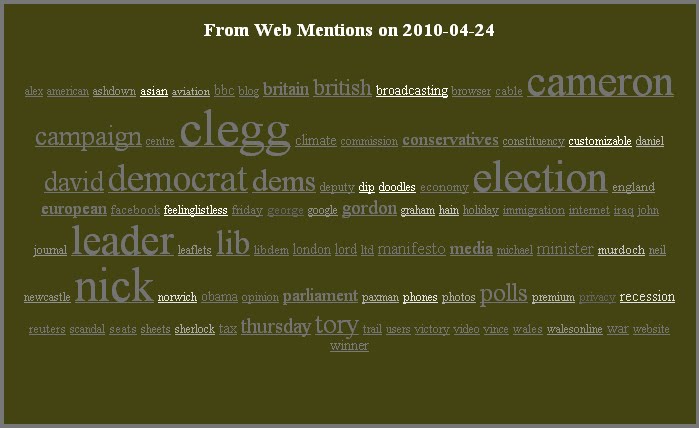
Day 4 Semantic analysis of the UK general election

This is the fourth daily semantic wall about three political leaders David Cameron, Conservative; Gordon Brown, Labour and Nick Clegg, LibDem.
The methodology being used is described in this post.
You are invited to comment and criticise as much as you like :)


The nature of the results for Gordon Brown have been very different to the other candidates. To begin with, the online community is not presenting a strong showing for Gordon Brown. It is therefore not a greate suprise to learn of a tactical change in today's press http://bit.ly/9kEInZ. 

Semantic web visualisation for Gordon Brown


Semantic web visualisation for Nick Clegg


Semantic web visualisation for David Cameron


Thursday, April 22, 2010

Day 3 Semantic analysis of the UK general election

This is the first daily semantic wall about three political leaders David Cameron, Conservative; Gordon Brown, Labour and Nick Clegg, LibDem.
The methodology being used is described in this post.
You are invited to comment and criticise as much as you like :)


Semantic web visualisation for Gordon Brown


Semantic web visualisation for Nick Clegg


Semantic web visualisation for David Cameron


Wednesday, April 21, 2010

Day 2 Semantic analysis of the UK general election

This is the first daily semantic wall about three political leaders David Cameron, Conservative; Gordon Brown, Labour and Nick Clegg, LibDem.
The methodology being used is described in this post.
You are invited to comment and criticise as much as you like :)


Semantic web visualisation for Gordon Brown


Semantic representation for Nick Clegg


Semantic representation for David Cameron


Tuesday, April 20, 2010

Day 1 Semantic analysis of the UK general election

This is the first daily semantic wall about three political leaders David Cameron, Conservative; Gordon Brown, Labour and Nick Clegg, LibDem.
The methodology being used is described in this post.
You are invited to comment and criticise as much as you like :)
This is not a full 24 hours so we can expect the returns to vary over a few days.

Semantic web visualisation for Gordon Brown


Semantic web visualisation for Nick Clegg


Semantic web visualisation for David Cameron


What is most interesting is that this is already showing major differences. I am curious to know what happened to Gordon Brown in his own analysis?

Semantic Public Relations - a future PR discipline or just future PR?

Over the last week, a number of people have asked me to explain what I mean by Semantic Public Relations.

I could spend a lot of time writing a definition of semantics  or the semantic web.  I could show how the inventor of the web Tim Berners-Lee finds it all absorbing, why Google thinks its is essential to its future survival, and how some serious thinkers see how it is important for the future of society.

It's a much more fun to put on a practical demonstration. That is what I am going to do.

The demonstration will seek to show that it is possible to identify as a moment in time the key semantic notions that define a genre and individuals in the genre.

The methodology I shall apply is listed in this post but I shall also provide the practitioner with the tools that allow practitioners and researchers to replicate  the findings.

To ensure that this is a relevant case study, I shall take an example of major competitive public relations campaigns, the UK General Election. Specifically I shall look at the semantic similarities and differences of the three leaders: David Cameron, Conservative; Gordon Brown, Labour and Nick Clegg, LibDem.

This is a big project and we are limited (by the technological challenge I face) to sampling the corpus. In the future we do not have to be limited by such constraints.

The methodology I am able to use is as follows.

  • Every 40 minutes I shall use and automated bot to interrogate the internet to identify new web pages published in a day which mention each of the three major party leaders. I anticipate this will be of the order of 200,000/300,000 every day (or more). Of these I will select 1000 pages (citations) on the basis of number of views and mentions of the leaders in headlines and first paragraph. This content will include publicly available items of:  news media pages in online newspapers, magazines and other news outlets (offering news that is not hidden behind robot blocks and paywalls); blog posts, Twitter tweets, Social Network contributions, wiki pages, Bulletin Boards, discussion lists, List Serve, Sidewikis, comments about photographs and videos, slideshows and other web based pages.
  • Each of these selected citations will be parsed (software available here) to extract the the contiguous text which will be retained for further analysis together with an audit trail giving date found and URL.
  • Each citation will then be parsed using latent semantic indexing software which will identify the semantic concepts in each citation (here is software that you can use to extract concepts from web pages).
  • I will then rank the concepts in order of frequency of use in the citations for each day. This will provide a rather boring list of words and their daily count.
  • To make it easy to see the result and to compare the three Party Leaders, I will use a wordwall for visualisation purposes so that you can compare the most significant semantic concepts for each of the three selected leaders.
  • These will be posted on this blog every day until polling day.
What do we anticipate this is going to show?
  1. This is a proof of concept demonstration showing the semantic differences between the three competitors. 
  2. This will show how using a sample of online content selected for its reach and readership the web reports the three campaigns.
  3. The analysis will show how these citations represent an online view of the competitors' similarities and differences.
  4. It shows how all manner of online influences can represent the three candidates.
As the evidence appears day by day, it will be interested if there is any advice that a PR professional would propose to a candidate based on what the online community is 'thinking'.

Of course some of the PR response will be based on the relationships at play; values that attach to the candidates and the extent to which these responses are driven by people who are motivated to do thinks (like post comments or vote?) and other factors.

Then, we have Semantic Public Relations.

I suspect that what I will be showing in this demonstration is that the online community is driving the agenda and what I think we will find is that the competitors are ignoring a large part of that agenda.

I suspect that the PR response that I hope you will provide will be in near real time and will interpret the results as part of a process in working out what future, internet mediated, ubiquitous interactive communication will look like for effective PR practice.

Enjoy.

It should be remembered that the methodology has not been fully tested (mostly so that it can be available quickly for the CIPR SM committee to see how the internet is moving on and in support of Philip Sheldrake's work). If this was to be a research project to provide a research base for PR practice, it would be conducted differently But this is a nice demo (and, of course, I am very happy to help anyone who wants to do this work for the PR sector).