Friday, March 24, 2006

Conferences worth going to

There are some really good New Media conferences for people to go to, and there are some that are less so and some that are just not worth the money as New Media conferences.

This one should be good

Speakers include:

Neville Hobson - Communications consultant, blogger and podcaster at nevillehobson.com
Guillaume du Gardier - Director Online Communications Europe, Edelman
Stormhoek Wines, the blogging vintners
Olivier Creiche, COO Europe for Six Apart
Martin Talks, CEO, Bluebarracuda.com
Julian Smith, analyst Jupiter Research
Antony Mayfield - Harvard PR
Lee Bryant - Headshift
Jeremy Phillips, director of Market Clusters
Gabe MacIntyre - Xolo.tv and Whisper Media
Nick Mailer - Positive Internet
Alex Bellinger - Audacious Online
Matthew Yeomans - Custom Communication
Mark Rogers - Market Sentinel
Vassil Mladjov, founder of Blogtronix
Heather Hopkins, director of research, Hitwise
Struan Robertson senior associate at Pinsent Masons
Graeme Foux - director and founder of Knexus
Genie Lutz - Partner, UK OnLine Presence and Tax Portal, PriceWaterhouseCoopers
Philippe Borremans - Public Relations Manager, IBM Belgium & Luxembourg
James Ledbetter, Senior Editor - Time Magazine
Peter Bale, Online Editorial Director, Times Online
Guillaume Champeau, Project Manager, AgoraVox.com


This one should be good too:
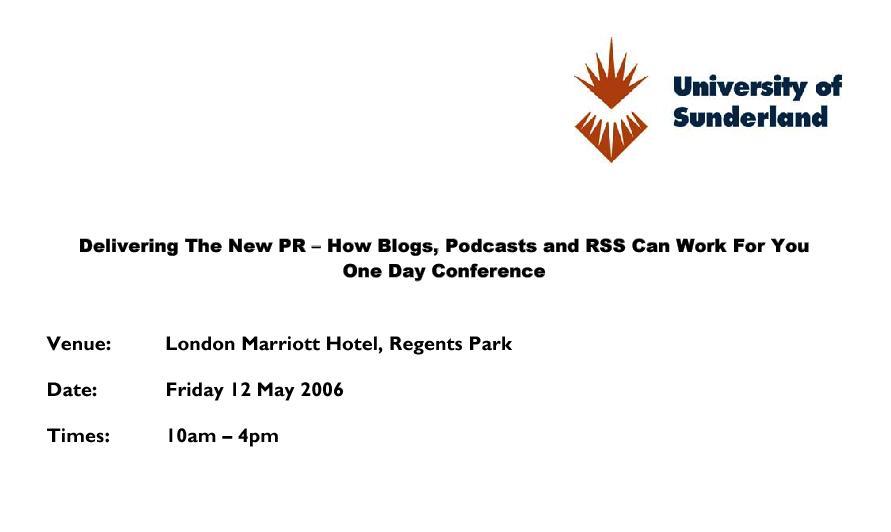


By contrast to some New Media conferences, this is a conference with speakers who know public relations (and marketing and advertsing); know the New Media; use New Media; have studied New Media and who are worth listening to:

Tom Murphy – Tom looks after PR and Community Affairs for Microsoft in Ireland, prior to this

Tom spent 14 years providing PR counsel to technology companies across Europe and North

America. He has worked in both agency and in-house roles with a range of companies including

BEA Systems, Gateway and Intel. Tom is the author of PR Opinions a

blog which covers the challenges facing PR and marketing professionals.

Elizabeth Albrycht – Elizabeth is an independent communications consultant and 15 year

veteran of high technology public relations practice. She has authored articles on blogging, RSS and

other new tools for PRSA's Tactics magazine, the IABC's CW Bulletin and the New

Communications Blogzine. Elizabeth blogs about PR and corporate communications at

CorporatePR and is the editor of Future Tense, a Corante blog that explores the future of work.

Neville Hobson, ABC - Neville is a communicator, blogger and podcaster and one of the

leading European early adopters and influencers in new-media communication for business. He

blogs daily at NevOn with commentary and opinion on business communication

and technology, and co-presents For Immediate Release: The Hobson & Holtz Report

a twice-weekly business podcast at the intersection of online communication, business and technology.

Philip Young - Philip is a Senior Lecturer in public relations and journalism at the University Of

Sunderland, specialising in media ethics. Prior to joining the university he ran a highly successful

PR agency and was an award-winning journalist with two major regional newspapers. Philip runs.the Mediations weblog and has written widely on new communications.

Chris Rushton - Chris is Head of Public Relations & Journalism at the University of Sunderland.

He is also chief examiner for the Chartered Institute of Public Relations' Advanced Certificate.

Prior to joining the university, Chris was managing director of a national PR agency, specializing in

corporate and financial PR. In addition, he has had a successful career in journalism, including seven

years as an award-winning editor of one of the UK's largest regional newspapers.

Stuart Bruce - Stuart is a founding partner of Bruce Marshall Associates, a PR consultancy based

in Leeds and London. Before starting his own business in 1998 he was responsible for UK public

relations and public affairs for Grant Thornton, one of the world's largest accountants.. Stuart has

blogged since early 2003.


Lets face it, the Internet is rapidly becomming the primary source for news for many people. Which puts New Media in the frame as well.

For more conference information click here

Thursday, March 23, 2006

A send-up from PRW's stable-mate


I have just received a £500 pitch from Haymarket Events (a PR Week stable mate). The event is called: PR And New Media: Strategically Controlling Messages And Managing Risk In A 24/7 Digital Environment. That give-away word 'Controlling' say it all.

The speakers are predominantly from the traditional media! So they must know a lot about citzen journalism. There are no 'A list' PR bloggers probably because they blog and dissintermediate PRW.

The programme includes gems like this:

Exploring The Impact Of New Media Within A Traditional World: Blogs And Pods Take On Print And Radio

Why would blogs and pods want to take on print and radio? Blogs are blogs not newspapers and podcasts are podcasts not radio. A quicker answer is already out and about in the 'real world'.

Investigating The New Media Channels Employed By Journalists: A First-Hand Exploration Into Getting Your PR Message Out There... The programme proclaims. Do they suggest bloggers should aim their posts for journalists to interpret? What for? New Media goes straight to the audience. No need for journalists.

Snapshot Case Study: Podcasting... But this is not a a PR podcaster. In fact not a podcaster at all! Can I suggest delegates listen to Shel Holtz and Neville Hobson.

Multi-Channel Consumers When, Where, How... Are People Getting Their Information? This is by George R. Andrew, Head of Market Relations, Scottish Widows, that famous blogger who is using new media all over his web site, or not as the case may be.

But the use of Nielsen-Netratings or ClickZ never crossed our minds.

Exploring Online Consumer Activity To Maximise PR Impact On Audiences Online

By Mark Brooks, Head of Media and PR, National Savings & Investments
Who is evidently pioneering interactive conversations and 'joined up' multi platform PR (Note the interactive, 'long conversation' at the web site. The find out what current experience looks like.
Or there are real case studies available through new media (such as your iPod) here.

Joe Blogging: Examining How To Counteract The Negative Influences Of Online Citizen Journalists On Reputation

The Book is called Online Public Relations (look right). The methodology was invented by Alison Clark. There is even a complete online lecture to get people started.

There are case studies here.

Nick Hindle, Head of Corporate Affairs, McDonald's will talk about: Minimising Corporate Risk And Gaining Buy-In In The New Media Climate Through Tailored PR Strategies

I guess he will cover sites like these. Then there will be reference to these white papers and so much more.

Fighting Back: Managing Corporate Issues In A 24/7 World

Even the title of the session is the antitheses to new communication.

... and so the programme goes on.

A lot of scare mongering, a lot of people not of the New Communication age and this is the way to make money with old rope and even older journos.

Now, the real fun will be to see who goes to this event - how embarasing if someone recognised you!

Wednesday, March 22, 2006

Corporate Transparency

Jeremy Pepper at his blog has taken up the issue of transparency.

Of the five big issues that are important in online communications, transparency is the hardest. I have been preaching a mantra about the five big Internet issues for a number of years. They are:

Reach, speed, porosity and agency and Transparency. Transparency has an ethical dilemma's attached.

All organisations have information that they would rather keep confidential. For most it is about sustaining a competitive edge or a financial advantage.

I once has a CEO who used to drive marketing managers nuts because he would entertain competitors and was quite happy to take them through the drawing office and onto the test track.

His view was quite simple. It will take them a long time to replicate what I show than and by then we will have moved on. We learn what they are doing by their questions and so, they will always be second.

He did the same with customers. But this time he would ask if the benefits the company was designing into the product would solve their problems.

It meant that the design and development staff knew that they were not in competition with other suppliers but did have a a close and transparent exchange with customers.

It did make being a PR manager easy except for one thing. Every customer wanted to be included among the application studies we wrote to show how well they had understood the designed in advantages and how it made their businesses more competitive. It played havoc with the PR budget.

Today, one would see this exchange as part of the continuing conversation.

So how do we, ethically, draw the transparency line?

In looking at what needs not to be transparent in an organisation the rules should but the community first and commercial advantage second and competitive advantage third. But this does not mean that all organisations have to be, or should be completely transparent.

It is actually about culture. Organisations have cultures. This is a culture developed as people inside the organisation interact and talk about what they do. They talk about things that have an explicit description and implicit values.

This culture, when acceptable to the the wider culture militates for the organisation. Professor James E Grunig has been making this point since 1992.

If people can communicate inside an organisation, including in conversation with the 'dominant coalition' and can hold symmetrical conversations with external audiences, cultural convergence will be powerful. It will make the relationship value drive turnover and profits and, guess what, a mutual understanding of the line between secrecy and transparency will emerge.

Picture: Transparency

The Vacuous Practitioner and Intelligent Responses

This is a rant about some of my colleagues. It is not about all of them some are quite beyond belief. It is also about some really good news.

It is dissertation time in academia and I am beginning to see the drafts of research by students into various PR activities.

They are researching practice at the sharp end. They are talking to practitioners in major organisations. They are seeking examples of practice and best practice. They are talking to real PR practitioners and it's not pretty.

I have a view of an industry comprising bumbling old men and airheaded kids.

In a major research project into evaluation, there is one sentence from leaders in evaluation and no reference from in-house practitioners about new media.There is no reference about declining traditional media circulation.

These people think AVE's are wrong but are so weak (pathetic comes to mind) that they cannot convince marketing and other managers that AVE's are at best the lowest form of statistical garbage.

In campaign planning there is an almost total absence of robust research methods and very (I mean VERY) little by way of SMART objectives and strangulated strategy which is being confused with tactics.

In on-line PR, practitioners are still stuck on web site building, Spam and SEO and, can you believe it, 'seeding' Usenet. Blogs are mentioned and there is some excitement about them but podcasts and wiki's are not on the horizon and RSS, you understand, is about Really Stupid Spindoctors for all they know.

A major Bank is still printing a glossy tabloid in-house newsletters and shipping them round the world (every country in Europe, Most US States and umpteen destinations in Asia and Africa).

In identifying publics there seems to be a view that best practice is to brainstorm a list of 'stakeholders' and then pick the five that can attract the budgets or the CEO's attention. Its not as though there are not powerful aids available.

One weeps.

The counterpoint is Professor Jim Grunig's new paper in the latest editions of JOURNAL OF PUBLIC RELATIONS RESEARCH. Here is a real breath of fresh air and an answer to so many of the responses the students are bringing to me.

It is cheering stuff.

Entitled “Furnishing the Edifice: Ongoing Research on Public Relations As a Strategic Management Function, this paper follows from a paper I presented to Bledcom (www.bledcom.com) in 2003 in which I appealed for relationships to be included on the balance sheet. Jim has also come round to this view. He says:

I am continuing to work on the ROI of relationships as the chair of a task force of the Measurement Commission of the Institute for Public Relations, which is studying how nonfinancial indicators of value are influenced by public relations. This task force was initiated by the late Patrick Jackson —the renowned public relations professional. Non-financial indicators of value, or intangible assets, are a hot topic in management and accounting circles. I believe that relationships are the most important of these intangible assets and that if we can show that public relations creates value in addition to financial value, we can show the overall ROI of the function. The British public relations practitioner and scholar, David Phillips (2005), also studied the literature on intangible assets and argued that relationships are the most important of these assets. I believe this approach to ROI eventually will show the value of public relations and encourage public relations scholars to join in the study of intangible assets.”

Here is a powerful insight by an influential academic.

Hooray!!!!!

Picture: Sad Clown

Tuesday, March 21, 2006

BBC Newspod

The BBC has started to promote BBC Radio Newspod which was first brought to our attention by Rob Fenwick

This podcast service allows you to listen to programme highlights from across BBC Radio News, presented by Eddie Mair and available each weekday from 1700 GMT.

Here, again is further evidence of the significance of multi-touch, multichannel communications for Public Relations practitioners.

Downloading podcasts from the BBC lets you save a copy of your chosen programme of package onto your computer. You can then listen to this whenever you want, or even transfer it onto your portable MP3 player.

Podcasting lets you automatically receive the latest episode of your chosen programme as soon as it's available. You need to "subscribe" to receive a podcast, rather like you might subscribe to a magazine and get it delivered each week. An important difference is that all of the BBC's podcasts are free, and you can stop receiving the files at any time.

If you would like a company/subject specific round up of daily news at about 0800 each day, please let me know, it is a service that can be developed based on my news summary engine.

Sunday, March 19, 2006

The tipping point for Public Relations

March 2006 was the tipping point for Online PR. PR' role is not as comfortable as some may believe.

According to The Editor's Weblog The latest figures from the UK Audit Bureau of Circulation show that every British regional paper, both morning and evening, lost paying readers in the second half of 2005.

Reports that the The Newspaper Society, sees some light in the dark numbers and claims that "websites, niche magazines and broadcast platforms, ‘Lite’ editions for commuters, podcasts, mobile phones and e-editions are all allowing people to access news and entertainment on the move, and are proving increasingly popular for regional press consumers.

We saw this month that people in the UK spend more time on-line than watching television.

This tells us that the tipping point is here and now.

The content manager at Northcliffe Electronic Publishing, Robert Hardie, said, "Readers who were previously disenfranchised for geographical or logistical reasons from buying their local paper can now access it online, and both the age and social demographics are different for the online audience than they are for the traditional newspaper-buying one.”

Communications director of the Society, Lynne Anderson feels that "Measuring circulation alone clearly no longer gives an accurate picture of a regional centre’s reach . The challenge is to develop a national method of multi-media audience measurement which provides more meaningful figures for advertisers and agencies." This suggests that PR media planners and the PR Evaluationsist have a problem. Apparently evaluation reach numbers are now suspect! Circulation is not king. The engaged readers is more powerful and more committed. An engaged reader not going to believe a BuzzAgent? The person who is intruding and getting in the way of what 'I' want to find out'. In the networked community, this is a receipt for market oblivion.

The Big Gorilla announcement that News International is working hard at developing its on-line presence is really important. It says that on-line is now top priority for PR. According to The Economist, Murdock's News Corporation spent more than a billion dollars buying barely profitable internet companies. He did not do this for nothing.

The debate is one of the side-effects of the digital revolution in which the dinosaurs must adapt or die. As one of the biggest beasts, ITV has already swallowed up a new competitor, the Friends Reunited website,” commented Jennifer Cunningham in the Herald noted this week.

The BBC which is no slouch when it comes to bridging the gap between traditional and on-line media, has signed up Dan Gillmore to explain the development of citizen media.

Georgina Harvey, managing director of Trinity Mirror's regional titles, said: "Trinity Mirror is rapidly becoming a multi-platform publisher.

This on-line presence must now open up new PR jobs to assist in influencing the changing face of PR with all these new communications channels opening up so fast. Press relations is no longer enough.

The future of Public Relations is no longer in print. In fact, it is no longer about narrow definitions of stakeholders or publics, such approaches need robust methodologies to succeed and PR has to work at a more profound level.

This new world is much more to do with social frames and understanding the nature of organisations. It needs these tools to help us use the language, content in context and appropriate communication channels. The 'long conversation (durring which the organisation may sell something) is now critical to relationship creation, building and management. The power curve militates against artificial WOM. People just don't believe plugs, spin, advertising and all the rest of the mantra you hear from the marketing and advertising industry based on OTS.

This brave new cultural world is a different form of PR. It includes the traditional techniques but to make them work needs not just and overlay of digital icing. PR practice now needs digital PR in the DNA of practice.

Hurry up! Hurry up! We don't have all minute.

Picture: Classic pics and art

Friday, March 17, 2006

Global PR Blog Week 2.0 » Blog Archive » Groupbytes: Digital/Social Rules for the post-Google Economy

Global PR Blog Week 2.0 » Blog Archive » Groupbytes: Digital/Social Rules for the post-Google Economy: "To understand the power and force of new media, it's important to appreciate what came before it. From our perspective, the most important driver and antecedent for new media is search, for this one technology alone has recruited many millions of people to go online for their many information needs. Granted, other technologies have helped to create the very large online population that exists today. But search is the dominant driver for the huge wave of recruitment we're calling 'the great migration.'

The second wave is where most of us - the PR bloggers reviewing this short paper - live. We're calling this 'the socialization of the Web.' In part, this socialization is a reaction, for one of the defining attributes of the first wave is that many people who have migrated to the Web for their many information needs have abandoned - willfully or inadvertently - offline communities. This has created both a crisis and opportunity for business and technology leaders. The groupbytes below are a distillation of the social rules that technology leaders have been importing or that have naturally arisen in a very large online experiment that's underway. Which leads to the controlling idea of this paper, and our wiki: technology and business leaders are now importing offline social rules into online environments. The winners will be those who best understand those rules, because the rules will influence all markets - online and offline. But how can we all get smarter?

Finally, we expect the lessons from the second wave to dramatically influence the third: the offline world's eventual adoption of lessons from the online world. This is already happening (the three waves are not exactly sequential), and it is one reason that the rules should matter to everyone, whether they are sold on the idea that they should have a new-me"

NEW PR JOBS FOR THE POST-BLOGGING ECONOMY

The range of Public Relations consultants are now looking to areas of practice that lie beyond traditional press relations is growing. Much of this new thinking is fresh and exiting. Giovanni Rodriguez of Eastwikkers has offered some refreshing insights.

This kind of thinking needs wide exposure because it is about change in the PR industry.

I like this approach because it is about relationship managment and chimes with my relationship managment model.

I have summarised (OK, if you are in the USA 'summarized' - and I just love my summary tool) their blog post here:

NEW PR JOBS FOR THE POST-BLOGGING ECONOMY: "To make things simple, here are five new roles for PR people that have already emerged in our profession. For each role, we name an historical role model (or 'archetype,' for the Jungians out there), and contemporary role models (PR people who are already doing great stuff in the industry today).

Georgegallup2_1The Researcher -- This one is way obvious. In this age of conversational PR, which is largely happening in the digital world, research and measurement people have a privileged place. They've always understood the value of listening, as well as the value of numbers. But unlike the pollsters and researchers of old, the new leaders will not use what they find to respin the message, but rather to enable the teams they support to enter the conversation truthfully. Historical role model: George Gallup. New-media role models: Katie Paine and Tony Obregon.

Mmead_2The Anthropologist -- corporate communications will learn a lot from the world of design that companies like IDEO has helped to evolve; like product and experience designers, communications people will go into the field and observe how people are actually using the tools. We'll see a lot more of this as companies accelerate the adoption of DIY community tools such as wikis. It's the social rule, not the tool, that many new communications professionals bring to the table. Historical role models: Margaret Mead. New media: Elisabeth Albrycht and Dianna Miller, who are studying wikis for SNCR.

VoltaireferneyThe Gardener -- to build and maintain communities, you need more than just anthropologists. You also need people who are talented in "caring and feeding" the community, and sustaining online environments that sometimes get fractious, unstructured, unproductive. This is a special talent, in rare supply, and the most enlightened members of this lot will always have work. Historical role model: Voltaire ("we must cultivate our garden"). New media: Constantin Basturea, Dan Forbush.

Flw The Architect -- Sometime the tools are just as important as the rules ... if you are smart enough to really know how to use them. A few folks in the PR world are way ahead of others on the technical side and are helping their clients to make sense of the technology tool kit so that they can actually do stuff, and build things (what a concept). Note: building is as much of an art as it is a science. The best folks in this group are creatives. Historical role model: Frank Lloyd Wright. New media: Phil Gomes, Mike Manuel, Jeremy Pepper.

LeeThe Impresario -- some PR people will lead by the sheer force of their personality, their work output, or the artistry/fun of their writing (after all, blogging is a writer's medium). For these folks, it's an opportunity to define and shape a new industry. We expect a number of people to emerge here, each with a different strength or style. Historical role models: Ivy Ledbetter Lee and Edward Bernays. New media: Richard Edelman, Steve Rubel, Scott Baradell, Neville Hobson.


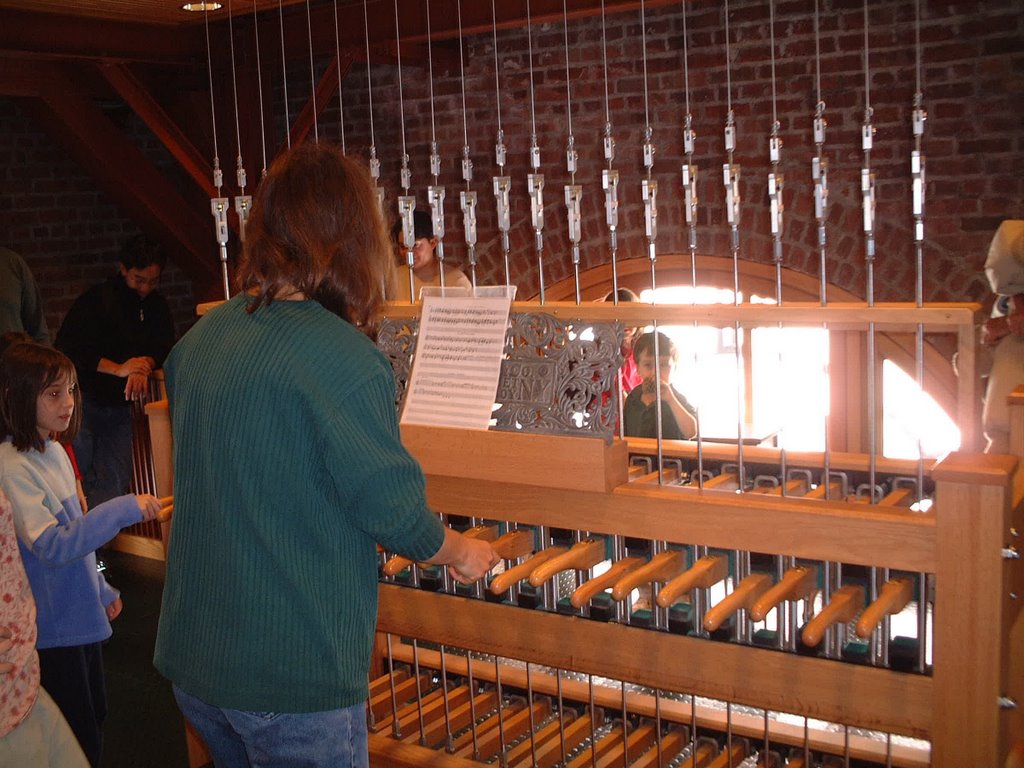
Picture: Chimes

Brave Cultral World

We have rapidly moved from the information economy to the networked economy and, in my view are approaching the 'cultural economy'. It chimes with the view that 'capitalism is a finished chapter in world history' according to Arie de Geus, author of The Living Company, and former head of Shell's Group Planning Unit.

At the same time we see Antony Mayfield at Harvard Communications giving us a view of the “The authentic voice of the global media market, Rupert Murdoch hails the coming revolution that the Internet will bring.” Murdoch has shifted the goal and talks about 'all... on a journey'. He has moved away from the corporate to the cultural in one leap. And, according to The Economist, his News Corporation spent more than a billion dollars buying barely profitable internet companies.

He said: "It is a creative, destructive technology that is still in its infancy, yet breaking and remaking everything in its path. We are all on a journey, not just the privileged few, and technology will take us to a destination that is defined by the limits of our creativity, our confidence and our courage."

It chimes with the view that 'capitalism is finished chapter in world history' offered by Arie de Geus, author of The Living Company, and former head of Shell's Group Planning unit.

Gitte Larsen review of the Geus thesis summarised here:

When the capital market became a buyer’s market in the late 1990s, there came an economic price, a world price of capital, and why should we keep on running companies to maximize shareholder value? Today, you should run a company to maximize the value that is returned to the people that are a part of the company. The reason that doesn’t happen yet is that you have an internal reality in the company that says results are entirely the result of human talent, while at the same time you have an external reality that says you must continue to see capital as the dominant production factor.

“A hundred years ago, a company was based mainly on capital; the human element was a minor element. The most important was capital assets. That’s absolutely untrue today, because the human talent you have in the company defines your success, with other assets playing a lesser role. Just look at how many assets Microsoft has, for example. Its capital assets are minimal compared with its market value. The difference between market value and the balance sheet is the value of the human ‘community’ in the company. That’s completely ignored in the language of today. And that’s the tension or great challenge for companies today. We have to change the way we talk about companies. Business is about people working together to produce economic material wealth and quality design. Denmark has beautiful examples of how good ideas and good design quality are essential – for example, Lego and B&O. Their success is based on the quality of the people that work there, not the quality of their machines.

“The Living Company doesn’t have employees or abilities. The company has members, and these members have a set of shared values. And this is certainly the “mysterious thing” about Toyota. Toyota has a strong ‘corporate culture’; if you are a member of Toyota, you share the values of that culture. That’s just one aspect of the Living Company, but it’s a very central and important one,” says de Geus. “There are examples of companies that have survived a long time – Shell, for example, is more than 100 years old – and these successful old companies have a strong culture. They have a set of values that the people in them share. That’s the biggest difference between a living company and how we usually define a company; that is, according to legal and economic definitions. The living company is a community of people from the start.”


Here is an mp3 of the Arie de Geus interview at the Busieness Innovation conference in Copenhagen this week.

Picture: City of Bradford

Thursday, March 16, 2006

Cracks in the Foundation of Stakeholder Theory by: Andrew R. Weiss Introduction

Some time ago I looked at the Stakeholder Model in the light of the Relationship Value Model. My conclusion is that Freedman's idea is OK as far as it goes but is not a complete theory. Great for Guru's bad for Companies....

Anrew Weiss has also found problems and here is what he is saying.

Cracks in the Foundation of Stakeholder Theory by: Andrew R. Weiss Introduction: Stakeholder Theory has become an established framework within which to identify and examine the impact of organization action. It has been used to inform discussion of corporate governance, business ethics, strategic management and organizational effectiveness.

Donaldson and Preston note that 'a dozen books and more than 100 articles with primary emphasis on the stakeholder concept have appeared and that 'the stakeholder model has become a standard element of 'Introduction to Management' lectures and writings' (1995:65-66).

In fact, one might argue that Stakeholder Theory is approaching paradigm status. It consists of a general system of ideas and assumptions, standard examples and established assertions.

Given its broad impact, the general foundation and assumptions on which the broad outlines of Stakeholder Theory rest warrant examination.

Stakeholder Theory posits a model of the enterprise in which 'all persons or groups with legitimate interests participating in an enterprise do so to obtain benefits, and there is no prima facie priority of one set of interests and benefits over another' (Donaldson and Preston, 1995:68).

The model rejects the idea that the enterprise exists to serve the interest of its owners, be that maximizing their wealth or some other reason for being in business. Rather, the model is based on the idea that the enterprise exists to serve the many stakeholders who have an interest in it or who in some way may be harmed"

Strategic Corporate Social Responsibility as Stakeholder Management:

"The term corporate social responsibility (CSR) may cause unnecessary ambiguity for companies. In particular, global scale companies including SAMSUNG electronics and LG electronics keep spending various resources for the related activities without coherent notion on the concept of CSR.

But what does corporate social responsibility mean to companies?

Without clear understanding about the meaning of CSR, how can companies respond or take actions on it? In this study, CSR indicates corporate stakeholder responsibility.

Having relevant key stakeholders in corporate business activities, companies may know how to respond or deal with them in a strategic way without losing competitiveness.

This study attempts to answer how and why companies respond differently to their stakeholders.

The study found that identified key stakeholders by decision makers resulted in different strategic choices or responses.

It may imply that unidentified stakeholders have no influence or impact on corporate business activities.

PR Evaluation Blog

Richard Gaunt now has a PR Evaluation Blog and notes that the USA’s Institute for Public Relations, which offers all of its research and publications free on the web, has published a new edition of the Dictionary of Public Relations Measurement and Research (pdf - 198kb), edited by Dr. Don W. Stacks of the University of Miami.

Media is booted and on-line time exceeds TV

Newspaper audiences may be growing online, but Web sites don't deliver the kind of revenue that can support large staffs of editors, reporters and photographers, reports TMCNet today.

Using figures drawn from a new study by the Project for Excellence in Journalism describing what it calls a "seismic transformation" in the media landscape, it argues that declining print circulation -- down another 3 percent last year in the USA -- could have major consequences. The industry has lost more than 3,500 newsroom professionals since 2000, a drop of 7 percent. The Washington Post said last week it would seek to cut 80 newsroom jobs through voluntary redundancies, the second such offer in just over two years.

The papers have plenty of company. Circulation declined last year at the big three news magazines. Network evening news ratings dropped 6 percent and morning show ratings 4 percent. The number of network correspondents is one-third lower than it was in the mid-1980s.

Early-evening news ratings for local TV were down 13 percent, the project says. And 60 percent of the local TV newscasts studied by the group -- once traffic, weather and sports are excluded -- consisted of crime and accident stories. What's more, the proportion of stories presented by reporters dropped from 62 percent to 43 percent between 1998 and 2002, leaving these programs increasingly driven by anchors.

The growth has been among outlets such as Google News and Yahoo, which aggregate content from other sources; blogs, on which, apparently, only 5 percent of posts involved original research; and satellite radio, which serves up news, talk, entertainment and music but little or no original reporting.

Another report in the UK this week has noted that people are now spending more time online than watching TV.

In addition, not to miss the audiences, TV is rushing to get on-line fast.

I have doubts about such services as subscription services.

Picture: How did broadcasting begin from the BBC

Wednesday, March 15, 2006

Framed for more effective PR

OK so you read it here first. The idea of Social Frames is becoming more relevant after results from A team at University College London claimed to be able to tell how well memory will serve us before we have seen what we will remember.


Scans of brain activity, published online in the journal Nature Neuroscience, indicate that the brain can actually get into the 'right frame of mind' to store new information.

They also suggest that we perform at our best if the brain is active not only at the moment we get new information but also in the seconds before.

For some time I have been working on an approach that can help us to understand what to say, when to say and how to say in a dialogue for optimum effect.


Lead researcher Dr Leun Otten from UCL Psychology and the UCL Institute of Cognitive Neuroscience said: "It sounds a bit like clairvoyance in the sense that we're able to predict whether someone will remember a word before they even see it." But we are now understanding how important it is to for time, place and content to chime with the audience. In other words to be available in the public's social frame.

The idea behind social frames can be summed up like this: Being in the right place (shop or bath) with the right interactive capability (shop assistant or bar of soap) with the right values in mind (I'm in a shopping mood), will have the greatest effect.

Leun says: "That's really new - scientists knew that brain activity changes as you store things into memory but now we have found brain activity that tells how well your memory will work in advance."

What this means is that to have the best effect, PR communication needs to be presented into the right environment: through an appropriate communication channel and couched in terms that resonate with culture of the public involved.

Picture: Mechanical Mirage

The Future of Public Relations

This week I was asked about the future of public relations and what were the issues we face.

I think that the evidence now accumulating in Neuroscience is going to be critical to the future of all relationship, social value, reputation and communications disciplines. The ability to 'look into' the brain to see its responses to personal, social and other stimuli is advancing so fast that we can test theory really quickly.

This has implications on Public Relations practice too. Over the years I have heard many wacky theories about how and why PR should work this way or that and how and why marketing or media or politics or lobbying or all sorts of things is the practice and only legitimate practice of Public Relations. Enter neuropsychology and we can see quite clearly the isms, fashions, the silly concepts and we can test claims of practitioners and academics alike.

This is going to be hard for many practitioners and not a few academics and researchers.

The first future issue is that our clients now have the tools to see through ill conceived theory, programmes and ideas in practice. This is evaluation of a new kind and it is red in tooth and claw.

The second big issue is the evolution of social media. This time I do not mean blogs, wiki's, 'New Media' as seen today but the truly interactive channels that will emerge for the population brought up with Xbox and Playstation. This generation is practised at interactivity using a wider range of communications such as visual and physical interactions as well as words and sounds. It expects rich media and the Internet is now getting faster and available as is the mobile media as well. These two convergent developments mean that multi-touch, multi-sensory communication (including the use of gaming technology to provide a 'physical' presence for the disabled) is upon us and will be part of the communications mix to be used by our students as practitioners in the next decade (or less).

Ethics, once a soft subject now has a hard edge. We can see exactly how a lack of ethical practice can be commercially damaging in real time and at a personal level. We are now also beginning to understand the relationship between wealthreputation.

The link between PR and Marketing is broken and now there is some doubt about the future of marketing itself. Nearly all its basic tenets are under pressure. Even the tenuous attempts to to see marketing with a supply chain rolefalling off the edge the old world.

The nature of the practice of public relations has to be based on a firmer footing. I believe that we have to invest in understanding the practice of relationship management. The CIPR research into size of the industry was a classic of how not to see PR. A large part of practice evidenced in their research showed that events management is a big part of the industry's activity but they just did not take the thinking to its logical end. Much of the practice of PR is well beyond the narrow thinking and narrow mindedness of a practice that has had its day (mostly press relations). If the rump of 'old PR' continues to be taught and practised as it is today, there will be no PR in ten years time. The world will have moved on and the PR institutions will continue to be 'old boys clubs'.

The critical issue is the time-scale for these developments to become mainstream for PR practitioners and the speed at which the traditional practices are usurped which requires changes in teaching as well as practice.

Lets take traditional press relations as an example and explain why I think press relations as taught and, for many, practised is now dramatically changed. The many pressures that drive the news agenda can now be mapped. Google News is no longer the only means by which media stories are disintermediated by computers. The outputs can be summarised, the story can be re-purposed and the content can be 'mashed' with other content and all of this is done by machine. This means that original content is very valuable and thereafter its application can go in many directions. We no longer write for the 'press' we write for the mashed media, a multi 'stakeholder' environment. So, we have to think of the press release as an original document that can (and probably will) be used in many ways, by many people and machines and that instead of writing for the press, we are writing for 'the media'. Press relations as we know it is dead. I guess this happened without us really knowing it in the last three years! LeedsMet, where I have my affiliations, as with other Universities has to grasp what has happened. The change is no longer in the future.

And then there is the notion that an organisation is not the 'nexus of contracts' (Coarse) or 'nexus of conversations' (Sonsino) but is the nexus of relationshipsless hard bounded than we tend to teach our business studies students and MBA's. I do not see the Business Schools going down this route. Too many vested interests are involved not least the notion of Stakeholder Relations which is not well understood. But I do see management practice evolving because of these changes. In a cultural economy where globalisation is no longer a wide eyed surprise, a lot has to change.

Things like PR evaluation have to grow up. Media relations can only be valued in terms of the number of communications domains reached (see social media above) and so is now not about counting clips or the reach/readership of a newspaper because the reach of the media is now dictated by the extent that it is 'pulled' by readers and referenced by commentators across a vast array of, mostly electronic, media (I thought that there was an exception in consumer media and now discover it is going the same way as B2B publishing). In other evaluation areas, I am not sure that ROI (return on discounted cash flow) has a role in PR especially as we now can see the effects of our actions at the level of a neuron in the minds of our co-conversationalists in a practice evolving round relationships.
and (disintermediated manurfacture, disintermediated distribution, dissintermedated markets) is under pressure as we move from a information to a networked and progressively to a cultural economy. Advertising as we have known it for the last generations seems to be and is much


PR has to change and the clock is ticking faster than most believe.


Picture: Virtual space for learning and collaboration

Tuesday, March 14, 2006

This is a commercial - make summaries for blogs - automatically

Sorry, and I don't do this very often but I am hugging myself over this little programme developed by Girish (my partner in language software in India).

So, you find a web page. Its a long story and too long to blog. You want to blog a summary?


This little programme does it for you.

Its a tool bar for Internet Explorer (Firefox to follow) and is available
here. You download it, install it and thereafter any time you want to make a summary of a web page you click the summary bar and it makes a summary.

Automatically.

You can edit the summary and can cut 'n paste.

You can blog it (Blogger only at this stage) and its virtually automatic.

There is an embryo wiki about it here (this is the fastest development and marketing event ever. We only started development last week and alph and beta tesing was - well - quick so we are keeping our fingers crossed).

Is there an ethical issue here – it rips off IP so fast!

The programme does include hyperlinks to the original but is that enough?

Try it, have fun and let me know how it goes. You get 50 free summaries and then we will be charging for the programme but not so as to break the bank ($30 – even PR thinkers have to eat!).

PR Lessons from the brain

Endless 'bargain offers' and in your face advertising and PR messages can be counter productive and that's official. In fact many of them can turn people off in a big way. We now have a much better idea of which half of the advertising budget does not work and it all comes down to empathy. No empathy half of the messages fail!

Using functional MRI technology, which measures activity in the brain, Sanfey, UA psychology graduate student Katia Harle and colleagues at Princeton University, Emory University and the University of Utrecht in the Netherlands have been watching what happens when a person is on the receiving end of what they call "The Ultimatum Game." In a lab setting, one person is given $10 cash and has the choice of how much to offer the test subject. The subject can either accept or reject the offer -- but rejecting it means neither person gets a dime.

The Ultimatum Game leads to a battle between the two brain structures. People who consistently reject unfair offers -- thereby cheating themselves and their fellow subjects of any money at all. People who accept more unfair offers tend to have the reverse pattern -- possibly because they're focused on the goal of making money.

About half the time with unfair offers, "people turn down money in order to make a point," and are prepared to make sacrifices to 'punish' organisations they perceive act unfairly.

Picture: Isaac Asimov book covers

Monday, March 13, 2006

How to scoop and be scooped

Earlier this month Milwaukee blogger Jim McAdams, was called by New York Times reporter Michael Barbaro who was "pretty irate."

"Do you get your jollies out of this?" McAdams recalls Barbaro asking.

What McAdams did was to scoop Barbaro on his story about how Wal-Mart was sending tips and information to sympathetic bloggers as a way of getting its message out. Barbaro, who maintains he was not irate, says he was "disappointed" that McAdams and other bloggers would "post what it is I was reporting on" after he sent them e-mails seeking comment -- with a request that the e-mails not be publicized. The online chatter enabled the Wall Street Journal to publish a short piece the same day as the Times.

McAdams, who teaches political science at Marquette University, says he had no obligation to keep confidential the fact that a reporter had sent him an e-mail. "You're talking about a bunch of conservative, pro-business bloggers who are sympathetic to Wal-Mart," he says. "This isn't really news. Wal-Mart is simply doing with bloggers what flacks have been doing with broadcast and print media for decades." In his posting, McAdams listed all the e-mails he had gotten from Wal-Mart's PR firm, Edelman, saying he used some and ignored others.

Newspapers have to build relationships too. Some of those relationships will be via print, Some will be in Google News, in another guise it may use other outlets of the many I identify here and monetisation of news will have different shape in the future – but it will be part of a conversation.


Picture: "Scoop" From Joe Giorgianni's collection.

Science of reputation, Significance of ethics

A team, led by professor of psychology Robert Johnston, a research psychologists at Cornell University has shown that different areas of the brain react differently when recognizing other people, depending on the emotions attached to the memory.

Professor Johnson says: "Humans clearly have an incredible ability to recognise, remember and store huge amounts of information about individuals - even individuals we have never actually met. This ability is the core of circuits that one might call the social brain." As one of the most social of animals, this is important and for Relationship Management is pivotal.

What is important for public relations is this ability to recognise and remember information about people we have not even met. One might speculate that capability to ascribe values to people from a distance is what we call reputation. That there is now a Neuroscientific proof behind the social science of reputation. This is important and offers underpinning of the work of ethical public relations (is there un-ethical PR?). It also shows how important the discussion on ethics was at the new Communications Forum with Philip Young and Max Kalehoff (VP Marketing at BuzzMetrics).


Picture: Lifted from The Stanford Medical Ethics conference and not a very ethical use of someone elses IP.

Sunday, March 12, 2006

Context is King

There is a science called semiotics which is the study of signs, both individually and grouped in sign systems. It is important to Public Relations because it underpins the work we do in developing visual signals and graphics to convey messages. Effective communication is at its best when it is multi-touch and offers additional ways to change people's attitudes, throughout their lives. It is one of the reasons we have to celebrate the breadth of PR practice (and why press relations alone is not enough). According to Scott Murray: "Our eyes only tell us part of what we need to be able to see. The other part is done by the brain, taking the input from the eyes and making guesses or inferences about what's out there in the environment. Usually these inferences are very accurate, but sometimes they lead us astray in the form of visual illusions." This means that, in ethical practice, we need to be aware that, in communication, there is a need to provide lots of context to our publics to ensure that the images that have of our clients is as complete as possible. This is more than a photocaption. It requires a that we provide a wide range of cues. The mantra so often heard in advertising and marketing circles about getting over 'our core message' is, from these studies, obviously wrong. Context is King.


Picture:
A visual illusion of two identical spheres makes the rear, or more distant one, appear to be larger. Image by Huseyin Boyaci

Friday, March 10, 2006

The Clarity Concept / Stakeholder Map

The projection onto a screen permits Focus Groups to agree on aspects of nearness of icons to represent Influence of stakeholders; size to represent Importance and colour to represent Attitude.

In this way maps are created in a visual form while the computer programme stores data which can be used for management reporting, decision making and evaluation.


The Clarity Concept / Stakeholder Map

Hot Wired Humans

The neoro scientists are telling us that we are hot wired to respond to the influences of the contexts that are created by Public Relations. The broader the PR campaign is the more effective the programme will be.

So that if the PR programme includes a range of communications channels, and creates a range of contexts suited to the relevant 'social frames', for a social group (which may be identified using methodologies such as focus groups and visualisation), The world we are immersed in literally helps to shape our brains. As we grow up with precisely timed development programmes, the world helps construct our mind's circuits and continually reshapes them as we experience new things and call on new skills. This process does not end in adulthood it happens throughout our lives. New neurons are are born in the adult brain. The survival of these neurons and and how quickly we learn new behaviours depends on the richness of the environment. Genetically, we are designed to be flexible. It is our nature to respond to nurture – throughout our lives.

Organisations can be described as a cultural entity in their own right and they fit into and influence the wider cultural entity of our societies influencing them in a continuous and evolving process. In the past this phenomena has been evidenced in the broad applications of corporate public relations, brand building and political movements. It is Public Relations working in its broadest sense and as relationship management.

The Neuropsychologists are showing how significant relationship management really is. In addition, they show how, through a process of creation of new neurons, PR adds new values that can become very powerful in society.

Photo: Wordswinker

Thursday, March 09, 2006

Where Grunig Where Freeman

In travelling to and from The New Communications Forum, I have been reading about developments emanating from the the Computational Neurobiology Laboratory at the Salt Institute and in particular the Book by Steven Quartz and Terrance Sejnowski, Liars Lovers and Heroes.

It has been an effort to come up to date with the way our brains work, developments in the debate about nature and nurture and the influences that act on humans from a wider perspective than the traditional public relations and marketing perspectives.

The first thing that is apparent is that in the 20 years since Grunig and Freeman first conducted, on the one hand, the research and the other promulgated their theories, Much has changed.

We understand much more about how the mind develops and what inspires our actions.

Not least in this mix is the power of culture in this mix.

There is a rich vein here.

Picture: Post modern Thinker