Friday, March 10, 2006

Hot Wired Humans

The neoro scientists are telling us that we are hot wired to respond to the influences of the contexts that are created by Public Relations. The broader the PR campaign is the more effective the programme will be.

So that if the PR programme includes a range of communications channels, and creates a range of contexts suited to the relevant 'social frames', for a social group (which may be identified using methodologies such as focus groups and visualisation), The world we are immersed in literally helps to shape our brains. As we grow up with precisely timed development programmes, the world helps construct our mind's circuits and continually reshapes them as we experience new things and call on new skills. This process does not end in adulthood it happens throughout our lives. New neurons are are born in the adult brain. The survival of these neurons and and how quickly we learn new behaviours depends on the richness of the environment. Genetically, we are designed to be flexible. It is our nature to respond to nurture – throughout our lives.

Organisations can be described as a cultural entity in their own right and they fit into and influence the wider cultural entity of our societies influencing them in a continuous and evolving process. In the past this phenomena has been evidenced in the broad applications of corporate public relations, brand building and political movements. It is Public Relations working in its broadest sense and as relationship management.

The Neuropsychologists are showing how significant relationship management really is. In addition, they show how, through a process of creation of new neurons, PR adds new values that can become very powerful in society.

Photo: Wordswinker

Thursday, March 09, 2006

Where Grunig Where Freeman

In travelling to and from The New Communications Forum, I have been reading about developments emanating from the the Computational Neurobiology Laboratory at the Salt Institute and in particular the Book by Steven Quartz and Terrance Sejnowski, Liars Lovers and Heroes.

It has been an effort to come up to date with the way our brains work, developments in the debate about nature and nurture and the influences that act on humans from a wider perspective than the traditional public relations and marketing perspectives.

The first thing that is apparent is that in the 20 years since Grunig and Freeman first conducted, on the one hand, the research and the other promulgated their theories, Much has changed.

We understand much more about how the mind develops and what inspires our actions.

Not least in this mix is the power of culture in this mix.

There is a rich vein here.

Picture: Post modern Thinker

Monday, February 27, 2006

What is in the conversations - BREAKTHROUGH


In five days time, I will be at the New Communications Forum with Elizabeth Albryght talking about strategies and tactics needed to focus on building, extending and nurturing the entire universe of connections (people) for organizations. In particular we shall discuss how relationship management strategies will play a key role.

One of the key elements in such strategies is intelligence.

For the last three months I have been experimenting with how we can find the drivers of on-line conversations. Of course, we are not the only ones with this kind or interest.

At the 'Network Building: The Corporate Communicator's New Strategic Objective' session on March 3rd, I will show the results of this research.

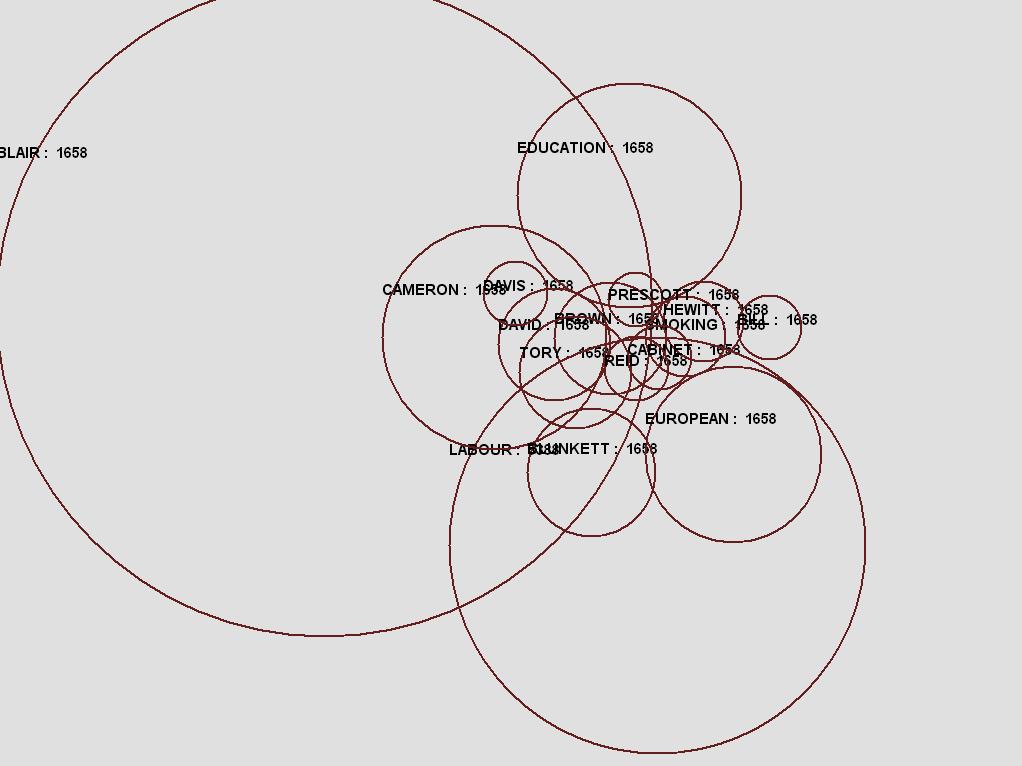
What I will show is a graphical representation of conversations (above).

As graphics go its no great shakes but its significance is huge.

What it represents is evidence that we can see what is driving the news agenda. The findings reveal that we can see concepts that change and morph in near real time.

The research shows that we can also add a predictive element too and so if there is a variance we can build in an alert mechanism that shows that the news agenda is changing abnormally.

It is an approach anyone can use to find out lots of things such as: What values are driving product/issue/brand acceptance.

It has a range of practical applications: What (and who) are the 'conversation drivers' so we know not only who is contributing to the news agenda but what are values and conversation triggers. The research shows how we can find evidence of how well are our messages are reflected in the media (it works for blogs just as well as news posts) and what is driving competition and the views (in the case of blogs) of consumers.

This is not about messages put out by organisations, these are the concepts that are being driven by people (news rooms, blogs, Usenet, email etc).

With such intelligence, practitioners can then look at how they can engage in conversations to create, build and develop relationships for our clients.

One has to remember that these are laboratory findings. This is not a ready made solution but in just a few months we can envisage a range of commercial products being made available for general use and practice.


Friday, February 24, 2006

Cultural Economy


  • We have moved from a hunter gatherer economy (about 60,000 years of it)
  • We have moved from an agrarian economy (about 6000 years of it)
  • We have moved from an industrial economy (about 200 years of it)
  • We have moved from an information economy (about 40 years of it)
  • We are in the networked economy (for about 7 years)
  • We are now moving towards a cultural economy.

This is not to say that all the old economies have gone away, They have not. What is important is that, as each economic era is superseded the new entrant offers increased wealth for the participants. It may seem that the horrid conditions of industrial workers in the 1850's was retrograde but, by the standards of the time, there were benefits for most people.

The newest of our economy's is at an early stage but is quite evident. Under the old regime of the information economy people were empowered to select a range of places and means by which they could achieve self actualisation. This meant that they could choose to but products in the high street or on-line. They could disintermendiate the supply chain. The retail part of the chain could be avoided. Enter Dell and Amazon. Customer experience became all the rage.

In the networked economy, people were able to find out much more about the things they believed would lead to self actailisation. They could ask questions and observe comments of people on-line to help seek alternatives and make decisions. They were able to choose between products and services pick 'n mix.

For example, they could choose to by a 'package holiday', a manufactured product, or could choose to buy or select elements that could make up a holiday and so they performed the role of the package holiday 'manufacturer'. What is important here is that the 'manufacturer may or may not be a 'co-producer' because it is the person who decides what, where, when and the price of the components.

Now we are seeing the cultural economy emerge. This economy drives the producer. It is where people are well informed and can contribute to knowledge and can make linkages between ideas and information.

Here we see people 'telling' producers what to make. In the UK there is a big row over cancer drugs.

In this case they are not licensed but consumers are insisting through the courts that they should be made available. What these people are doing is changing the marketing policies and plans of organisations. To succeed, these consumers deploy whole cultures including knowledge about product development, production, marketing, distribution, public opinion, the legal system and political structures to make products available.

As the key elements of the Internet make organisations more transparent and porous, the impact is cultural and organisations have to respond to cultural drivers to find the competitive edge,


Connected

With Elizabeth Albryght at the New Communications Forum, I will be examining strategies and tactics we need to focus on building, extending and nurturing the entire universe of connections (people) possible for an organization. But how do we do this? We will postulate that relationship management strategies will play a key role.

But first there are some givens.

The first is that the Internet is capable of reaching the majority of the population. By this I do not mean that everyone has to be connected. They do, however, need access and this can come in a variety of ways. However, we have to recognise that 70% of the population has some form of Internet connection and even more have a cell phone connection.

The second is that there are many forms of communication. Some are traditional and social, some are mediated and many are on-line of which a lot are un-mediated. In addition many of these media are conversational (e.g. Chat, SMS, IM, Usenet, Blogs, Wiki's).

Finally we have to recognise that not all communication can be monitored effectively but that there is enough that can be to give us some effective intelligence about what is going on in cyberspace.

We will also have to take into account that corporate users of the Internet are pretty poor at using interactive technologies.

With the exception of email and cell phones, the use of the Internet by senior management in most organisations is pretty well limited to searching using Google. Most corporate managers are too busy to do many of the things that 'ordinary folk' seem to have time for.

While some people surf for fun people turn to the Internet to maintain social networks.people’s communities are transforming:

The traditional human orientation to neighborhood - and village-based groups is moving towards communities that are oriented around geographically dispersed social networks.... People’s networks continue to have substantial numbers of relatives and neighbors — the traditional bases of community — as well as friends and workmates.”

For many practitioners there seems to be a fundamental disconnect between the interactive communities and corporate managers who are being discussed on-line and their organisations which makes the role of the New Communications practitioner hard.

I will post more on where all this is going over the next few days.

Picture: The Connected Project


China and the Internet

This week, I received my copies of 'On-line Public Relations' translated into Chinese this week.

It seems odd that this book should now have a market in China. When I wrote it, the Internet was much frowned upon across the Republic. Even now, issues like the limitations placed upon Google mean that much of the Internet is different for the Chinese than for other parts of the world.

But the Chinese now have to face the the advantages and disadvantages of the Internet.

The change in organisations caused by Internet Transparency, Porosity and Agency does not go away because the Internet is in China. The rules remain the same and the lecture one might offer here in the UK would be just as significant in China.

The idea of social communication among a population as big theirs is an interesting thought.

Picture: Wades Stuff

Tuesday, February 21, 2006

Global - Snowball


We have been seduced into believing that we live in a 'Global Economy'.

This is not true. We certainly have a capability to trade internationally but there is nothing new in that.

What has happened is the information economy, which emerged in the middle of the last century from the manufacturing economy of the previous 200 years, allowed companies and people to buy direct from suppliers. Examples of Amazon and Dell are often quoted.

Certainly, this digital rip tide capability was not bounded by geography and it washed away many regulations and rules put up as protectionist barriers by governments and companies.

But the basis for the exchange of ideas and good was bounded by cultures and use and application of technologies. These boundaries exist and remain and will not go away quickly.

Internet communities are created when conditions are optimised rather like a snowball. The culture (snow) has to be right, the momentum has to be right and the effort has to be made and, its quite easy for the snowball to fall apart and fom into althernative communities.

What this means is that we need to understand cultures and networks to be effective and to generate real shareholder return.

Marketing RIP

The theory of The Supply Chain is well established and are described thus: The entities of a supply chain typically consist of manufacturers, service providers, distributors, and retail outlets. Supply chain activities transform raw materials and components into a finished product (Wikipedia).

This worked well for the first two waves of economic change as we progressed through 8000 years from an agrarian economy, then for 200 years as an industrial economy and, from about the 1960's, to an information economy. From about 2000 we have been in a new, networked, economy.

The information economy caused the supply chain to begin to break down. The late professor Peter Doyle called this the disintermediation of supply chain which was observed at the turn of the century (also reported by Evans and Wurster in their book Blown to Bits) . This effectively allowed organisations and consumers to go direct to the manufacturer and circumvented the traditional distribution channels. In effect, we were able to go online and buy products direct. Examples of successes in this new form of economy include companies like Amazon and Dell.

The Networked economy is now disintermadiating manufacture.

We now see a model where the customer seeks a solution and the customer becomes the manufacturer. An example might be seen in the 'package' holiday. Once this was a product offered as a complete package but now is changed such that the customer will assemble the components of the holiday by going direct to the supplier for the flight, hotel, hire car, insurance etc. to create or 'manufacture' their own 'package'.

Another example of the networked economy is where the consumer takes control of management functions such as Marketing.

The competitive advantage is not found by creating a product, service or network that can be copied but in providing an organisation that can respond to customer's ability to create their own 'product', develop a market or to be involved in product evolution.

Analysis of the case of Herceptin, a drug for cancer sufferers indicates how this works. Heceptin may be sought as a palliative for which it is not proven to be efficacious but 'in the mind of the consumer' offers a solution to their need and so the consumer usurped the role of marketing.

In the case of Herceptin, a woman embarked on a legal battle to be prescribed this breast cancer drug free through the UK National Health Service.

Ms Rogers and her clinician believed Herceptin offered her the best chance of survival. There was said to be no evidence from any specialist in the field which did not support the use of this treatment for women who fit the eligibility criteria.

However, the drug was not licence for this particular treatment even though three-quarters of cancer doctors were allowed to proscribe the drug for early stage breast cancer.

This is a case where the consumer has taken control of the National Health Service' and Roche marketing and was demanding that it changes its marketing policy. The 'consumer' was acting as product managers and was driving the 'marketing plan' and, in this case, was using the courts to force her marketing plan upon the organisation.

The values that she ascribed to the drug were her values which were not the same values as the organisation.

In this case the value dissonance between the consumer and organisation are played out in a court but in other circumstances that are played out in the market or on the streets.

For example a musician may achieving stardom by approaching a market through free downloads of music to iPods and optimises the shareholder return from sell out gigs. This approach to market is culturally outside the common understanding of the traditional music industry to the extent than Emap announced that after 28 years, it was closing its one time iconic magazine Smash Hits, the pop music magazine. At a time when consumer magazines, and particularly celebrity magazines, was the best performing print genre, the dissonance is considerable.

The networked economy heralds the death of Marketing as networked consumers become the manufacturer and create their own markets.

Pictuure: Webclip Art


Wednesday, February 15, 2006

Blogs Jumped too

Issues become important when they 'jump' from one communication channel to another. Blogs have jumped in a big way and the traditional media is busy adding value to the blog brand. The growth of comment about Blogs in the traditional media has spiked. It has now hit 500 per day on Google News.

So the reason Blogs are important is that they are cheap says Business Week.

Max Kalehoff, vice-president of marketing at BuzzMetrics, says that companies want to gauge the seriousness of bad news says The Economist.

Blogs are there to to aid consumer choice says Toshiba. It has developed mobile phone technology that searches for product reviews on up to 100 web journals, or blogs, in 10 seconds. Just use the phone's digital camera to snap a photo of the barcode of a product you're thinking about buying.

Blogs are for TV buffs. Veoh software, installed on a PC or Mac, creates a virtual television network that allows video bloggers and independent producers, as well as film studios and TV networks, to distribute TV-quality, full-screen video to users with broadband connections.

At The Winter Olympics there are blogs dedicated to individual athletes, random comments from people hanging out in Turin and thousands of links to news stories and pictures. At this year's Games, the polished performances of seasoned commentators are in competition themselves - against the new media world of blogs.

Blogs are bad for kids (of course)

Blogs and wikis have moved past the flashy tech bling phase and are now settling in as core elements of the enterprise collaboration infrastructure.

"Companies increasingly recognize the business value wikis and blogs can generate and are looking for ways to bring these technologies into the enterprise," said Lou Latham, research analyst for Gartner, Inc. "However, there is high concern among organizations regarding how wikis and blogs can be securely managed and monitored to protect confidential or proprietary information and mitigate risk.” which is a problem for the Sarbanes-Oxley compliance watchers.

You can use a press release to get better blog ranking. But most journalists would not cover the story so this is yes another use for the good 'ol press release.

Hey 'Truckers News' has just got a blog.

One would have thought they would have created a podcast for all those drivers who don't want to surf 'n drive at the same time.


BuzzAgent a load of Dicks

This from Katie Paine According to Ad Age: "Turning WOM into a medium -- as opposed to just a marketing discipline or tactic -- could do wonders for its stature, allowing agencies to buy buzz alongside traditional media buys. There’s even a rate card forthcoming this week. ....BzzAgent campaigns work like this: Volunteer agents choose a campaign to work on and receive information about the product. After forming an opinion, the agents spread it to people they know and then produce a report on the activity. The reports are then analyzed for the client. Agents receive points in exchange for reports that they can redeem for rewards."


You would need to be a very special agent to make this work. This is pretty hard to do and keep up consistently. The power curve militates against artificial WOM.

There is also another element which is very well known. It works in the same way that advatorial does. People just don't believe plugs, spin, advertising and all the rest of the garbage you hear from the marketing and advertising industry based on OTS.

Circulation is not king, readership is.

And by that I mean engaged readers. Is an engaged reader going to believe a BuzzAgent? The person who is intruding and getting in the way of what 'I' want to find out. In the networked community, this is a receipt for market oblivion. Its really just another ploy from the advertising industry and WOM will find a way round it.

Remember what we did with 'pop-up' ads and all that jazz.....

Picture: Whirlygig TV


Gordon - Value Relationships

We love to think of economies in terms of 19th Century Industrial Models. It is just not on any more.


Tucked away in the ZDNet report on the re-valuation of the contribution of IT to the UK GDP is a comment from Roche. They believes that by underestimating the value of the software sector to the economy, the Government also underestimates the value of the "knowledge economy" as a whole.

Well, I agree but that takes me a step further to the value of relationship management. In the Relationship Value Model there is a contribution made by organisations to the economy when their relationship management investment pays of in enhanced relationships that generate added value through better understanding of values inherent in our culture.

It is a lesson that needs learning fast. British soldiers beating up kids diminishes the the value of our GDP because it reduces the value of our relationships. In other words it makes it harder to create wealth.

Underestimating the value contributed by, for example, Tesco is also a mistake and knowing the value of Tesco's relationship values would be helpful for Tesco and for policy makers such as the Chancellor of the Exchequer.

As we reduce the values that contribute to relationships we undermine reputation and that is very costly to restore.

Tuesday, February 14, 2006

Understand the Network

Its not all about ranking in blogs but it is all about networks. Some of it is driven by technology, and some of it is driven by other things like who we work with, who we party with and our family ties and contacts.

A lot of how we understand networks has to do with culture. It is here that the PR industry has a big problem and it has everything to do with how you like to get your eggs.

In the UK there is deference in our culture which also hangs over Europe. In this culture, institutions were always supposed to be the mouthpiece of the people (Governments, newspapers, councils, professional, trade and business associations).

In many instances, and not long ago, institutional communication was forced on us by governments like the Soviet dominated East Europe, Franco dominated Spain, the mad generals in Greece not forgetting the Press Barons and their Trades Unions in the UK. This has meant that networks tended to be muted, family affairs.

Many practitioners may not feel that they want to have networks that go beyond 'the family'. They are 'programmed' not to practice in the networked society.

It is an easy criticism to level at a particular type of practitioner. One would be of a certain age and probably not part of the on-line community but probably running a PR consultancy or in-house department (white, male, baby-boomer, technophobic, near innumerate, prepared to accept any old numbers as long as it can be called 'research' and will fool a hack and with a fine palette for claret). In the UK such practitioners tend to be Fellows of the Chartered Institute of Public Relations and would not know if they had Google ranking or not.

Such practitioners would understand the concept of social stratification but would have some difficulty with Network Society as conceived by Jan van Dijk and Manuel Castells.

Plagiarising from Wikipedia: “Van Dijk defines the network society as a society in which a combination of social and media networks shapes its prime mode of organization and most important structures at all levels (individual, organizational and societal). He compares this type of society to a mass society that is shaped by groups, organizations and communities ('masses') organized in physical co-presence (Soviet, Spanish or Greek until quite recently). According to Castells networks constitute the new social morphology of our societies.”

And how does this relate to how you get your eggs. Well its like this... UK consumers bought £8.2bn ($14.3bn) of goods from websites last year - up 28.9% on 2004 This is big news because shopers are now spending almost as much on goods through the internet as they do in shops. What this means is that building on-line relationships is now a commercial imperative and someone will get the job of persuading more people to but their eggs on line, an probably for the UK's largest food retailer.

Breaking into on-line communities effectively is pretty hard.

There is a particular type of PR practitioner that should not apply.


Beware Blog the Barbarians

A third of Europe's public relations practitioners are about to be pillaged, raped and cast aside. Blog the Barbarian is rampaging over their PR landscape.

Its not just The Economist who has noticed a New Breed of Brand Assassin. "The crowd has come on the field and is trying to get into the game.” says Richard Sambrook, editor from the BBC.

Who is the biggest distributor of content? It is the consumer, who does not expect to be paid for this service but wants free in kind services.” Tom Glocer, CEO, Reuters.

Their media people were not reading the media that matters — media written by their very own customers. This page is already No. 5 in Google under Dell sucks. I gave them time. They failed.

The power law is dominant because of a quirk of human behavior: When we are asked to decide among a dizzying array of options, we do not act like dispassionate decision-makers, weighing each option on its own merits. Movie producers pick stars who have already been employed by other producers. Investors give money to entrepreneurs who are already loaded with cash. Popularity breeds popularity. First-movers get a crucial leg up in this kind of power-law system. This is certainly true of the blogosphere.

Not being in early in the conversational media means three in ten PR people will always have to struggle.

The Blog Barbarians are here.

 
Picture: David Garcia "Waiting for the Barbarians"


Interfering with Culture

Public Relations is the business of interfering with culture. I say this simply by examining the standard definition of 'Culture' in the light of areas of Public Relations Practice that are supported by the Public Relations institutions; the scope of Public Relations practice that has been found to be practices and evidence for more recent (if less comprehensive) research and studies.

The standard definition I have adopted for this essay is that given by Sir Edward B. Tylor in his book, Primitive Culture, published in 1871.

Tylor said that culture is

"that complex whole which includes knowledge, belief, art, law, morals, custom, and any other capabilities and habits acquired by man as a member of society."

I have simply taken each of the elements identified by Tylor and examined them in such a way that their meaning is realistically comprehensive (mostly using Wikipedia) and then have identified how Public Relations affects each culture element as part of common practice.

From this analysis, it is fair to say that the business of public relations is to change culture.

Cultural Elements

PR practice

Comment

Complex whole

PR planning and management representing holistic and reductionist viewpoints.

Holism as a principle says that the properties of a system cannot be determined or explained by the sum of its components alone.


Reductionism in philosophy describes a number of related, theories that hold roughly that the nature of complex things can always be reduced to (be explained by) simpler or more fundamental things (genes are an example).

The breadth of practice and skills brought together through a known and explicit form of management (see Gregory 2001) to encompass every form of social organisation as it reaches into society.

Knowledge

Knowledge is information of which someone is aware. Knowledge is also used to mean the confident understanding of a subject, potentially with the ability to use it for a specific purpose.

PR has a role to create the means by which channels for communication can be used for explaining information in such a way that it can be understood by third parties as knowledge

Belief

Beliefs can be presented as perception, through reasoning, offered for contemplation and communication. In the psychological sense, belief is represented as a mental state that takes the form of a propositional attitude.

In the religious sense, "belief" refers to a part of a wider spiritual or moral foundation, generally called faith; historically generated by a group's need to provide a functionally valid foundation to sustain them.


Public Relations is a practice that makes explicit the combined values of tangible and intangible assets to publics. An example of this practice in found when practitioners are involved in creating statements of purpose, vision, mission etc.

Art

Art can be described as Liberal arts, of grammar, rhetoric, logic, arithmetic, geometry, music, and astronomy. History, Linguistics, Literature, Philosophy,

Public Relations practice uses the arts and also has significance influence over the arts. From the events organised by public relations practitioners in aid of the arts to the use of art in communication and presenting the case of its clients.


There is also an element of imagination and ideas development used in the practice of Public Relations (often called creativity) .

Law

Law in politics and jurisprudence, is a set of rules or norms of conduct which mandate, proscribe or permit specified relationships among people and organizations, intended to provide methods for ensuring the impartial treatment of such people, and provide punishments of/for those who do not follow the established rules of conduct.

Not only is Public Relations subject to the law, it is involved in the law in many ways.


In its creation it has a lobby role; in Explaining the law to citizens its is involved in explaining the law; in its presentation and advocacy on behalf of its clients it has a role in prosecution and defence of ideas, concepts, people, organisations, brands and products.


Many practitioners are involved in a practice that aims to bring people outside the law to justice of to bring them within the law.


Morals

The understanding of normative ethics is important for Public Relations.

Consequentialism argues that the morality of an action is contingent on the action's outcome or result. Some consequentialist theories include: Utilitarianism, which holds that an action is right if it leads to the most pleasure (and least pain) for the greatest number of people. Egoism, the belief that the moral person is the self-interested person.

Deontology, on the other hand, ignores the outcome of an action and instead requires acts to be taken that are in accordance with an individual's duty. Examples of deontology include: Kant's Categorical Imperative, which roots morality in humanity's rational capacity and creates certain inviolable moral laws. The Contractarianism of John Rawls holds that the moral acts are those that we would all agree to if we were unbiased.

Philosophers such as John Locke who believe that humans have absolute rights are also considered deontologists. Aristotle and others argue for virtue ethics which focuses on the inherent character of a person, as opposed to the specific actions they may take.


The understanding of normative ethics is present in everyday public relations practice and is practiced as part of advising the client on moral approaches to issues.


Public Relations practice often has to take a moral stance or has to explain the moral stance of its clients.


In addition, Public Relations has to observe the moral mores of its publics in the execution of PR programmes.

Custom

Which may include the elements of ethics but is also significant in law . Custom, or customary law consists of established patterns of behaviour that can be objectively verified within a particular social setting. Generally, customary law exists where

* a certain legal practice is observed; and

* the relevant actors consider it to be law (opinio iuris).

In sociology, a norm, or social norm, is a rule that is socially enforced. Social sanctioning is what distinguishes norms from other cultural products or social constructions such as meaning and values.

One of the principles of Public Relations is the practice of representing the viewpoint of external publics to internal publics and vice versa. In doing to it has to both understand and explain the norms and customs of publics.


In addition, Public Relations is often tasked to change customs and norms. For example, a healthcare campaign my be aimed at reducing obesity or smoking.

Capabilities acquired by mankind

There are many ways of examining Capabilities. Capability In a dictionary sense is the quality of being capable physically or intellectually or legally; OR the susceptibility of something to a particular treatment; "the capability of a metal to be fused"; OR an aptitude that may be developed.


One Capability Approach is a philosophical framework pioneered by economist Amartya Sen for evaluating social states that focuses on human capability (positive freedoms to achieve the various 'doings' and 'beings' people value) instead of utility (happiness, desire-fulfilment) or command over resources (income, commodities, assets).


In Public Relations, the practice is involved in explaining capabilities of the client. It also has a role in creating understanding among publics so that they can acquire capabilities.


This can be a corporate client or an individual (e.g. Celebrity). In addition, Public Relations is involved in using capabilities both as the agent and in employing agents with capabilities.

Habits acquired by mankind

Habituation is an example of non-associative learning in which there is a progressive diminution of behavioral response probability with repetition of a stimulus. It is another form of integration. An animal first responds to a sensory stimulus, but if it is neither rewarding nor harmful the animal learns to suppress its response through repeated encounters. Not all habituation is conscious like this - for example, a short amount of time after dressing, the stimulus the weight of clothes creates is 'ignored' by the nervous system and we become unaware of it.

Public Relations practice depends on habituation for much of its activity. For example, it depends on people's habit of reading newspapers to execute media relations programmes. However, another part of Public Relations practice is involved in changing the habits of peoples by, for example, offering the context in which a habit may be changed or discarded.

Membership of Society

The social sciences generally use the term society to mean a group of people that form a semi-closed social system, in which most interactions are with other individuals belonging to the group. More abstractly, a society is defined as a network of relationships between social entities

Public Relations practice is predicated on creating groups of people or relationships that support a view, product, brand, vision or mission.


One may want to examine this idea further to see how Public Relations can influence culture or perhaps see how the generality of practice is applied in changing culture.

Picture: Edward B Tylor


Monday, February 06, 2006

Cultures at war

Some time ago, I posted a comment about how one might identify cultures. Since then the issue of the Danish Cartoons has brought the whole issue of culture to the fore.

A review of the issue so far is dealt with quite well by the BBC in a Q&A and I don't want to debate the issue. I want to look at how we, and by that I mean the Public Relations profession, can begin to bring our skills to bear on resolving the issues we face in dealing with relationship management across cultures.

Of course it would be easier to take this argument forward if the academic journals where able to publish peer reviewed papers in under a year so that research could move on. In the, so far, unpublished paper 'Towards Relationship Management' (which I gave to the Alan Rawel Conference last May and which will probably not be published 15 months later), I put forward the initial arguments needed to begin to develop strategic responses.

This paper identifies an approach to understanding organisations as the 'nexus of relationships' (and deals with the arguments of Coarse, Sonsino and others).

Assuming that everyone is now up to date on this issue, and I have covered it in this blog here, here and here as well, we can begin to use the Relationship Management Model.

This model talks of networks in which the communications channels facilitate the the exchange of tokens and values that allow people to draw together as organisations. I will demonstrate how this is done at the New Communications Forum on 3rd March.

In the year since I first put this theory together, I have been examining the nature of such networks and the work of academics who try to understand the nature of culture. The raw definition was provided by Edward Burnett Tylor in his book Primitive Culture and I have adapted it as you will see in the blue box at the top of this page and there is more about the nature of society and culture on the Middlesex University site. I am now reasonably happy to replace the word network in my theory with 'Culture'.

Thus we see the role of Public Relations in its Relationship Management role as a practice that changes cultures.

I gave a taste of what I mean by this here.

We live in a culture and our own part of this culture can be considered a sub culture. Within that sub culture we have from time to time a different take on what it means to us as we move from social frame to social frame.

The role of public relations is to identify both common values and dissonance and through building on the one and exploring the other, we bring convergence and a wider public to mutual understanding.

To put the current row over the Danish cartoons into a broad relationship context we see a reaction which is seen to be expressing a growing European hostility towards and fear of Muslims. Some Muslims, mainly in Europe, have supported the re-publication of the images so that individual Muslims can make their own minds up and welcomed the debate on the issues that that cartoons have raised. It has also been pointed out that cartoons in the Arab and Islamic press "demonising" Jews and Israelis are common. In many European countries there is a strong sense of secular values being under fire from conservative Islamic traditions among immigrant communities. Many commentators see the cartoons as a response to this.

As can be seen there are many cultures at work here. From a perspective of the culture that seeks to bring mankind together, there is a need to identify the stakeholders and to discover the range of commonly held beliefs and values and those that provoke dissonance between stakeholders.

With that knowledge, the role of Public Relations is to develop the means by which objectives can be evolved, strategies developed and tactics deployed for the use in relevant channels of communication.

The role and capability of public relations as a practice of Relationship Management in bringing mankind together in this difficult time has to be exploited for the good of all.

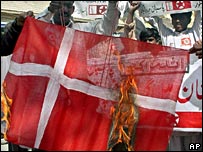
Picture: Danish Flag from the BBC report


Sunday, February 05, 2006

Stakeholder mapping

One of the most difficult things to do in public relations is to map the relative significance of different stakeholder groups (why I am using the term stakeholder is explained here).

You can see an example of what stakeholder maps look like here.

Since 1994, and in addition to worrying about relationship management in general, Dr Jon White and I have been puzzling this question and for a number of years we have been using a technique called 'visualisation' (there a quick primer about Visualisation at Wikipedia including Knowledge Visualisation, and Information Visualisation ).

It springs from an approach we call the Clarity Concept and I have recently started a Wiki to get some of the mass of research relevant to this approach in one place.

Visualisation allows groups of people to develop visual representations of the relative significance of different stakeholders. The latest version of software to aid this process was developed by Renderspace, part of the Pristop PR group, is called 'Publigram'.

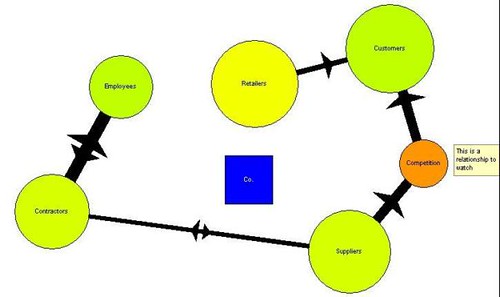
An example of Publigram in action gives you an idea of this kind of Stakeholder Map.

The icons, in this instance, showing the relative importance, influence and attitude of stakeholders as described by a stakeholder group. The use of stakeholder groups is, in this instance effective because of the use of visualisation and draws on both explicit and tacit group knowledge.

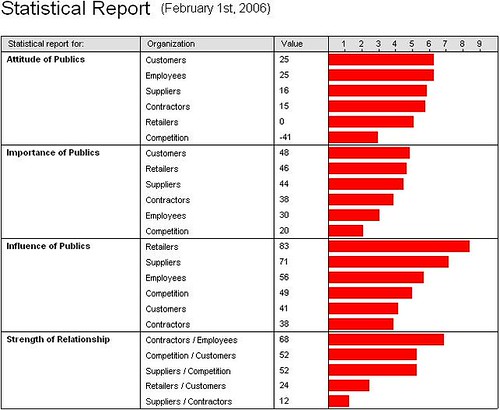
Stakeholder maps have been in use for years. They can be developed using a whiteboard and sticky labels. One of the advantages of using software is that all the features of the whiteboard approach can be incorporated and, in addition, we can use the visual model to provide statistical representation of decisions made by the focus groups (see below). With a statistical view of the present and future ambitions of the organisation, one can use gap analysis to identify where most change is required among stakeholders which offers and aid to planning and (later) evaluation.

An example of the statistical output from the Publigram software is shown here:


There is more information on our Wikis http://theclarityconcept.pbwiki.com and http://publigram.pbwiki.com

Get a free wiki at PBwiki.com here

Friday, February 03, 2006

New Communications Forum

I will be deserting England's land of the Moonrakers and Stonehenge, I will be in Palo Alto on 1st to 3rd of March at the New Communications Forum which is a great excitement. It is a privilege to share a platform with with Elizabeth Albrycht, Research Chair at the Society for New Communications Research. I admire her work and her science.

We will be talking Rocket Science. I make no apology!

Rocket science produced some of thegreat spectacles of the 20th century. It brought the firstsatellite with its iconic beep, beep beep, Uri Gagarin, the firstmen on the moon, the Hubbletelescope, the US/RussianSpace station, satellitetelevision and even inspired Google Earth.

The rocket science I am talking about is no less significant.

Elizabeth's research and some of my findings are based on some pretty profound work. It builds on aresource drawn from many disciplines including psychology, the social sciences, economics, communications and management theory. It is supported by empirical evidence and a growing number of people round the world from many

disciplines who are working in the same or closely allied fields.

This science is the science behind relationship management. It has evolved as we observed the digitally networked community emerging.

It emerged as we observed huge, often global, communities come together, work together, morph and changed.Some have massive influence in areas like politics, corporate survival and profitability. We saw the Internet influence events in Seattle, creation of global enterprises like Google and effects on cultures and especially, at present, how we regard religious faiths.

This means that all of our strategies and tactics need to be focused on building, extending
and nurturing the entire universe of connections possible for an organization. But how do we do this? Relationship management strategies will play a key role. As Richard Edelman put it this week we have to be an 'integral part of client communities within and outside of the company. We need to bring relationships from (the) broad stakeholder world.'

This is powerful stuff - it affectsour daily lives and it is about culture, power, values and wealth.

It can create. It can destroy. Some of us will be involved in the research, some will be involved at a technical level, some will but observe but it will change the framework against which communicatorswork.

I commend you see and hear Elizabeth's contribution. She will herald this new science. It is about our world and will be the one of the important signposts about the profound change we are witnessing.