Wednesday, September 28, 2005

Of multi media context relevant messages

One of the early issues that faced us in the early days of mass use of the web was the extent to which it could be used by people.

The critical element was not about haves and have nots (that is resolved by the influence of the Internet on society both directly and indirectly – i.e. Third party influence such as a doctor keeping professionally up to date to better serve both haves and have nots). The key issue was the time available to use the Internet.

In recent years it has been quite obvious that people use many communications channels at the same time. This was raised as a news item by Trevor Cook when he reported on a story on the Revolution web site describing how people use many media concurrently.

I raised the subject in a post about the media and the phenomena of multi touch in our society.

This is but one more element that needs to be included in PR strategies and tactics. What is apparent is that to gain attention, embed messages and to be memorable the practice of public relations has to work to offer many cognitive devices using a range of social networks and channels for communication and content suited to a range of contexts.

The mono culture typical in many approaches to marketing communications (giving rise to expressions such as 'being on message') is inadequate and often counter productive. People mistrust the robot response of 'on message' politicians. Meanwhile we now know that relying on 'core messages' has dubious effect if it does not produce synaptic modulation.

The significance of PR's multiple domains is that these skills can be applied in tandem to reach publics in a way no other management discipline can.

Television may be the 800lb gorilla but it is only effective in the broader context of its jungle habitat and less massive, but, from the consumer's viewpoint, cute siblings.


Picture from Jersey Zoo and Durrell Wildlife Conservation Trust, with information about the life and books of the naturalist Gerald Durrell.

Sunday, September 25, 2005

Stakeholder Theory is Flawed

Tell me about your stakeholders. Who are they? Who says?
Well, governments, accountant and economists and even misguided public relations people. That's who. But stakeholder theory is, as currently envisioned, flawed.
Organisation are a coalition of multiple relationships. These relationships coalesce into what people recognise as organisations. Such organisations are given rights and privileges by governments and so are, lets pretend, a single entity.
Of course this is a nonsense. Organisations, as we are told to understand them are dependent on both internal and external relationship. They are a nexus of relationships. Organisations are not hard bounded. They are coalitions.
If you were to say, one of my stakeholder groups are my customer, I would challenge your view by asking 'how many types of customer do you have?
Regular, occasional, prospective, past, engaged of just gratification or impulse consumers. I would go further. When, I would ask, are these people customers, where are these people when they are customers, what do they know, or want to know about your organisation, brand, product, benefits and advantages of being a customer? How interactive are they as customers? What is the social framemarket segmentation. This is about society. that describes your customer? And so my questions could continue. Very soon, you will find that you have a coalition of people who, at some time might be described as customers. This goes a whole lot further than merely 'having a stake'. It asks much more of what we mean by 'a stake' and what we mean by an organisation.
Equally lets look at shareholders. Are they a stakeholder group? Are they current of past stockholders, do they remember they own your shares. Are they dependent of the return or changing stock value or not? Are they engaged with your organisation or are your shares just part of a wide portfolio.
So we find that shareholders are not just one kind of investor. The Relationship Value Model exposes this quite clearly. They are a coalition of people who, at some time might be a shareholder with an interest in the organisation. What kind of social frame describes your shareholders.
Like companies 'stakeholders' are not a hard bounded group but are a coalition and, in their own way at their own time in specific environs and applying specific knowledge and interactivity, form a nexus of relationships that the stakeholder theorists would describe as stakeholders.
They look like cattle, moo like cattle and therefore are cattle. But just like the farmer, you might like to recognise them for their individuality. Daisy is different to Gerty.
These people are distinguished by the social space they inhabit from time to time and that changes everything in accounting and public relations.
It is the foundation from which one can 'landscape' the interactions that form your organisation to include both the hard bounded legal organisations and the wider, wealth sustaining and wealth creating entity. This is the nexus of relationships to value for both the opportunities and threats that are inherent in organisations.
Having good relationships with this nexus can mean the difference between value creation and its destruction.
Time for PR practice re-think.
Imagine that you wanted to help a consumer product like shampoo.
Think of the social frames that are involved.
There is the time when the TV advert comes on when the consumer is at home flicking through a magazine. There is the time when the consumer reads about the companies that sell shampoo. There are the places where the shampoo is on display in shops. There are the places people actually use shampoo. There is the environment where shampoo can be purchased and so the list goes on. Each will describe an environment or network; a time; available knowledge and the knowledge that the consumer want to use (attention) and gradually the social frames are created each one offering a communication opportunity to help memories bring about convergence between the product or brand and the person's perceptions, needs, desires and actions.
This is not a stakeholder, it is more than market segmentation it describes the opportunity to create, sustain a body of shared values and lever wealth from relationships.

What is PR

Eavesdropping on umpteen universities teaching public relations to fresh faced students in their first semester, one might hear a lecture or tutorial asking the attentive freshmen, “what is public relations?”

There will be the usual view of PR taken from 'Sex and the City', the keener members of class will have a view of about generating plenty of 'good ink', providing the strategic public relations approach needed to 'connect your business with prospects, customers and other key audiences'. There will be more like that. But parties and 'good ink' aside, there is anothet view that students will come to learn about. Typically they will be of the nature of the following statements.

  • Public relations practice is the planned and sustained effort to establish and maintain good will and mutual understanding between an organisation and its publics (CIPR)

  • Public relations practice is the process of organised two-way communication between an organisation and its audiences, its objective is to build a level of mutual understanding and respect which allows the organisations goals to be more readily met (CIPR)

  • …is an instrument of management by means of which all consciously used forms of internal and external communication are harmonised as effectively and efficiently as possible, so as to create a favourable basis for relationships in the groups upon which the company is dependent. (Van Riel 1995).

  • Public relations is the management, through communication, of perceptions and strategic relationships between an organisation and its internal and external stakeholders, for mutual benefit and a greater social order.' (Valin 2004)

  • Public Relations is defined as: “influencing behaviour to achieve objectives through the effective management of relationships and communications” (CIPR/DTI 2003)

  • Public relations is ".. what it says on the tin" "It is about organisations building relationships with its publics... to build positive relationships in both directions" (Gregory 2005)

This seems to be very confusing and is made even less helpful when mixed with the concept that there are many types of PR practice which were identified in 2005 (Phillips 2005) and many description in the literature such as the 472 types identified by Rex Harlow.

This all seems so much more complicated than Sex and the City parties and 'good ink'.

The concept that the many domains and practices of Public relations are different is deceiving.

There is an overriding principle behind the practice. It is that the various domains and types of practice seek to change relationships and to create a better relationship.

The distinction between changing relationships and making relationships better is important and has ethical implication's. The processes and skills of public relations can apply for good and ill. This question of ethics will come to the fore in a later post.

There is another principle that is noticeable which is that this is a planned and managed process.

The significance of the process being planned and managed is important. This profession is based on a managed process with know outcomes. Others can try and through good luck and serendipity appear to do well but, in the long term, the structured approach wins every time.

So what are these processes and skills? What is the PR 'magic bullet'?

There are two components to this.

The first is that the practice of public relations is about relationships.

The second is that there is some form of value in having 'better relationships'. A poor relationship seems to be of less, even negative, value and a good relationship would appear to be valuable. So, public relations is about value.

But what is meant by 'relationships? What is meant by relationships?

Indeed, as we see so many references about relations between organisations and their publics or constituency (sometimes misleadingly called stakeholders), what do we mean by organisation?

The Relationship Value Model is beginning to answer such questions.

  • Van Riel CBM (1995) Principles of Corporate Communication, Prentice Hall

  • Valin, J. (2004) Overview of Public relations around the world and principles of modern practice Remarks by Jean Valin, APR, (2004) Fellow CPRS Chair of the Global Alliance At a the CONFERP conference Brasilia, October http://www.globalpr.org

  • Chartered Institute of Public Relation and the UK Department of Trade and industry “Unlocking the Potential of Public Relations: Developing Good Practice” (2003)

  • Gregory, A. (2005) The Message BBC 14th January 2005

  • Phillips, D. (2005) Domians of Practice

  • Harlow in Wlicox, D.L.,Cameron,G.T., Ault, P.R.,Agee, W.K.2003 Public Relations Strategies and Tactics 7 th Edition Allyn and Bacon

Picture (Domian field) http://www.artandmind.org/wamfestival/Pages

Wednesday, September 21, 2005

ROI = Return On Inconsequential

In a series of short essays, I intend to examine the ways we can begin to use measurements for use in the Relationship Value Model.

This first essay sets out to look at the macro issues of measurement.

What is the value of culture, the great religions, democracy, countries? Is it greater now than ten years ago? Is their value going to change more or less for the next generation compared to the last generation? Will the value be greater or less?

What about asking the same question of peace, prosperity, democracy, liberty and social cohesion?

Now we have got that out of the way and without regard to the share price of MacDonald's, is the company more valuable today than it was ten years ago? Is its value in the long term going to increase? Will its value increase as much in the future as it did in the past.

These may seem intangible and subjective measures but are none the less, great questions of our time for many people.

These assessments are all conditioned by what we understand by the words culture, religion, democracy, country, peace and even MacDonald's. Well lets get granular. What is the value of the MacDonald's brand, products, marketing, CSR programmes, customer?

These are all tokens and we understand what these tokens mean only from the values that we associate with them.

What is more, we cannot make judgements about the value of MacDonald's without a view of prosperity or countries or even religions and democracy.

Our (society's) understanding of these tokens and the values is shaped by many things but through one process. We only understand these values through relationships. Unless we can interact with other information, views and information, and that means people, we cannot gain the insights we need.

It follows that to be able to measure and evaluate, we need to be able to understand relationships.

We need to be able to identify the extent, depth and breadth of the relationships we have in order that we can begin to measure the values of such things as cultures and organisations.

To make this assessment harder, people have different understanding of these tokens and values at different times, in different places and when they have relevant interactions.

What is the value of culture to a person white water rafting? Are they really going to worry about getting a burger or a CSR programme as they flash through the roaring and pounding white waters?

Thus one may idly ask the return on investment on plant, machinery, intellectual properties, processes, communication, brand promotion, stakeholder relations and other isms of accounting in the spume of water and crash of the boat. It would be an idle pastime too.

In trying to measure what relationships exist, we have to begin with the Social Frame of the moment. The time, place, available (and usable) knowledge, and interactive capability are all important when identifying relationships.

Thursday, September 15, 2005

Government PR

It is the role of government to protect the wealth of its people. This is but temporary unless governments can enhance or act to enhance wealth. This is the process that, using the Relationship Value Model, brings about democratisation. It is also the process needed for stable government.

Civilisation has the advantage of passing on wealth in the nature of knowledge from one generation to another. The acquisition of knowledge through its exchange between people is thus of the current generation and their ancestors. But there is a knowledge process in which two pieces of knowledge create a third understanding and thereby new knowledge or new wealth.

People cannot create wealth without knowledge because we are dependent on the accumulation of learning for survival from birth. Without it, babies die. We can only effectively learn through relationships.

But learning is not enough in the process of creating wealth. We are able to use creative capabilities to enhance knowledge. In other words to add value to knowledge or, more precisely, to add values to knowledge and the values we hold.

The distribution and re-distribution of knowledge is simple vendor/customer relations which is a re-distribution of wealth. There are function of government that re-distributes wealth. This approach to government is legitimate only when it is incurred as part of the wider process of government, namely to sustain (protect) and enhance the wealth of its people.

These tax and spend functions inevitably end up making the provider wealthy and the customer poor and thereby creating demand for even more wealth distribution.

Health provision is a classic case. The endless growth of health care expenditure distributed money from the health rich people to the health poor people. It does not necessarily make people healthy but does make them demand more.

The role of government is to both create an environment in which people can gain new wealth and, in its role as distributor of wealth, add value or create the means for added value in the process.

This means that its role is not just to be a provider of redistributed wealth (healthcare) it is to add value in the process. In the case of health care, it should provide both healthcare and the opportunity for the tax payer, government and the poorly to take out something else – added value. Three groups thereby all gaining some new knowledge or values.

The tokens used in government public relations have to offer values through networks and their channels for communication that are both conducive to convergence for the three groups (e.g. tax payer, tax collector, tax recipient) and offer the means for value added.

Regrettably, a large part of government communications is focused on getting the government's message across which is, as we all know, propaganda.

(The picture is from 'What it Means')

Wednesday, September 14, 2005

Perception is a PR tool

In my promised series of brief examinations of the application of cognitive psychology as applied to the practice of Public Relations, I have dealt with memory and attention. Now it is time to examine perception.

Cognitive psychologists say that we carry a model or personal image of the world, relationships and other concepts around with us. As the senses provide information we adjust this perception to arrive at cognitive consistency, (and resolve cognitive dissonance).

Cognitions are defined as being an attitude, emotion, belief or value, or even a mixture of these. I have covered emotion and value already and will return to attidue and belief at a later time.

From a PR perspective the role public relations plays is in identifying the tokens and values within networks that have sufficient resonance with a person's perceptions (when they use their senses e.g. read something or hear something etc.) such that they pay attention. The PR process then has to offer tokens and values in an appropriate social frame which adds the campaign 'messages' to the understanding or personal model of the recipients. When this is done in such a way that both the organisation and the recipients gain an added value or understanding, the PR campaign will have been effective. Both parties will have a new understanding and new values. On the one hand the organisation will have gained an empathetic understanding and relationship with the recipients (publics) values and the recipients will better undestand the organisation and messages.

In participating with people's endless modelling and re-modelling of their internal view of the world, public relations, in the Relationship Value Model, adds values of interest and significance .

PR helps people understand the world.

Sunday, September 11, 2005

The Value of Public Relations – Today's example


The significance of public relations in the creation, sustenance and management of wealth seems to be esoteric to many practitioners and not what they do. My assertion is that this is exactly what they do.

Perhaps we need to ponder the value of an icon (in the language of academia, a token) and see how values can change. I offer you George W Bush.

How valuable was GWB to Americans six months ago compared with today?

Can you see? GWB public relations has not added to his value or sustained his value and has not been well managed. This is not just about his reputation, that is the fall out from poor public relations management. Good PR management would have changed the way he handled this crisis because it was going to change his value (including the value of his reputation).

Now let us look at another icon. Lets try New Orleans. Events have robbed this great City of much of its value.

Lets quickly move on. Is there a means by which we can measure the public relations value of George W Bush and New Orleans. One way is by comparative analysis and the only way this can be don is from a perspective of the publics concerned.

From the perspective of the Washington political village, which currently is the most valuable of the two? Which offers the greatest opportunity for generating wealth. By asking the Washington political circles, it is relatively easy to identify the value of GWB v New Orleans.

In this way we can plan and react to crisis and issues.

Let us go back to September 1st 2005. On that day GWB has an issues, New Orleans had a crisis. The difference between the two is the difference between issues and crisis management. Crisis management threatens survival, issues are are the stuff of day to day management.

A value assessment on that day would have helped GWB manage his PR. In New Orleans the value assessment was of a different order and was changing by the minute. Nevertheless, for the mayor and Governor, such an assessment would have helped both handle the crisis more effectively.

Public relations is about managing wealth.

Saturday, September 10, 2005

Is "free" all it's cracked up to be?

Perhaps its a good time to explore this exchange on Seth Godin's blog. It is at the heart of my research model and it may provide some insights. The concept of value is very important and we are continually blinded about value because of its close association with money. Public Relations is about creating value and wealth and so is tied into economics.

Value is created when two actors (people) exchange tokens (explicit things) and values (implicit things) and create an added value for both parties (e.g. satisfaction v financial return). This value can be tangible or intangible. In fact there are very few really tangible assets. Money, for example, is just a token representing values.

If, as Acland Brierty tried, you want to 'give' something (a token) away, you have to supply it with a range of values that are of interest and that are motivating to the 'purchaser' such that they can rationalise how both actors in the transaction will come out of it with the added value.

One might look at a paradigm where the vendor says that they would like to make something free (for good value reasons) and there is a way that it can be done e.g. Click on any of the Google advertisements.

Perhaps one could be less blunt about it but you get the gist. One other thing is that Google adds have very little by way of emotional 'tug' which is very important in value transactions.

Friday, September 09, 2005

Managing Issues in the Blogsphere

I was interested in Trevor Cook's comment about managing the 'long tail' of blogs.

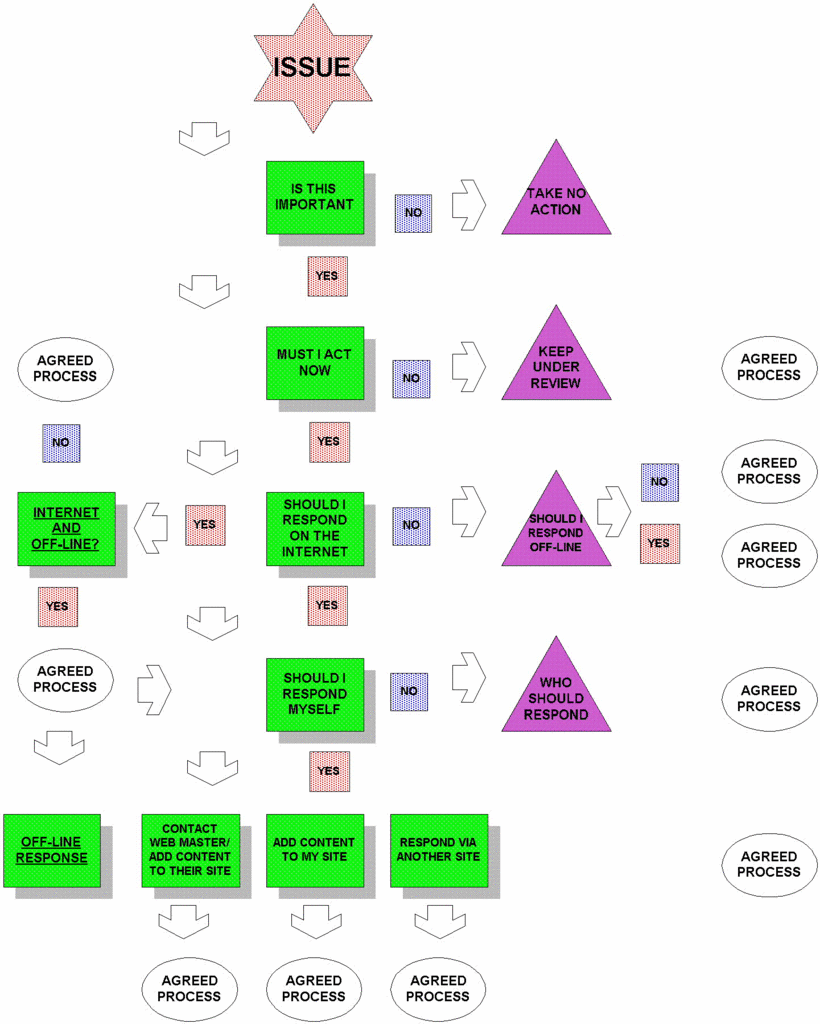
This image (below) is a process that was devised by Alison Clark and is in my book.
It is an approach for handling comments and issues that arise in on-line public relations. Of course, it is a process that integrates within the application of the Relationship Value Model.


It offers a methodology and PR discipline for handling the 'long tail' of commentary in the blogsphere.

The first thing to note is that there is a need for constant and thorough monitoring and maintenance of records even when no action is taken.

The processes for monitoring are noted in my post about Lisa Poulson's issue and this is how to treat citations once they have arrived.

This is not rocket science. Its very simple, long established and basic PR.

Thursday, September 08, 2005

Do 1300 PR practitioners face unlimited fines?

If man were not a social animal he would not be as economically successful as he has been. A biological perspective can prove highly illuminating. (John Kaye Financial Times 15 March 2000).

This statement by on of the leading economists of our time should have started bells ringing all round the PR industry half a decade ago.

Public relations, a practice claiming to affect publics (marcoms, internal PR etc.), a conscience between the organisation and its publics (CSR, Community PR etc.) an arbiter between the organisation and its sponsors (financial PR, Lobbying etc.), is about working with the social animal - mankind.

If John Kaye is right, and I believe he is, the logic of his statement is that the role of public relations is to work with and through society to make people economically successful.

This means we need to be successful in creating, sustaining and optimising value. This is as true of efforts to make companies big and profitable, protect the environment or bring relief to the dispossessed. Public relations is active in all these areas and many more. But let us concentrate on the PR role in the measurement, evaluation, auditing, value, management and development of tangible and intangible assets. It lies at the heart of our practice if we so choose.

Thus the PR practitioner can choose to be at the heart of wealth creation or can serve up hot dogs to its followers.

In November, Directors of companies (including, of course, PR directors) of all 1300 companies quoted on the London Stock Exchange will be told that they could be at risk of unlimited fines from new UK Government requirements to extend the scope of company reporting. The London Stock Exchange (LSE) is the global capital market of choice for over 500 international listed companies from over 60 countries. This means that being involved in financial reporting is an issue for PR especially those in in the corporate communications domain of public relations practice worldwide. The big issue is the, now mandatory, requirement for Annual Report 'Non Financial Reporting'. In 2003 I wrote a paper for XPRL to help explain why and how Non Financial Reporting is an issue for PR practitioners.

The UK law (which applies to all quoted companies on the LSE) now expects companies to report on relations with a range of named stakeholder and other 'users' of annual reports. Basically, the way the law is written, any social group with a copy of the Annual Report can be described as a 'user' and thereby a stakeholder for whom companies have to submit a report on its relationships.

As Stakeholder Theory, as it is presently regarded is flawed. This means that the whole process of implementing the law will be fraught with difficulty (not to mention silly, distracting and expensive legal wrangles).

However, there is another way. If PR practice regards its work as “influencing behaviour to achieve objectives through the effective management of relationships and communications and accepts that is is not just rhetoric but is grounded in theory, then we can resolve the issues that face the 1300 practitioners who have to bear responsibility for the impact of Non Financial Reporting.

For this reason, it is incumbent on the practice and among the practitioners of PR and their professional and consultancy associations to grasp the issues at stake.
(Picture - John Kaye)

Wednesday, September 07, 2005

Wither traditional media

There will always be a place for what we recognise as the print media. Its diversity in the form of newspapers, magazines and trade and technical publications will continue but over the next three to five years may morph somewhat to cope with information overload into lifestyle interest more than mass media. Dave Gray's comment yesterday warrants a closer look.

The driver is the emotional connection between the publication and reader rather than price or circulation reach. Research by Guy Consterdine over many years shows how close (symbiotic) the relationship is between print and reader.

There is also a lot of good research about how the range of media is used by consumers and confirms the view of Eric in his recent blog.

I have discussed the need for PR to work across many channels of communication in the networks available to publics in daily activities and during crisis.

The emotional tug and symbiotic significance (convergence) is evident in research over many years showing a much higher proportion of celebrity coverage and lifestyle and entertainment in all forms of newspapers over the last few years.

Broadcast media will go much the same way as digital advances come to the fore. The relationship between television, radio, computers, handhelds and integrated devices open up new combinations as Tim Porter demonstrates so well. This kind of development will be quite sudden and is exemplified by iPod, Blackberry Blogs and Wiki's, all are phenomenon only a couple of years in the making but with massive market penetration and, as Becky Quinlan shows news relevance.

This means that news, views and marketing promotion will need to evolve even more into multiple touch contact with consumers.

Muti-tasking is growing fast. The number of touchpoint for the Big Brother programme now combines a primary touch of TV, iTV, Web and SMS with secondary touch of newspapers, magazines, land and cellular telephony, email, discussion lists/Blogs and interpersonal communication.

The feature of this form of communication is that there are three types of consumer inter-reactions. These are: a primary touchpoint (TV); plus secondary (iTV, Web and SMS) and tertiary (newspapers, magazines, land and cellular telephony, email, discussion lists, Blogs, Wiki's events, posters and interpersonal communication). Any of these channels can be primary, secondary or tertiary and in any combination for different forms of communication. The most successful PR and marketing programmes will use this breadth of contact points and each offers a different experience. Jane Genova was right to extract this point from the Cathleen Black's interview.

Consumers are agnostic about where much of their information comes from. Sky television has a global, regional, national and local footprint as does the BBC and so too does content in magazines as diverse as Hello! Magazine and Logistics Europe. As long as the emotional touch is present, there is no boundary to where the news is derived or transmitted from. News, fashion, industry and commerce is global. Even local newspapers include content that comes from the four corners of the world. The .net is ubiquitous in these respects although regionalism is evolving fast.

The consumer features that stand out in this complex mix are time available to use the channels, information overload, accessibility to the range of media and content on the one hand and emotional connection and habit on the other. The generation that now accepts change as a matter of course favour the former influence in time of peace and prosperity but, as the Katrina and the Tsunami showed, in times of crisis, traditional influences are very strong, with TV coming out on top.

Tuesday, September 06, 2005

The future of PR- Flackers or saviours

Photo from the BBC reports of Katrina

Richard Edelman eloquently and movingly describes the digital divide in his blog of 2nd September. He said of the New Orleans disaster


There is no co-creation of the narrative as in London or during the tsunami, where the best content came from participants in the unfolding tragedy. Why? Because the tourists at Phuket were armed with digital video recording devices that could capture the oncoming wave and resulting devastation while the victims of the subway bombing who could snap photos on their cell phones.”

This is why, I believe that it is very important for PR practitioners to get to grips with the fundamentals of their professions.

We have to remember that, at its heart, PR is about changing value and creating wealth. To begin with, we have to learn to distinguish between the networks that are available to publics and the communications channels that are used by people in such networks.

In normal PR activity, this is very important but for crisis and issues management, such as the one we see before us in the USA and the emerging story of Typhoon Nabi, it is vital.

PR has to sharpen up its act (and work harder at developing the theory and practice) to be able to offer the ability to create, sustain and enhance value in the networks that are available. We have to be able to use the communications channels that are being used and we have to be able to communicate using tokens and values that are going to be bring empathetic understanding and deliver tangible value.

In New Orleans, some of the networks operated in the Superdome, some at local level and some were as small as family and care units.

4000 miles away, I could see some of the communications channels being used. They were desperate messages for help written on sheets and hung on the sides of buildings. People were waving from the flooded streets and so on. The electronic click of the mobile phone was not there, but has this wizardry blinded us to real communication? These were symbols that are important in our understanding of communication.

As PR practitioners we have to learn to recognised the breadth of networks and channels available. I try to do this when using the Social Frames because it identifies the environment, interactive capabilities and the knowledge and issues of moment and in play.

In addition, we have seen in this tragedy another facet of public relations. It is easy to us shorthand. We can use expressions like the 'people trapped' and 'victims' etc. But the truth is that this is not one homogeneous 'public' this is not a 'nexus of contracts' – the old paradigm of 19th century capitalism. This is the real network of society – the nexus of relationships. This is a lot of people in a range of circumstances and in a miscellany of relationships that are linked sometime tenuously and sometimes strongly with each other. I have tried to explain this in the theory of the Relationship Value Model but it is so eloquently exposed to our eyes along the Mississippi today.

There are some very serious lessons for PR practitioners to emerge from this event. We have the tools and educations to move from flackery to the political science and management capabilities of the practice of public relations and relationship management. In our maturing profession, we can begin to use our knowledge, skills and can deploy our domains of practice to create, sustain and enhance value. Was it more needed than for those who have lost so much and who need our capability to create wealth at this elemental level when the tokens in question are water, food, medicine and shelter?

Monday, September 05, 2005

Attention!

"Everyone knows what attention is. It is the taking possession by the mind in clear and vivid form, of one out of what seem several simultaneously possible objects or trains of thought...It implies withdrawal from some things in order to deal effectively with others." (William James).

In the practice of Public Relations, it is a critical element in the process of changing the value of relationships between organisations and their publics and I promised to cover more cognitive psychology as it affect the practice of PR.

Attention is a cognitive process. It is effective when a person is selectively concentrating on one thing while ignoring other things.

It is one of the most intensely studied topics within psychology and cognitive neuroscience. It is associated with the human mind (decision-making, memory, emotion, etc.), attention is considered the most concrete because it is tied so closely to perception. As such, it is a gateway to the rest of cognition.

In the Relationship Value Model, we seek attention by working in appropriate (i.e. publics inhabited - see also Social Frames) networks and use communications channels. This is where we can gain attention and awareness to prompt the senses using tokens (by their nature explicit). In this way, we can use a range of emotional triggers that do not need to rely on memory (implicit, tacit, metaphorical values). In PR we bring values into play to create cognitive convergence and thereby begin the process of creating perception and memories about our client/brand/product/issue. In this way we add value through relationships.

The PR process is unlike the advertising model in that we are seeking a symbiotic empathy with publics rather than hitting them over the head with an advertising mallet. George Chua commented on these moves in marketing last week. Indeed recent research by Robert Heath and Agnes Nairn suggest, that advertising (which is rapidly becomming another Domian of PR practice) is finding that this aproach is quite critical.


The significance of emotions on CSR, brand and stakeholder management.

Studying how the brain works is important for understanding how PR works. In reading Bruce G Charlton, we get a further insight into how and why PR, using the Relationship Value Model, PR is effective and where and how the extra dimension of emotional attraction comes into play.

We have, what is called a ‘somatic marker’ mechanism which forms the basis of human consciousness. The somatic marker mechanism is the way in which cognitive representations of the external world interact with cognitive representations of the internal world - where perceptions interact with emotions.

In other words how the world we 'see' interacts with the world as it is represented in our minds.

What is unusual about humans is that we are also aware of our bodies, our ‘selves’, and this inner-directed attention forms the root of consciousness. Consciousness is based upon an awareness of the ‘somatic’ milieu, and that awareness of inner states evolved because this enables us to use somatic states (ie. emotions) to ‘mark’, and thereby ‘evaluate’, external perceptual information. And this interaction of cognitive representations occurs in working memory.

The public relations process acts on the mind of publics by explicating the context in which the world we 'see' is recognisable (“marked”) so that the internal self can recognise, evaluate and relate to the PR objective. Or, to express it another way, in a network and using a range of channels for communication we present tokens and values ('markers') that are significant in the 'somatic milieu'.

Human consciousness and human language evolved and are adaptive specifically for social tasks. Our form of consciousness was ‘designed’ by natural selection for dealing with other people.

Strategic social intelligence is the ability to perform internal cognitive modelling of social relationships, in order to understand, predict and manipulate the behaviour of others - and is found only in animals with a large pre-frontal cerebral cortex (humans and other apes and primates, dolphins, elephants and some other social mammals).

Understanding these processes helps us understand emotions. Emotion is an aspect of a person's mental state of being, normally based in or tied to the person's internal (physical and self created model of the world) and external (social) sensory feeling. Emotions are recognised in the form of Love, hate, courage, fear, joy, sadness, pleasure and disgust.

If we experience an emotional state then our brains will record this body state in nerve cell activation patterns obtained from neural and hormonal feedback, and this information may then be used to adapt behaviour appropriately (sweaty palms, shortening of breath, dilated iris, stand, flee etc.).

When we 'see' something that our 'internal' view of the world finds strange, it has an emotional impact (sometimes strong, sometimes weak). For example, if we see the approach of an aggressive looking man (that is, a man that out internal model recognises as aggressive), this image provokes sympathetic nervous system activation which affects the internal environment of the body by its action on smooth muscles and hormonal levels. This change in body state corresponding to the emotion that we call fear leads to patterns of nerve cell activation in the brain.

Emotions are therefore cognitive representations of body states that are part of a homeostatic mechanism by which the internal milieu is monitored and controlled, and by which this internal milieu influences our behaviour.

In public relations we seek convergence between the tokens and values of the organisation and its publics. This is why PR is so effective in brand development and so called stakeholder management. We are able to provide the context in which the the tokens and values can be presented and in such a way that emotions can work to meet PR objectives.

If an organisation behaves without social responsibility and thereby shows tokens and values that provoke disgust, fear or sadness, then the response of publics will have an emotional element which is damaging. And as I have already shown, tokens affecting emotions are more powerful than any other.

We can see examples of 'emotion' tokens used among PR bloggers over Katrina.

Neville Hobson

Paul Chaney

Jane Genova

Picture of 'emotions' from the Science Museum.

Saturday, September 03, 2005

Why the world needs PR

In five week, I have championed public relations from my very granular view of the professions. I have so far put forward 14 reasons why it is such a profoundly important practice.

One realises that this is not always (or even frequently) the practice we see every day but across the many domains of practice, the whole points in one direction which is to change relationships between organisations and people.

Be assured, as we explore the Relationship Value Model, there will be more reasons to add to this list.


1 It is the core management discipline for any successful economy

2 PR adds 'value' in the minds of people and social groups

3 It is effective because it is highly developed using multiple touchpoints to stimulate corporate, brand, product and event awareness in the minds of target publics.

4 It is one of the oldest forms of advocacy and socio-economic development.

5 It is grounded in sociology and is a social construct.

6 People's brains are wired to be receptive to good public relations. Its part of their psychological make up.

7 PR has a process for managing relationships to change values which can be interpreted as being the nature and role of public relations management.

8 It is the premier management discipline.

9 PR works at the granular level of corporate (and organisational) value and on a plane that is more significant than current tangible and intangible accounting.

10 Public Relations is the very glue that makes brands and branding work.

11 We understand important things like culture and nationhood by understanding what PR is and does.

12 Public Relations is a broad Kirk, with many domains of practice and one aim which gives it great strength in depth.

13 Public Relations is capable of working in the old and new communications and social paradigm's.

14 From the Relationship Value Model we can learn to understand constituents with both good and evil intent.

Given the importance of our profession, we now need to accept even greater responsibility for it.

(The pic is 'Justify')

Friday, September 02, 2005

I See Friends Shaking Hands

Pondering the practicalities of my post yesterday, I succumbed to thoughts that should not be included in this blog. The question I asked was: “What are the practical applications of the Relationship Value Model for the devastated communities in America's Southern States.”

The theoretical answer is that there is a need to create networks and to open communications channels for people and organisations to expose their explicit needs, solutions and capabilities and the values they seek or can provide.

We need to start with networks. Such networks can be people on the ground, and organisations and institutions. Some institutions and organisations will be in vicinity and others can be remote. In PR planning terms let's just start with models such as Social Frames and a list of these networks.

We then need to identify which channels for communication are available and working among networks. The channels are face to face contact, television (and we know from studies done by Delahaye's research into the channels for communication in Tsunami disaster last Christmas that TV leads the media agenda), radio, newspapers, cell phones, sms services, email, telephones, web sites, blogs, Usenet, mail and lets not forget the messenger who travels on foot. As the channels progressively return to normal, they need to be used according to their reach.

A practical response right now is to identify the channels that are working (because many are not available) and the channels that can be made to work.

Next is to work on what explicit things we can make available to the networks through the channels and an explanation about what we mean. This is offering tokens and values to people in the networks in order that they can interact and respond in where the tokens and values are of their interest. In the first place this might mean a simple explanation of what is available to networks through the channels and how they can respond and progressively the needs will emerge and will change the way the networks and channels can interact.

It may be that such a process will help people find their loved ones, and outside help can be directed to where there is need.

The process should mature and into people, institutions public services and companies offering services, capability, products not to mention cultural revival from and to the affected areas as part of the economic recovery of the area.

Fortunately I am not GWB, but if I was, I would want to set up a number of Relationship Value Model operations not least to allow business people in the affected areas to offer their services to the more fortunate of us who are outside and who can adopt a policy of facilitating recovery and providing information to help in the process, for trade and business in the socially and economically disrupted region.

The better the networks and channels for communication, the faster and more effective the recovery will be. For this network, the blogging community, the practical actions can be simple such as a blog to allow people who have businesses in New Orleans and the surrounding area.

To come back on topic, I have tried in a small way to show how in practical terms the Relationship Value Model is applicable in restoring and creating value for the citizens we all feel for in the hard hit Southern States. The Model, in the words of my icon of The South, Sachmo.. “I see friends shaking hands.......They're really saying, I love you.”


Thanks for the pic Rato

Thursday, September 01, 2005

How do you measure value when it counts?

For a second, it is worth reflecting on what happens if people and organisations loose thier relationships.

Hurricane Katrina alerts us to just such hypotheses. In a few hours, US citizens and industry lost its relationships with hundreds of relatives, friends, customers, suppliers and workers.

The systems for managing the economies of Louisiana, Mississippi and other states devastated by flooding in the aftermath of Hurricane Katrina, were suddenly of no value and people and industry's knowledge of the region is now all wrong. Indeed all was lost - everything that they depend on for social interaction and regional trade ceased to exist. The nature of relationships has also changed. While many assets are in a parlous state, there is no hope of revival until a new set of relationships are created. What is so telling and is so relevant to the Relationship Value Model, is how in a network and across communications channels, the construction of relationships to cope with a disaster come to the fore. To see this at work, one only needs to see Josh Britton's work.

The human tragedy is at its most dire when relationships have been severed and the need for new networks with effective communications channels to be created to re-establish, create and sustain relationships. Needs (tokens) have to be identified and their value established to be appropriate to the many displaced and affected people and businesses. Without relationships the economic impact is huge as Barry Wood reports (picture)

We can already see from Jane Genova's blog that there is a need to maintain and sustain relationship. It is an immediate imperative is for a networks and channels and her analysis show what I mean.

Evidence of how networks and communications channels are used to create relationships are found across the net as Steve Rubel's blog shows.

Much less extreme examples are every day occurrences for some organisations. In

some instances the loss is not total but by degree but the stark reality of Katrina focuses our attention on the value of relationships and alerts us to the need to protect and manage them effectively. Today, the devastated area needs the relationship management skills of public relations to help re-build and bring a re-birth to the region. Relationship value really counts in to mitigate this tragedy.