Sunday, October 30, 2005

The opensource value relationship media moguls

My colleague at LeedsMet, Richard Baily has the knack of putting his finger right on the important trend with a practical example. He spotted that Audi is setting up its own TV channel. The idea is not new but both the technology and opportunities are of a different order to past examples.

The significance of this, as I pointed out over the weekend is that, among the channels for communication, the monoliths are and will have a rough time unless they seek a different value model.

The genie just won't go back in the bottle.

Now, you can have your own TV station for cost of a series of TV ads. Content is not so costly and the range of relationships offer big returns.

Multitouch is here and the savy relationship management managers will exploit it anyway they can. If this means own TV stations, own news media and working with others in a networked community, so be it.

We have already seen the CEO of BBDO has been quoted as saying mobile telephones and other devices will soon become more important for marketing than traditional television (FT 06/04/05)

The added collaboration increases the size and value of the company (more material relationships) and at the same time the opensource/collaborative process reduces financial costs.

In the process, we see added value accruing to both the organisation and the publics. Better reach and wider choice are obvious. This Audi experiment is a classic example of the Relationship Value Model in practice albeit a tentative step.

Here then is the real opportunity. It is the agency that aggregates the content, clients and relationships and in doing so becomes the opensource media mogul.

The only requirement is that the agency really understands the nature and significance of Relationship Value.

Picture:

A Day in the Life of Chemmy Alcott. Sharing the secrets of her fitness regime, British ski champion Chemmy Alcott drives through the Austrian Alps in her Audi A3 Sportback for a day of intense summer training. See the video here.

Flat Earth

The old hierarchical structure of organisations is again tested and this time by Forrester research. In the summary of Globally Distributed Development Defined, they identify exactly how porous the shell of organisations have become.

One thing they do point up is that the Relationship Value Model has not yet arrived in Forreserland.

They identify this problem:

The challenge of globally distributed development is more difficult than most companies believe. Application development (AD) organizations have run distributed projects for years — teams work at multiple locations, some developers telecommute, and the customers they serve often work at remote locations. But distributed development in 2005 means much more than this. Not only do AD staff work in multiple locations, but their teams also include third-party consultants and tool vendors' staff, spanning continents and cultures. Companies moving to a globally distributed development model must alter their processes, their tool sets, and their staffing models to address these different types of challenges.”

The same can be said for call centres, distributed manufacturing, all of supermarket food sourcing and almost every form of corporate business today.

This throws up an issue about how we define organisations and we have been down this route before. What this points up the huge value that needs to be placed on the value of relationships and the value of the expert who can aid the management of relationships throughout organisations.

This thinking is also the thinking of the open source movement and much of Web 0.2.

This meanst that now it is time to take the issue further and consider citizen everything. Yes, everything. Journalism, TV, radio, music, video, TV, invention, production, distribution, exchange and horror of horrors – the nature money itself!

We are aware that intangibles are the larger part of corporate assets measured in terms of money (which is only a metaphor for wealth) and now I want to explore this concept further.

If we take money out of the equation, we get a better view of value. It no longer gets in the way of thinking about value.

I am working on it now because I want to look at how the Relationship Value Model can be applied to the big companies? What happens to the big projects, the big engineering, the big aeroplanes.

The thinking begins!

Picture: The Solidity of the Road to Metaphor and Memory, 1934 Misha Reznikoff , oil on canvas 30 1/2 x 40 3/8 Smithsonian American Art Museum

Saturday, October 29, 2005

The question of content

The AOL Time Warner debate rumbles on about who really acquired whom.

The real issue is about content and this is a critical issue for public relations.

We love the content of our publications. The touch and feel of a book, newspaper or magazine is a mixture of visual and touch signals that are very important in our lives.

We are happy as couch potatoes and the effect of visual cognition is dramatic. Some visual environments are associated with presence, which is characterized by high levels of arousals and intensive affect. High levels of arousal and intensive affect are associated with lower levels of ad awareness, which means that peripheral cues will play a more important role in the persuasive process as technology advances in visual communication develop.

Has pap TV had its day?

Radio is not just wallpaper. Sounds are evocative and stir emotions. Like all other media, radio is growing fast.

The importance of all this is that this is about the future of communication.

Usenet, that ancient manifestation of citizen journalism, showed us the way back in the '70's. Listserve, Chat, discussion boards, Instant Messaging, Blogs, Wiki's and podcasting are a continuum. With the Web, iTV, SMS, mobile voice, video and movies they form a high reach divergent and convergent communication mix and, more to the point, content.

Which takes us back to AOL/TW. The rich content in the Time Warner archive is important and significant. With the Internet's capability to offer transparency, porosity and agency, this archive is now vulnerable and all the more so because of Web 0.2. This makes it even easier for information to be made available, 'leak' out of organisation, and morph as it goes (see this BBC report). Additionally some content will be re-cycled forever.

Joel Cere Reports on Sir Martin Sorrell's IABC comments. He points out that Sorrell

'...singled out News Corp recent online media “panic buying” spree and the threat to some traditional media’s business models (newspapers classifieds v. Craiglist). His question to media owners: “How can traditional media continue to charge more for less?" Sir Martin Sorrell blamed the failure from traditional media to embrace online on the age of people who run major media/ad groups and a reluctance to change. may also have made the point that the News Corp buying spree will not help News Corp. NewsCorp cannot keep up and cannot put up.'

I commented: Citizens, global citizens in networks, media, disparate on-line global media and now Web 0.2 break out of the command and control media mogul's grasp.

At present rates newspaper and magazine editorial will shrink by 30% in five years (print won't die – it will change). Web TV (including podcasting) will undermine the big TV companies (and they will begin shrieking about stinking fish any day now – just like the music industry did over MP3). But the effect will be a breakout just like citizen music with share of the music consumer market fleeing the big producers in double digits per year.

The UK's Newspaper Licensing Agency, the Copyright Licensing Agency and their international counterparts want to control the distribution of news articles (news clips) and just shoot themselves in both feet (if its not relevant and accessible on line, its not relevant any more and is accessed by minorities already overwhelmed by vastly more significant stuff on-line). Once again, the protectionist media owners have failed to grasp the significance of our networked society.

Sir Martin just blurted out what is known.

There is a paradigm of buyer/seller. It is the paradigm of mass media, full on above the line advertising, point of sale promotion and marketing managed discounts.

But people want more. They want and always have wanted added value. The seek extra values they can take out of a transaction, the experience of relationships. They want content.

Some will come from the AOL/TW's of this world but the nature of open source translates well into citizen content with its massive manpower and hyper commitment. People seek the community and selectivity, involvement and recollections of relationships that the psychologists have been unravelling in the last four years. These ideas of associated value has had the brand management industry entranced and it has struggled with this idea. But the reality is that this is a public relations industry opportunity because PR can add extra value in relationships. This means that to serve his clients, Sir Martin may think it is some value to invest in some serious research. By that, I mean real hard empirical research among the top PR academic research houses in the world. There is no need to research blogging or podcasting or Web 0.2. That is a given. What is important is why and how multitouch relationships building is important, can build value and create wealth. WPP has spent money on advertising, marketing and brand management academic research. Now, to survive, it could look has to look towards the only organisations it has that can strategically manage multitouch – PR.

Picture: Time Warner

Wednesday, October 19, 2005

Reputation is a reflection of wealth

PR people are obsessed with corporate reputation, the reputation of CEO's, brands, services and such like.

Of course, this is, again, the industry looking for measures that are symptoms and not cause.

As organisations develop wealth through the relations they create, the participants in this relationship building activity compare the explicit tokens espoused by the organisation with their own.

The signs and symbols, expressions and actions and representations of attitude, emotion, belief or cultural values are examined for cognitive consistency, and cognitive dissonance. Through this process they value the organisation's tokens by comparing them with their own perception. Where there is consistency, the reputation is positive and where there is dissonance, the reputation is in decline.

In resolving dissonance the public relations practitioner adds both value and enhances reputation.

This means that the practitioner's primary role is in resolving those issues that surround dissonance and thereby enhance the value of the organisation and, as a by-product, change its reputation.

The value of organisations change before their reputation does.

In attempting to measure reputations, some people use a all manner of algorithms and achieve the kind of results that one expects from measuring symptoms. They conclude that the symptoms exist. Wow!

This is an approach that might change one's view of blog management. Managing comment in blogs to enhance the value of an organisation as a defence against criticism is about managing dissonance to enhance corporate value and the by-product is an enhanced reputation. Such activities are implemented in a variety of ways among the different domains of public relations practice. Thus Jim Horton might refelct on the value of not the reputation of The New York Times but its loss of value.


Picture Cognitive Dissonance by Charles Neenan


Sunday, October 16, 2005

Actors

I have been asked to explain what I mean by 'Actors'.

There is a case for using the term in the sense of the 'actor network theory' a more human version of the computer model.

I used there term in much the same way as it is used in social network contexts and from the Latin etymology:

  1. one that acts: a doer

  2. one that takes part in a situation

  3. (legal) An advocate or proctor in civil courts or causes.

  4. (legal) One who institutes a suit; plaintiff or complainant.

  5. (policy debate) One who enacts a certain policy action.

Latent publics are important in PR but Actors are not latent. There is knowledge and cognition in the human and social make-up of people that means that there is always a possibility of identifying tokens and values where there can be common ground. But sometimes these can be very difficult to find and the process may be long term to develop mutual values.

Thus there remains a group of actors available in as in Grunig's latent publics.

There is a need for actors to 'hold' tokens and values and thereby be a participant if only because of awareness within a social frame.

Actors are people.

We need PR evaluation principle

In the light of the recent IPR Summit on Measurement I think it is time to create an underlying precept for PR evaluation.

My view, which is that there are two models to be concerned with.

The first is a transactional form of relationships (a buyer/seller - agentry – model). In this model the organisation and the public take out of the relationship a value (the buyer gets benefits the seller is rewarded for providing them).

There is the second and higher level of relationship management (explicated, among others, by the Relationship Value Model) in which, the participants in the relationship get the rewards as in the buyer/seller model and also identify added mutually accepted and understood values. This is new value i.e. the creation of wealth.

Indeed, there is no other discipline that can create value ergo... PR is the process by which value and wealth are created.

This then gives us a real and true Return On Investment (ROI) which is not about transaction but about wealth created.

This is important for Public Relations both in practice and for academia because this is really where the value of public relations is to be found. By extension PR evaluation should seek answers where and to what extent value has been created both positively and negatively.

I touched on this concept in a previous post. In that case I showed that it was not too difficult to take a subjective view of changing values but this is far too vague for our purposes.

You may imagine that I prefer a robust, granular, replicable and transparent process having watched the wriggling smoke and mirrors hype which masquerades as PR evaluation from all too many vendors and which is endorsed by institutions that should know better.

But it is not easy to create such capabilities.

This is not a single 'magic bullet' but there is a need for an over-riding concept and I think that the added value provided by public relations is a good place to start.

Picture: Magic Melodia - The world of magic, of dreams, of alternative realities echoes throughout the new complexity modes of thought. - In art maybe, but this should not be the mantra for PR evaluation. The Art of Leila Kubba Kawash

Friday, October 14, 2005

What is PR about


Its worth listening to this BBC programme called The Message chaired by Jenny Murray (pictured).

Wednesday, October 12, 2005

How Mintzberg relates to the Model

Fraser Likely prompted me to look again at the work of Henry Mintzberg (Pictured) this week and I am grateful to him for doing so.

On Mintzberg's site is a reference to a chapter he has written for Developing Theory about the Development of Theory, to appear in Oxford Handbook of Management Theory (Michael Hitt and Ken Smith, editors) called The Invisible World of Association. The paper posits:

We have business and we have government. For too many intents and purposes, we have nothing in between. This distinction has framed the great social debate for more than a century: capitalism versus socialism, markets versus controls, individualism versus collectivism, privatization versus nationalization, “free enterprise” versus “democracy of the proletariat.” The debate features no cooperatives, no NGOs, no not-for-profits, no volunteer organizations, not because they don’t exist—clearly they are present in large numbers—but because they have been forced aside by this simplistic divide.”

It strikes a chord with the Relationship Value Model and does so for this reason.

The Models shows that corporations as well as political and other institutions comprise a coalition of relationships among actors with convergent tokens and values.

It points up that there is not a simplistic divide and goes a step further in showing that even in government and business, it is too simple to lump them together as homogeneous entities. It also shows that the boundaries of these entities are not as rigid or clear cut as one may imagine.

Mintzberg offers us types of association (Activist organisations using advocacy for others, protection associations with advocacy for ourselves, benefit associations offering serviced to others and mutual associations offering services for selves) and I would add that these associations are also not as hard bounded as one might imagine.


This is quite important in public relations practice. It means that we have to be reasonably sure about which coalition of relationships within (and without)organisation is being represented by the public relations programme and, equally which coalition/s is/are the relationship partner.

In each case, such coalitions can be quite broad and, in some instances, can stretch well beyond the bounds of the organisation concerned.

We see this with some campaigning organisations in some cases such as Life Sciences Research, quite blatantly and brutally so. In this instance the campaigning 'association' (to use Mintzberg's term) no longer identifies the company as a the legal entity but as a coalition of related organisations/associations including the New York Stock Exchange.

While direct approaches to organisations can be very effective, this example demonstrates the power of relationship action across the wider nature of a company, their broader nexus of relationships.

This validates the Mintzberg hypothesis which is why his view is so significant yet again.

Where did the Relationship Value Model come from?

The Relationship Value Model, is work in progress and is based on a stroke of luck last May when following the UK General Election.

I was creating summaries using a natural language engine engine which generated semantic concepts about the actors (politicians) involved. This provided a very granular analysis of concepts derived from investigative reportage at a time of very high visibility about the leaders of the political parties. The corpus is about 1800 press articles.

The process is replicable and agnostic and it occurred to me to examine coverage of three party leaders for each party plus three other people as a control group (an industrialist, a celebrity and a sporting figure in the news at the same time).

As expected the concepts for the politicians were significantly the same and the three in the control group had concepts that had virtually no relationships to the politicians at all.

I then took the concepts for each of the actors and gave them four subjective values: Strengths, Weakness, Opportunity and Thread (SWOT) from the perspective of the actors concerned.

Analysis of this data immediately grouped the actors into their respective political parties and the control group had few (negligible) similarities. There are differences between actors in the political parties but the level of convergent values is very high for each of the political 'organisations'.

From this, it seemed to me, I could postulate that an organisation is the nexus of people with both common tokens (in this case semantic concepts from the content analysis) and common values (SWOT) under common circumstances (i.e. a general election - which I describe as a network).

This led to a postulate that there is a need to re-visit two concepts. The first is the nature of organisations (nexus of contracts is no longer accurate and nexus of conversations is too narrow -
Coase/Sonsino). An organisation, it seems, is described by common tokens and values held by actors. Such commonality is not a single semantic structure but coalitions of tokens and values commonly held by actors - and thus - an organisation is the nexus of relationships.

The findings are very exciting for practitioner and theorist.

  • Organisations are very loosely bounded and more organic than is traditionally held.

  • Relationships are formed from an appreciation of both explicit tokens and implicit values between organisations and people and or organisations.

  • Relationships flourish when explicit tokens and implicit values held by social groups create a third token or values which is recognised by the parties involved and recognisable by other actors in the same network (how wealth is created).

  • Stakeholders cannot be seen as a homogeneous social group, the theory is flawed.

  • This is a proof for Georg Simmel (it is also offers an empirical test for the theories of Durkheim, Webber and Marx).


Picture First published on BBC.co.uk Tuesday 3rd May 2005.

Monday, October 10, 2005

All change in PR

If the ammount of published pages continues to decline at the current rate, traditional media relations will have 30% fewer editorial pages in print publications inside 5 years.

What will PR people do then?

Saturday, October 08, 2005

Television and the online citizen

The 800lb gorilla is back in the limelight. Al Gore put it there. But the gorilla is about in many ways. The movement is gaining ground for Internet Protocol Television (TVIP)and much more.

Some of the will be interactive offering the visual equivalent of blogs. Some will be mobile.

What is much more important is that almost anyone will be able to create a TV station and use the Web to transmit.

The gorilla will still be big but will break out of the straight jacket of controls, reach and limited programming content.

For PR this means we need a much deeper understanding of semiotics and all the paraphernalia of visual (as well as sound) production.

This new evolution, similar to the impact of the web on newsprint, MP3 and podcasting for music and voice will be a citizen movement. The big corporations will have some but the populous will have an even bigger slice.

TV advertising revenues will, like print and sound, take a beating and the communicators will have a great time.

The gorilla now needs to watch out for citizen TV and the online community needs to be wary of the power of 800lbs.

(picture from the Goriller Foundation)

The Quest for Public Relations

Advertising effectiveness is not what it was, marketing is confused. The industry is in crisis.

At the same time, Public Relations is at a crossroads.

In communication, the number of pages of print has declined for the third year running and email, blogs, podcasts, Wiki's, IM, iTV (and up coming Internet Protocol TV) romp away.

The staples of PR practice like media relations are no where near as attractive as they were.

The revenue stream is moving in a different direction.

There are emergent practices like CSR rubbing shoulders with Reputation Management and ethics consultancy in an era of advisory. There is a confusion of communications channels and they require many different skill sets – and, though revenue rich, they are a moving target.

Inevitably this means that public relations practice will morph and change.

To be able to manage this change, there is an even greater need for practice to be grounded in good and ubiquitous theory. Just like medical doctors, accountant and lawyers, there is a need for the fundamentals to be in place.

Upon this foundation the industry can adopt the new processes and adapt to the emergent environment.

For many years, there has been a school of public relations that espoused a practice called 'relationship management'. In simple terms it is a practice that posits that public relations is about creating, sustaining and managing relationships between organisation and their publics.

From a grounded theory perspective this was always a non-starter. There is a presumption that organisations are a 'nexus of contracts'. Primarily founded in a Marxists (wealth is founded in production) paradigm, it has failed the information revolution where the greater part of corporate value is identified as intangible assets. In addition, there is the problem of what is meant by 'relationship'.

PR is predicated on these two pillars of shifting sand.

With empirical evidence that can explicate 'organisation' and 'relationship', public relations practice is free to develop practices that are designed to create, sustain and enhance relationships between organisations and organisations and the public sphere.

It is also free to take up a position as a professional practice as opposed to a craft service.

All of human society and all human evolution is based on relationships. Family, tribe, state, religion, civilisation, economies, local and national institutions are the bedrock of human endeavour. Now, that is a great landscape for the practice of public relations and it is our challenge to prove and exploit this opportunity.

It all begins with the initial research, an exploration for PR as daunting, exciting and exotic as the explorations of Marco Polo and the findings as exciting as Xuanadu, the capital of Kublai Khan' s empire.

Can we do it?

Yes we can!


(picture: Marco Polo)

Stock prices for newspapers are down 12 percent this year, advertising dollars are flowing from print to the Internet - Reuters

So far in 2005, mills have cut their newsprint production by 4.4%.

According to a recent survey ( Clear Content, 2005 ) conducted by Clear Context on email usage, the number of email users is increasing by millions everyday.

IDC expects the IM market to rocket from $315m in 2005 to $736m in 2009.

BT is upgrading its network to enable it to stream interactive television into customers’ homes over a two-way high-speed broadband internet connection providing services designed to appeal to ordinary television viewers as much as to computer buffs.

Thursday, October 06, 2005

Language

We depend on it. It distinguishes us from all other beings. Its use is fundamental to excellent PR. Language is important.

Language development and the working of the brain to allow us to use language is complex. It is important and powerful.

It can affect knowledge, cultures and emotions.

Semiology - is the study of signs and is the process of carrying meaning. It depends on the use of codes that may be the individual noises or letters that humans use to form words; the body movements they make to show attitude or emotion, or even something as general as the clothes they wear.

To be really good at public relations, we need to know about these things.

To be able to identify the tokens and values our organisations want to reveal and the tokens and values relevant to our publics, we need to have a pretty good idea about what language is and what signs are being communicated in networks and are relevant in social frames.

How to survive, create, sustain and enhance value


The nature of organisations is that they survive by creating, sustaining and enhancing their value.

To do this they develop relationships, maintain relationships and add value to their relationships.

Value can come in many shapes as Charles Handy explains this week.

To create relationships, organisations present explicit ideas, products, services, issues and other tokens to gain attention in social networks through a range of communications channels. They then provide explicate the values they hold in a context that is applicable to the culture and in terms that are acceptable to the network. The symbols, words and presentation used have to be network sensitive and be empathetic to the perceptions of the members of the network.

In turn, the members of the network respond by paying attention and by identifying the common values, new values and dissonant values and respond in a range of responses from acceptance to rejection.

These responses, to paraphrase Gunig and Hunt, can be latent (not immediately recognising the significance), aware (recognising the significance) or active (responding to the significance). A well managed organisation will take a close interest (with continuous monitoring and evaluation) in these levels of response and the extent of acceptance or rejection. This will, or should, have an immediate impact on the behaviour of the organisation. It has to change to meet the type and level of response or loose out on the relationship opportunity that has been created.

In addition, the converse is true. People in networks also offer tokens and values for the astute organisation to respond to. The organisation can choose to ignore (latent response), note (aware response) or react (active response) to the signals emanating from the networks. This skill set is critical, if an organisation is to survive and flourish.

In sustaining relationships, organisations have to react. They have to continue in the exchange of tokens and values to embed the relationships values in the collective memories of network members. The context has to be made wider and affective in the many social frames inhabited by publics. The effective relationships offer a range of contexts in which the exchange of tokens and values can be made. This requires a range of tactics which are evident in the toolkit available in public relations practice to create a wide range of touchpoints to offer a opportunities for the exchange of values between publics and the organisation.

In getting to this point, an organisation is, at best using PR in its agentry mode. It is functioning in the buyer/seller model of marketing. The true value of public relations is when it is creating value. Here there is an ethical element (which I will deal with at another time) but the real contribution to be made by public relations is its capability to create new wealth. Here, the tokens in a relationship and the values of the parties to the relationship bring new concepts and new ideas and new realisations. It is when the organisation sees values espoused by publics that are not its own and creates a response to meet the needs of both parties. It is the time when publics identify values espoused by organisations and adopts them. As Chris Lawer explains, this thinking is at last reaching into areas like brand management thus, organisation may have the brand but the publics own the brand values. Brand values are in the head of the consumer not in the ownership of the brand. Understanding publics such as consumers helps the organisation empathise with the public's brand/social values, respond to it creatively and derive new mutual value.

New realisations may take a different turn. It may be the introduction of people and their ideas effected by PR. My example is the added value generated when a patent, offered to a Board of directors for exploitation.

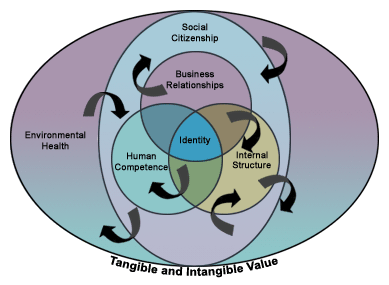
These ideas go further than the intangible values of Verna Allee which are pictured here. There is a long way to go before organisations realise what thier true values are.