The time has come to look at the 'next big thing' and its a big thing for PR.
Way back in 1999, I noted in the first edition and expanded in the second edition of 'Online Punlic Relations' that PR practitioners needed to watch the evolution of platforms for communication. Then it was the PC, the laptop, mobile phones and games machines.
Today one would add smart phones, dongles and memory sticks, television sets and the ever expanding internet of things.
This we all know about and can see evolving before out eyes.
But emerging in the background are the internet based experiences that are comming to the fore.
One example is Augmented Reality, another is location based smart phone apps and yet a third is intelligent smart cards that open doors and provide access to the underground. All useful and all primative.
While Skype may make it easy to make an international video conference call it is a long way off creating a virtaul office of sitting room experience.
As more optimies software and bandwidth comes available, will it be possible to be the person winning the 100 metres at the London Olympics from the comfort of your garden lounger? Will you be able to experience the trension, the agony and the thrill?
Well, we are, step by tiny step moving in that direction.
We already have High Definition 3D augmented reality (without glasses) and we have the ability to take a photograph of our surroundings and translate that into information about the object, street or store.
But what if the street or store was created using semantics intelligently combining our history of interets and the many realities that reflect the image we photograped with similar or related objects, sounds and even smells. Tuning into our physiological, neuropsychological and cognitive mechanisms is already part way there as our smart phones monitor our biorythms.
Now it seems that many of the building blocks are in place.
What are the implications for developing relationships, sharing values creating virtual community interactions and offering richer exoperiences through this new media?
Well,there is no doubt that this is a Public Relations issue. It is about media, it is about relationships, it is about personal and community values and it is about publics/stakeholders/social and user genertaed communities.
I wonder how far the universities with public relations or media academics to deploy on how to write a press release are begining to extend the idea to working with the experiential web?
The first such centre will be at the laeding edge of our profession.
Wednesday, October 06, 2010


Thursday, September 30, 2010
Some research questions
Now is the time of year when students begin to look forward to their next steps in education.
I am fortunate to be able to help some students with an interest in online public relations and at this stage, we are exploring ideas.
Without giving away any of my students work but just exposing some of my thinking to them and a wider audience I seek criticism from real experts.
The first of the conversations I have had is challenging. It is for a work in social media.
We know that there is a lot of practitioner experience available from all over Europe and the United
States in particular. However, there is much less well grounded academic research available. This is a fast moving environment and traditional academic publishing is, by comparison, slow.
This means that the student has an opportunity to add to the body of knowledge as part of a Masters degree by submitting their own papers.
While, at face value, one may like to look at so called 'social media' as it is used today there are some early decisions one would have to make.
Perhaps it is a good thing to first of all think about what we mean by 'social media'. Is this truly a media, or is is a defined range of communications channels used by people (after all FTP is not social media but is used a lot). If so which people?
Social media channels such as Facebook and Twitter, Linkedin and bulletin boards, Blogs, wikis, Foursquared, Augmented Reality, video and other sharing channels (like, for example, YouTube, Slideshare and Picasa) are available on many communications platforms such as PC's laptops, smart phones, games machines like Nintendo Wi and Xbox and slates like iPad. Some are good on one channel and not so good on others.
The range of platforms offers us a view as to what sort of people access which channels and under what kind of circumstance. We still need more research in this area.
From this we might understand that people without the relevant platforms or channels might be disenfranchised. But we know that there are intermediaries (who has not seen a child show a grandparent
something 'cool' on a mobile phone).
Thus I think it is worth exploring what we think we mean by social media.
We have to define the channels that exemplify social media and then explore the platforms on which these are available.
A student will need to find sources that can inform an understanding of channels that are available, useful and are or can be (or have been) popular.
A student will need to explore the recent academic works from the PR, marketing and communication academic journals.
The extent to which these disciplines are new suggests that it will be useful to look at a number of other academic disciplines.
I find that the behavioural sciences and neuro-psychology research is informative and is beginning to
explain people's use of platforms (for example people watch television and use a laptop and a mobile phone concurrently under a number of circumstances) and these activities use a wide range of parts of the
brain that normally would not be active using only one platform/channel.
This involves a lot of searching and research - and playing with lots of digital toys too :)
At an early stage, it is helpful to look at how much content there is available to the public and how much of it is about, for example, a specific brand. Here is some software that gives us a quick overview http://www.trackthisnow.com/.
I would not be at all surprised if, at an early stage, a researcher did not discover that there is a lot of content discussed and shared about almost every thing in many channels and across a lot of platforms.
Experience suggests that most organisations do not and actually probably cannot engage their communities at such a hectic pace across so many platforms and channels. This is an interesting consideration when thinking about the role of both PR and marketing in an age of near ubiquitous interactive communication.
For one student this may help in a finding as to how relevant Social Media is as a brand communication instrument. In the totality of all the conversations of all the people using a range of channels and platforms, it may be that research will explore any opportunity to be part of such conversations and if, in addition, the brand can be 'inserted' into the conversation.
My view is that it will quickly becomes noticeable that this is much more difficult than most believe (and challenges much current practice).
A proposal to consider the future is one that has me hooked.
A student might be extremely brave to consider the future and the evolution of Social Media communication past, present and the new trends for the future.
It is a fascinating subject. The amazing first burst of Usenet and BB's activity three decades ago was astonishing. It showed that people want to engage with each other online, globally and in a new and dynamic way.
I know it has taken the communications industries a couple of decades to see how dynamic the whole concept is and there is a long way to go among leaders in industry and commerce (and academia and government). Equally, I recognise that there is the potential for a radical revolution as potent as any in prospect or history.The Bourbons discovered what happens when eating cake is no longer an alternative to recognising social change in 1792. Such revolution is in prospect for a lot of countries, economies and governments not to mention companies in the next few years.
The extent to which near future developments such as the Semantic Web with automated ontology creation will affect corporate transparency and porosity is an interesting thought.
The development of virtual realities such as 'walk in' Augmented Reality will change personal relationships, experiential marketing and even replace some travel and meetings and is an exciting prospect. I can bet, and history is on my side, that it will become popular in personal relationship experiences long before commerce really gets its head round the wider applications.
The ability to, at will, identify clusters of online values (words, pictures, experience values) and their proponents, supporters and interested constituents will transform marketing. But much more important will change the nature of relationship building, commerce and even the nature of value.
Yes, the future is interesting.
There is another tack that has been presented to me. It is the consideration and strategic analysis’s of brand
communications in different social media platforms. I am sure this will be fascinating for people in PR and Marketing.
Its drawback is that it will need updating every six months or so and so the challenge is be to find a replicable methodological approach - but, of course, each time results are report, they will create a sensation of interest as long as the methodology is robust.
Being able to'listen' to the totality of conversations of a sample in each channel and across a number of
platforms has its challenges and then to try to identify the extent to which the brand is implicitly or explicitly part of these conversations is not impossible and there will be a lot of people who will find this capability really helpful.
A researcher would have to deploy some heavyweight technologies but they are available.
No one can imagine how excited I am at working with bright enquiring young brains in such an array of new thinking that will soon be available to the public relations practitioner - well, those who are following there new developments.
I am, of course interested in comments and insights from you..... One thing we do know is the power of the network to help answer hard questions.
I am fortunate to be able to help some students with an interest in online public relations and at this stage, we are exploring ideas.
Without giving away any of my students work but just exposing some of my thinking to them and a wider audience I seek criticism from real experts.
The first of the conversations I have had is challenging. It is for a work in social media.
We know that there is a lot of practitioner experience available from all over Europe and the United
States in particular. However, there is much less well grounded academic research available. This is a fast moving environment and traditional academic publishing is, by comparison, slow.
This means that the student has an opportunity to add to the body of knowledge as part of a Masters degree by submitting their own papers.
While, at face value, one may like to look at so called 'social media' as it is used today there are some early decisions one would have to make.
Perhaps it is a good thing to first of all think about what we mean by 'social media'. Is this truly a media, or is is a defined range of communications channels used by people (after all FTP is not social media but is used a lot). If so which people?
Social media channels such as Facebook and Twitter, Linkedin and bulletin boards, Blogs, wikis, Foursquared, Augmented Reality, video and other sharing channels (like, for example, YouTube, Slideshare and Picasa) are available on many communications platforms such as PC's laptops, smart phones, games machines like Nintendo Wi and Xbox and slates like iPad. Some are good on one channel and not so good on others.
The range of platforms offers us a view as to what sort of people access which channels and under what kind of circumstance. We still need more research in this area.
From this we might understand that people without the relevant platforms or channels might be disenfranchised. But we know that there are intermediaries (who has not seen a child show a grandparent
something 'cool' on a mobile phone).
Thus I think it is worth exploring what we think we mean by social media.
We have to define the channels that exemplify social media and then explore the platforms on which these are available.
A student will need to find sources that can inform an understanding of channels that are available, useful and are or can be (or have been) popular.
A student will need to explore the recent academic works from the PR, marketing and communication academic journals.
The extent to which these disciplines are new suggests that it will be useful to look at a number of other academic disciplines.
I find that the behavioural sciences and neuro-psychology research is informative and is beginning to
explain people's use of platforms (for example people watch television and use a laptop and a mobile phone concurrently under a number of circumstances) and these activities use a wide range of parts of the
brain that normally would not be active using only one platform/channel.
This involves a lot of searching and research - and playing with lots of digital toys too :)
At an early stage, it is helpful to look at how much content there is available to the public and how much of it is about, for example, a specific brand. Here is some software that gives us a quick overview http://www.trackthisnow.com/.
I would not be at all surprised if, at an early stage, a researcher did not discover that there is a lot of content discussed and shared about almost every thing in many channels and across a lot of platforms.
Experience suggests that most organisations do not and actually probably cannot engage their communities at such a hectic pace across so many platforms and channels. This is an interesting consideration when thinking about the role of both PR and marketing in an age of near ubiquitous interactive communication.
For one student this may help in a finding as to how relevant Social Media is as a brand communication instrument. In the totality of all the conversations of all the people using a range of channels and platforms, it may be that research will explore any opportunity to be part of such conversations and if, in addition, the brand can be 'inserted' into the conversation.
My view is that it will quickly becomes noticeable that this is much more difficult than most believe (and challenges much current practice).
A proposal to consider the future is one that has me hooked.
A student might be extremely brave to consider the future and the evolution of Social Media communication past, present and the new trends for the future.
It is a fascinating subject. The amazing first burst of Usenet and BB's activity three decades ago was astonishing. It showed that people want to engage with each other online, globally and in a new and dynamic way.
I know it has taken the communications industries a couple of decades to see how dynamic the whole concept is and there is a long way to go among leaders in industry and commerce (and academia and government). Equally, I recognise that there is the potential for a radical revolution as potent as any in prospect or history.The Bourbons discovered what happens when eating cake is no longer an alternative to recognising social change in 1792. Such revolution is in prospect for a lot of countries, economies and governments not to mention companies in the next few years.
The extent to which near future developments such as the Semantic Web with automated ontology creation will affect corporate transparency and porosity is an interesting thought.
The development of virtual realities such as 'walk in' Augmented Reality will change personal relationships, experiential marketing and even replace some travel and meetings and is an exciting prospect. I can bet, and history is on my side, that it will become popular in personal relationship experiences long before commerce really gets its head round the wider applications.
The ability to, at will, identify clusters of online values (words, pictures, experience values) and their proponents, supporters and interested constituents will transform marketing. But much more important will change the nature of relationship building, commerce and even the nature of value.
Yes, the future is interesting.
There is another tack that has been presented to me. It is the consideration and strategic analysis’s of brand
communications in different social media platforms. I am sure this will be fascinating for people in PR and Marketing.
Its drawback is that it will need updating every six months or so and so the challenge is be to find a replicable methodological approach - but, of course, each time results are report, they will create a sensation of interest as long as the methodology is robust.
Being able to'listen' to the totality of conversations of a sample in each channel and across a number of
platforms has its challenges and then to try to identify the extent to which the brand is implicitly or explicitly part of these conversations is not impossible and there will be a lot of people who will find this capability really helpful.
A researcher would have to deploy some heavyweight technologies but they are available.
No one can imagine how excited I am at working with bright enquiring young brains in such an array of new thinking that will soon be available to the public relations practitioner - well, those who are following there new developments.
I am, of course interested in comments and insights from you..... One thing we do know is the power of the network to help answer hard questions.
Thursday, September 23, 2010
Stockholm Accords and Sustainability
This is second of a series of lectures notes I am preparing about the Stockholm Accords.
Some months have passed since the World Public Relations Forum discussed and approved the Stockholm Accords. It was the culmination of an intensely participated collaboration process which involved some 1000 leaders of the global public relations community from 42 countries by the PR industry's Global Alliance.
There is a Stockholm Accords digital HUB that you may visit here at: www.stockholmaccords.org. The discussions are worth following and I recommend all practitioners to visit and get engaged.
You can access the Accords here. I have also provided a text version here (for all those people who like to copy 'n paste and not get irritated by the use of PDF)
The Accords offer us a view of sustainability in these words:
An organization’s sustainability is based on balancing today’s demands with the ability to meet future needs, based on economic, environmental and social dimensions*.
In this network society, sustainability leadership offers a transformational opportunity* to enhance the organization’s reputation and demonstrate success across the triple bottom line.
Public Relations professionals identify, involve and engage key stakeholders* contributing to appropriate sustainability policies and programs by:
· interpreting society’s expectations for sound economical, social and environmental investments that show a return to the organization (the advocate)*;
· creating a listening culture – an open system that allows the organization to anticipate, adapt and respond (the listener)*;
· ensuring stakeholder participation to identify what information should be transparently and authentically reported (the reporter)*;
· going beyond today’s priorities to anticipate the needs of tomorrow, engaging stakeholders and management in long-term thinking (the leader).
Reviewing each of these elements in turn, we can extend the debate.
An organization’s sustainability is based on balancing today’s demands with the ability to meet future needs, based on economic, environmental and social dimensions is a bold and, I suggest, a late 20th century view. It will hold good for some time to come but the move towards greater competitive transparency, the evolution of the semantic web and ever more effective 'Blazing Netshine' that allows us all to search and expose the minutia of human endeavour will challenge economic, environmental and social dimensions with added elements.
The nature of value is being challenges in many ways.
What is 'free' (i.e. not paid for with today's monetary currencies) is frequently challenged in today's society. Patents and Trademarks, copyright and personal assets are exposed in near ubiquitous interactive communication and yet many things seemingly 'free' are much valued.
The 'Free' search engine Google has immense value for most people well beyond the irritation (and much ignored) advertisements. Its value as part of a new form of memory and access to knowledge is huge and dwarfs the utility of Library of Congress and all the other libraries in the world combined.
The nature of value is changing so fast, one might begin to consider coinage as being of lesser utility this year compared to last.
We are beginning to understand value differently. We are beginning to understand commonly held values as being the element that aids/is the essential ingredient for relationship creation (paper by Bruno Amaral and me) and meta values commonly held between two or more people as an indication of the strength of relationships.
Indeed, we are now seeing such values attached to ideas and artefacts as a description of their value and utility for individuals and communities.
It follows that basing anything on economic needs may have to face up to a new form and understanding of economics that truly are (in a process of becoming) dimensionally different. Here is a simple example of what I mean. What is the value of Google to humanity in this generation? Google valued by markets at $165bn gets two trillion site hits per year. It is a lot of knowledge transfer and priceless (if sometimes trivial).
This leads one to imagine the environment for the existence of organisations.
In an era of developing ubiquitous access to knowledge, corporate environments will have difficulty being an entity. The nature of transparency, porosity and agency as described by the PRCA/CIPR Internet Commission a decade ago (and revised by Philip Young and myself in Online Public Relations) mean that organisations become less bound by a corporate 'hard shell'. We already see this in organisation where 'contracting out' and the use of agents such as PR consultants to act on behalf of and in the interests of an organisation is commonplace. As each employee gets a Twitter Account, the evolution of this transparent and even porous nature of organisations becomes ever more, and publicly evident. The changing environment militates against the structure of organisations as we know them today and we see this in a range of manifestations where the boundaries between one organisation and another is blurred.
An organisation’s sustainability based on balancing demands in social dimensions is also a significant challenge. The social constructs for much of society is changing.
The emergence of Brazil, India and China as big and developing (and more open) economies, the ability to communicate across borders at will and the dynamic of social groups formed in the silicon sitting rooms of Twitter, Facebook and Linkedin are very different social dimensions. Add smart phones and location based micro communities and society looks very different. These are considerations for all who signed up to the Stockholm Accords and have to be thought through by the professional bodies as well as their members.
The professional bodies also have to re-act or be left on the shelf.
The Accords postulate that, in this network society, sustainability leadership offers a transformational opportunity to enhance the organization’s reputation and demonstrate success across the triple bottom line.
Sustainability to be long lasting has to be flexible and enhancing reputation is not limited to economic, ecological and social advantage.
I have already suggested that economical advantage my be difficult to quantify as values take on a different role and are probably better viewed in relationship building terms than monetary value.
Environmental and social advantage may then also be measured in their capability to bring relationship values to the fore. This is not a tautologous argument. Environmental and social values are not the same and current practice needs a lot of new and additional work to achieve 20th century gaols. To be effective in the 21st century, PR has to evolve a triple line that can extend into the much more complicated world of individual, corporate and environment relationships and their value drivers today.
Oddly enough identifying, involving and engaging key stakeholders is very easy. We have not yet developed the technologies sufficiently well but espousing values will quickly build relationship clusters with people holding similar values. In the bast it was a little understood but effective brand empathy matrix. Today, we understand it as a not wholly different, but stakeholder derived values matrix.
As we move towards greater competitive transparency and learn to manage organisational porosity it will become much harder for an organisation to determine what information should be transparently and authentically reported. The stakeholder not only has the whip hand by virtue of a wider view of values porosity will inevitably reveal and the community will punish any organisation that lacks authenticity. Secretive accountants and pharmaceutical companies are going to have to find a values driven accommodation with society to remain as they are.
It is professionalism that develops a capability to go beyond today’s priorities to anticipate the needs of tomorrow and, in addition more emphasis on todays word among PR teachers.
Some months have passed since the World Public Relations Forum discussed and approved the Stockholm Accords. It was the culmination of an intensely participated collaboration process which involved some 1000 leaders of the global public relations community from 42 countries by the PR industry's Global Alliance.
There is a Stockholm Accords digital HUB that you may visit here at: www.stockholmaccords.org. The discussions are worth following and I recommend all practitioners to visit and get engaged.
You can access the Accords here. I have also provided a text version here (for all those people who like to copy 'n paste and not get irritated by the use of PDF)
The Accords offer us a view of sustainability in these words:
An organization’s sustainability is based on balancing today’s demands with the ability to meet future needs, based on economic, environmental and social dimensions*.
In this network society, sustainability leadership offers a transformational opportunity* to enhance the organization’s reputation and demonstrate success across the triple bottom line.
Public Relations professionals identify, involve and engage key stakeholders* contributing to appropriate sustainability policies and programs by:
· interpreting society’s expectations for sound economical, social and environmental investments that show a return to the organization (the advocate)*;
· creating a listening culture – an open system that allows the organization to anticipate, adapt and respond (the listener)*;
· ensuring stakeholder participation to identify what information should be transparently and authentically reported (the reporter)*;
· going beyond today’s priorities to anticipate the needs of tomorrow, engaging stakeholders and management in long-term thinking (the leader).
Reviewing each of these elements in turn, we can extend the debate.
An organization’s sustainability is based on balancing today’s demands with the ability to meet future needs, based on economic, environmental and social dimensions is a bold and, I suggest, a late 20th century view. It will hold good for some time to come but the move towards greater competitive transparency, the evolution of the semantic web and ever more effective 'Blazing Netshine' that allows us all to search and expose the minutia of human endeavour will challenge economic, environmental and social dimensions with added elements.
The nature of value is being challenges in many ways.
What is 'free' (i.e. not paid for with today's monetary currencies) is frequently challenged in today's society. Patents and Trademarks, copyright and personal assets are exposed in near ubiquitous interactive communication and yet many things seemingly 'free' are much valued.
The 'Free' search engine Google has immense value for most people well beyond the irritation (and much ignored) advertisements. Its value as part of a new form of memory and access to knowledge is huge and dwarfs the utility of Library of Congress and all the other libraries in the world combined.
The nature of value is changing so fast, one might begin to consider coinage as being of lesser utility this year compared to last.
We are beginning to understand value differently. We are beginning to understand commonly held values as being the element that aids/is the essential ingredient for relationship creation (paper by Bruno Amaral and me) and meta values commonly held between two or more people as an indication of the strength of relationships.
Indeed, we are now seeing such values attached to ideas and artefacts as a description of their value and utility for individuals and communities.
It follows that basing anything on economic needs may have to face up to a new form and understanding of economics that truly are (in a process of becoming) dimensionally different. Here is a simple example of what I mean. What is the value of Google to humanity in this generation? Google valued by markets at $165bn gets two trillion site hits per year. It is a lot of knowledge transfer and priceless (if sometimes trivial).
This leads one to imagine the environment for the existence of organisations.
In an era of developing ubiquitous access to knowledge, corporate environments will have difficulty being an entity. The nature of transparency, porosity and agency as described by the PRCA/CIPR Internet Commission a decade ago (and revised by Philip Young and myself in Online Public Relations) mean that organisations become less bound by a corporate 'hard shell'. We already see this in organisation where 'contracting out' and the use of agents such as PR consultants to act on behalf of and in the interests of an organisation is commonplace. As each employee gets a Twitter Account, the evolution of this transparent and even porous nature of organisations becomes ever more, and publicly evident. The changing environment militates against the structure of organisations as we know them today and we see this in a range of manifestations where the boundaries between one organisation and another is blurred.
An organisation’s sustainability based on balancing demands in social dimensions is also a significant challenge. The social constructs for much of society is changing.
The emergence of Brazil, India and China as big and developing (and more open) economies, the ability to communicate across borders at will and the dynamic of social groups formed in the silicon sitting rooms of Twitter, Facebook and Linkedin are very different social dimensions. Add smart phones and location based micro communities and society looks very different. These are considerations for all who signed up to the Stockholm Accords and have to be thought through by the professional bodies as well as their members.
The professional bodies also have to re-act or be left on the shelf.
The Accords postulate that, in this network society, sustainability leadership offers a transformational opportunity to enhance the organization’s reputation and demonstrate success across the triple bottom line.
Sustainability to be long lasting has to be flexible and enhancing reputation is not limited to economic, ecological and social advantage.
I have already suggested that economical advantage my be difficult to quantify as values take on a different role and are probably better viewed in relationship building terms than monetary value.
Environmental and social advantage may then also be measured in their capability to bring relationship values to the fore. This is not a tautologous argument. Environmental and social values are not the same and current practice needs a lot of new and additional work to achieve 20th century gaols. To be effective in the 21st century, PR has to evolve a triple line that can extend into the much more complicated world of individual, corporate and environment relationships and their value drivers today.
Oddly enough identifying, involving and engaging key stakeholders is very easy. We have not yet developed the technologies sufficiently well but espousing values will quickly build relationship clusters with people holding similar values. In the bast it was a little understood but effective brand empathy matrix. Today, we understand it as a not wholly different, but stakeholder derived values matrix.
As we move towards greater competitive transparency and learn to manage organisational porosity it will become much harder for an organisation to determine what information should be transparently and authentically reported. The stakeholder not only has the whip hand by virtue of a wider view of values porosity will inevitably reveal and the community will punish any organisation that lacks authenticity. Secretive accountants and pharmaceutical companies are going to have to find a values driven accommodation with society to remain as they are.
It is professionalism that develops a capability to go beyond today’s priorities to anticipate the needs of tomorrow and, in addition more emphasis on todays word among PR teachers.
Why PR needs to take digital more seriously
A fortnight ago I was invited to make a contribution the the CIPR social media series.
I chose to extend some of the comments here which have leant in the direction of placing PR as the key discipline in the societal evolution of the internet.
This is what I said:
Such a view may change the way we teach public relations and even open new opportunities for research.
This may be exciting for some and threatening for many and downright cookie for lots of our colleagues.
If one believes, as I do, that PR is about the spread of values, knowledge and the development of relationships round values and knowledge then this thesis works.
It is not without some learning which was hinted at in the last chapter of Philip Young and my book 'Online Public Relations' and has a mirror in other research about communities, communication and the spread of values Steven Pinker hinted at this month for the Economist among many other approaches (which made me ask if Public Relations contribute to less violent society?).
I do think that we are at a watershed. The idea that a lot of PR is about events organisation and press relations is already almost indefensible. In addition subject areas like CSR, Corporate Affairs and other like subjects as far too flimsy without a better, deeper sense of what is happening in today's manifestation of human evolution.
Extrapolating Pinker's view that wider community interaction takes the violence from the savage might it not be that community interaction offers us a new form civilisation as well?
If that is so, the discipline that is equipped, not as an arm of marketing but as the high priesthood of devolved cultural development sounds pretty attractive and my thesis is that we currently have such an opportunity.
I chose to extend some of the comments here which have leant in the direction of placing PR as the key discipline in the societal evolution of the internet.
This is what I said:
Such a view may change the way we teach public relations and even open new opportunities for research.
This may be exciting for some and threatening for many and downright cookie for lots of our colleagues.
If one believes, as I do, that PR is about the spread of values, knowledge and the development of relationships round values and knowledge then this thesis works.
It is not without some learning which was hinted at in the last chapter of Philip Young and my book 'Online Public Relations' and has a mirror in other research about communities, communication and the spread of values Steven Pinker hinted at this month for the Economist among many other approaches (which made me ask if Public Relations contribute to less violent society?).
I do think that we are at a watershed. The idea that a lot of PR is about events organisation and press relations is already almost indefensible. In addition subject areas like CSR, Corporate Affairs and other like subjects as far too flimsy without a better, deeper sense of what is happening in today's manifestation of human evolution.
Extrapolating Pinker's view that wider community interaction takes the violence from the savage might it not be that community interaction offers us a new form civilisation as well?
If that is so, the discipline that is equipped, not as an arm of marketing but as the high priesthood of devolved cultural development sounds pretty attractive and my thesis is that we currently have such an opportunity.
Friday, August 27, 2010
Semantic progress
Yesterday Philip Sheldrake gave a talk to the Chartered Institute of Public Relation Social Media gathering (anyone can come - it costs £10 and is at 5pm every Thursday) on the semantic web. It was excellent and you can access it here.
Among the things he showed us was the work of Philipp Heim (University of Stuttgart), Steffen Lohmann (Carlos III University of Madrid), Timo Stegemann (University of Duisburg-Essen).
They have taken existing structured data to allow you to go and find relationships between two entities (I chose to find the relationship between Nick Clegg and David Cameron on this page).
The work they have done is important and uses existing structured data sets.
At Klea Global my colleague Girish has been working towards a way of creating structured data sets using Natural Language Programming including LSI to build (RDF) structures on the fly from content derived from newspapers, Blogs, Facebook, Twitter etc.
He already has gone quite a long way and you can see an example of how it is possible to create this process with some very new and pretty smart tools. One of which is available for you to try here.
OK, so what is this for, and why is it relevant to Public Relations.
I guess the secret is in the second part of the name of our profession: relations.
Using these capabilities, we can find out all manner of relationships between two entities (subject - object). When, using the Semantic Web, these relationships make sense, all this data will be ever more powerful.
To get some idea of how much data, here is another 'toy' you can play with from Klea Global labs (and yes, I have started to put it all in one place at last): Track This Now. Using this free 'search and scope presence' software, you will see that an amazing amount of information is accumulating about your company, client, university etc.
Knowing how much there is, and knowing that most of what is said online about organisation does not come from the company or traditional media is only half the battle. There is so much accumulating out there that we are overwhelmed.
If only we could find out what the relationships were between all those tweets and press articles, we would have some chance of influencing them, building up huge SEO for clients and lots of other marvellous things. Worry not... salvation is at hand.
These are very early days for these developments to bear fruit for the PR industry but next year they will be quite astonishing. We already know how to do it and in less than a year will be doing it.
This is so exciting for our industry and my only regret is that we don't have a single university in the UK with a capability to do this sort of research.
Among the things he showed us was the work of Philipp Heim (University of Stuttgart), Steffen Lohmann (Carlos III University of Madrid), Timo Stegemann (University of Duisburg-Essen).
They have taken existing structured data to allow you to go and find relationships between two entities (I chose to find the relationship between Nick Clegg and David Cameron on this page).
The work they have done is important and uses existing structured data sets.
At Klea Global my colleague Girish has been working towards a way of creating structured data sets using Natural Language Programming including LSI to build (RDF) structures on the fly from content derived from newspapers, Blogs, Facebook, Twitter etc.
He already has gone quite a long way and you can see an example of how it is possible to create this process with some very new and pretty smart tools. One of which is available for you to try here.
OK, so what is this for, and why is it relevant to Public Relations.
I guess the secret is in the second part of the name of our profession: relations.
Using these capabilities, we can find out all manner of relationships between two entities (subject - object). When, using the Semantic Web, these relationships make sense, all this data will be ever more powerful.
To get some idea of how much data, here is another 'toy' you can play with from Klea Global labs (and yes, I have started to put it all in one place at last): Track This Now. Using this free 'search and scope presence' software, you will see that an amazing amount of information is accumulating about your company, client, university etc.
Knowing how much there is, and knowing that most of what is said online about organisation does not come from the company or traditional media is only half the battle. There is so much accumulating out there that we are overwhelmed.
If only we could find out what the relationships were between all those tweets and press articles, we would have some chance of influencing them, building up huge SEO for clients and lots of other marvellous things. Worry not... salvation is at hand.
These are very early days for these developments to bear fruit for the PR industry but next year they will be quite astonishing. We already know how to do it and in less than a year will be doing it.
This is so exciting for our industry and my only regret is that we don't have a single university in the UK with a capability to do this sort of research.
Sunday, June 20, 2010
A first look at the Stockholm Accords
The first in a series of five papers examining the Stockholm Accords
Introduction
Pre-amble
Governance
Introduction
Public Relations was ambushed by marketing in the mid 20th century. It became the servant of its child and was largely subsumed into something called ‘Marketing Communications’.
In this lecture and associated papers and seminars, I will explore the nature of the profession from a perspective of Public Relations forced back into its roots of persuasion, diplomacy and relationship building by ubiquitous interactive communication.
Drawing on the perspectives of the Stockholm Accords and their ready acceptance by practitioners and academics worldwide, I will examine how the professionals, the associations, managers, consultants, educators, researchers and students in the PR sector have to adapt.
This paper outline the perspective I will take and will be supported by four further papers (including Management, Sustainability, Internal Communication, External Communication) that will be published in advance of the lectures.
Pre-amble
The extra-ordinary experience of one of the biggest companies in the world being ill-prepared for a historically unmatched oil spill disaster from every PR perspective in 2010; the complete breakdown in relationships and trust among bankers two years earlier and the ill-preparedness of the industry as new platforms and channels of communication become commonplace, forms the basis of a new professional construct in which PR has to administer its principles on a sustained basis and to affirm them throughout the profession, as well as to management and other relevant stakeholder groups.
The Stockholm Accords provide the basis by which modern day practice may be examined in what Phillips once call ‘Blazing Netshine’, the internet as ubiquitous, interactive communication.
The Stockholm Accords can be accessed at http://www.wprf2010.se/stockholm-accords/draft-of-the-stockholm-accords/comment-page-1/#comment-171
Governance
“All Organizations operating under the stakeholder governance model empower their leaders -board members and elected officials- to be directly responsible for deciding and implementing stakeholder relationship policies”, claims the Accord.
In the papers published in 2000 (Phillips, Journal of Communication Management, , 2001) and in the subsequent book (Phillips, Online Public Relations, 2001) , I made it clear that I thought that the concept of fixed social or economic groups could not be a long lived construct in a digital age. The reality is that now we can explore the nature of such group, whether beings with a ‘stake’ in an organisation, namely ‘stakeholders’ (Freeman, 1984) or people with an interest in the issues that face organisations, the publics described by Grunig and Hunt (Grunig, J. E., & Hunt, T, 1984) and Grunig, et al (Grunig, L. A., Grunig, J. E., & Dozier, D, 2002) . The reality, we discover in a very large data set and published by Amaral and Phillips (Amaral, B. and Phillips, D, 2009) is that groups of individuals form and re-group round clusters of ever changing mutually held values. The concept of such groups, it seems is not wrong, but they are much less fixed than the marketing literature would have us believe.
The communicative organization, described in the Accords does indeed require timely information because the groups which interest practitioners change quite rapidly. As Professor Anne Gregory put it at the World Public Relations Forum Stockholm in June 2010, ‘Public Relations is complex’. One might add, fast moving.
We are now also aware that the nature of groups on line is that they can have and do access a broad and often well informed knowledge base. For this reason, if non other, the modern parctitioners requires knowledge and understanding of economic, social, environmental and legal developments, as well as of its ‘stakeholders’ expectations.
Practice needs the tools, and an ability to be able to use them and have sufficient (and pretty comprehensive knowledge) to asses such influences in near real time.
It is with such skills that the practitioner can promptly identify and deal with the opportunities and risks that can impact the organization’s direction, action and communication.
This then suggests that mastering the actuality of the iPhone and iPad generation and those people whose lives are mediated by the immediacy and ubiquity of the internet is a PR imperative.
The Accords invite the profession to participate in defining organizational values, principles, strategies, policies and processes.
In the last year we have moved a long way. We are gaining considerable insights into the nature, relevance and significance of values. Indeed, one might suggest, based on the presentation provided by Amaral at Euprera (Amaral, 2010) that the nature of values and the capability to identify values extant in an organisation and among the wider community is much less difficult than first thought.
The extent to which such values express the mission and objective of the organisation can now be considered in juxtaposition. It is remarkably easy with such tools to be able to identify dissonance.
With such capability principles, strategies, policies and processes are much more easily managed and implemented.
The reality is that, as the use and application of the internet escapes from the Personal Computer and becomes ever more evident in mobile phone, games and the ‘Internet of Things’, much of what the practitioner needs is to be found in digital social networking, interaction and mediation.
This does require the practitioner (hopefully the research based academic practitioner), develops, becomes knowledgeable and hones research skills and tools to interpret ‘stakeholders’ and society’s expectations as a basis for decisions.
The practitioner capable of delivering timely analysis and recommendations for effective governance of ‘stakeholder’ relationships is thus a reasonably practical ambition and practitioner capability. It does require a very mature, well educated and committed career practitioner. But, as we discover from the BP Oil disaster and the Banking crisis, a long overdue recruitment capability is required among non-exec board members. The simple sense to employ public relations practitioners rather than what can be described as Johnny-come-lately and often ex-journalists to do a proper job may be considered in the best interest of the shareholder and future societal contribution of the firm.
In the interest of professionalism, is it right that we could or should judge the practitioner who allowed a bank to be so wary of its trading partners that it nearly brought the world’s financial structures to an end? Is it, one might ask the responsibility of a public relations person to have some role in the effectiveness of organisational relationships?
The Accords are proscriptive in calling for enhancing transparency, trustworthy behaviour, authentic and verifiable representation, thus, they suggest, sustaining the organization’s “licence to operate”.
There is a need to explore such propositions. The nature of radical transparency is an anathema for most organisations, indeed, for most individuals. However, we are seeing a trade off between transparency, which Philip Young and Phillips (Phillips, D. & Yoing, P, 2009) explore at some length, and the convenience it offers individuals. Does this translate into the future organisation?
Today, the location capability (using triangulation between mobile cell transmitters) of the mobile phone is one form of tracking a phone, there are a number of organisations are involved in ‘blue casting’ using the mobile Bluetooth facility to broadcast messages to people in close proximity and many of us are aware of the GPS facility embedded in mobiles. At the same time we broadcast emails, photos and voice without a care. Much of these data is used by organisations to collect information about the users.
People make themselves and their actions and activities transparently available.
Why?
The pay back is terrific with a host of location specific services that range from directions to a destination to discovery of local products and services. This trade of is much more extensive that this short description and will become even greater in the future as the ‘Internet if Things’ becomes ever more common. What we are seeing is an extension of personal transparency towards radial personal transparency.
The question the profession may like to ask itself is whether organisations might want to or wish to extent transparency further because the trade-off is so beneficial. Indeed, there are ethical issues at every turn and, just to make life more interesting for the practitioner and the Accords, is that the proposition is, and rightly, a sign of professional capability that this should be a matter for the practitioner manager and academic.
The Accords invite practitioners to espouse trustworthy behaviour. Of course, we understand the nature of trust and trustworthiness but how far have the Centre for Public Relations Studies[i] or the The Institute for Media and Communication Research[ii] explored the nature of trust in an internet mediated world through the extension of the thinking of, say, contributors to the Oxford Internet Surveys group such as Dutton et al ?
There are interesting areas for research with Dutton et al ( Dutton, W.H., Guerra, G.A., Zizzo, D.J. and Peltu, M., 2005) offering an interesting starting point with papers on Trust in the internet. A key determinant of social capital is thought to be trust in other people. But we find that internet users are actually more trusting than non-users, implying that they have more social capital.
The fashion for talking about organisations that have an internal listening culture, an open system that allows the organization to anticipate, adapt and respond to events though the experience and using the contributions of its ‘stakeholders’ is an area for further exploration and the subject of a further paper.
In this series of papers I shall be presenting consideration of other Accords including Management, Sustainability, Internal Communication, External Communication and the coordination of these activities.
Dutton, W.H., Guerra, G.A., Zizzo, D.J. and Peltu, M. (2005). The cyber trust tension in e-government: Balancing identity, privacy, security.0:13-23. Information Polity 1 .
Amaral. (2010, February). Concepts of Values for Public Relations. Retrieved June 20, 2010, from Euprera Spring Symposium: http://www.euprera.org/?p=69
Amaral, B. and Phillips, D. (2009, July). A proof of concept for automated discourse analysis in support of identification of relationship building in blogs. Retrieved June 20, 2010, from Bledcom.com: http://www.bledcom.com/home/knowledge
Freeman, R. E. (1984). Strategic Management: A Stakeholder Approach. Boston: Pitman.
Grunig, J. E., & Hunt, T. (1984). Managing public relation. Orlando, FL: Holt: Rinehart and Winston.
Grunig, L. A., Grunig, J. E., & Dozier, D. (2002). Excellent Public Relations and Effective Organizations: a Study of Communication Management in Three Countries. Hillsdale, NJ: Lawrence Erlbaum.
Phillips, D. & Yoing, P. (2009). Online Public Relations 2nd ed. London: Kogan Page.
Phillips, D. (2001). Journal of Communication Management, . Journal of Communication Management Vol. 5 Iss: 2, pp.189 - 206 , pp189-206.
Phillips, D. (2001). Online Public Relations. London: Kogan Page.
Monday, June 14, 2010
Social Media Employment - too many looking for a career?
I have compared the number of pages indexed by Google that have the words 'Social Media Job' with the number of searches for the same term.


Globally, there is a small but continuing gap with demand outstripping supply.
In the UK demand is slowing:

But supply seems to be increasing:

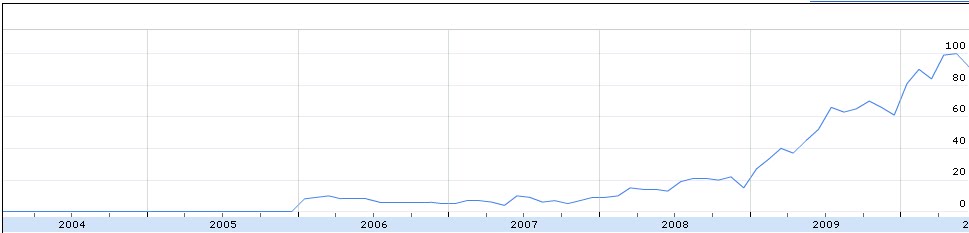
Globally, there is a small but continuing gap with demand outstripping supply.
In the UK demand is slowing:

But supply seems to be increasing:
No grammar, can't spell and want to 'do' PR

In an article in the Telegraph, Dr Sigman is reported as saying that "Children should be banned from using computers in schools until they are nine-years-old because the early use of technology is destroying their attention spans." Here then, is another insult delivered to the profession.
Perhaps an academic can, in the future, present findings to the professions for the professional to consider rather than some headline grabbing and throw away line.
Is it the use of computers that explains why the generality of students with three or more 'A' level exams cannot spell and have appalling grammar? Why is it that some can construct a 'sentence' without a verb and often a subject?
How is it that PR, journalism and other students enter university without an ability to recognise and write in different styles?
Why is it that a lecturer is not able to return scripts to students without a mark because the quality of grammar makes the work confusing, contradictory and or misleading?
Now that the Qualifications and Curriculum Development Authority is to be abolished can we have a simple rule for teachers at every level. Stand up to the bureaucrats, confront the parents and give the (paying) student a chance of a sustainable career by refusing shoddy work and if that means using computers or not is down to the professional judgement of the teach.
I am the least of literates, but now see young girls in offices being mentored for their writing after 18 years of schooling. They have been let down badly by the likes of the Qualifications and Curriculum Development Authority. Now it is the teacher's turn to show how education can be just that.
Picture: Socrates using his socratic method. http://www.skolavefurinn.is/_opid/islenska/bokmenntir/heimspeki/heimspekingar/sokrates/14_sokrates_2/sokrates_eiturdrykkur_4.jpg

Monday, May 31, 2010
Fluffy Clouds and a PR Ontology
Girish Lakshminarayana is something of a coding wizard. He takes my half-formed ideas and turns them into code, adds insights of his own and comes up with astonishing results.
It is his genius that is taking me to to an RDFa description of text (I know about the semantic web reservations about this) and other data that will describe the requirements for Semantic Public Relations.
Today, we are able to identify the semantic concepts embedded in individual page citations; automatically describe the type of web page (descriptors range from link farm to blog), add the date/time of publication (with some accuracy), identify names, titles and even email addresses in text and pick up some other fun attributes. We can do this in a scalable computing environment to allow a very big corpus to be examined. In a word, we know who people are, what, where and when they find things interesting and how relevant they are to the corporate drivers of our employers and clients (which we can also gain from online insights). We know what is available to influence them and the values available they hold dear.
Using interesting mathematical models, and we use Bayesian and Boolean logic a lot (this is fuzzy logic used to ensure that, for example, aircraft systems keep planes in the air), we can do some very deep analytical modelling. This means that we can look at word concepts that competitors have in common, the types of media that they have in common, the dates when these were common between them and much more and from these we the triplets that take us to insights as opposed to answers. We can then create documents accompanied by semantic markup (and some of these apparently structural components can be - in my view - much more organic and identified on the fly).

Over the years, as more corporate activity has been mediated by the internet, it has become possible to be more and more accurate in the information we can glean and process to good effect. Over the years we have published these findings by showing some of the outcomes.
Because of cloud computing the size and range of these data is no longer constrained, which means we can cover much more ground than ever before.
The PR industry is already beginning to gain advantageous from the evolution of the semantic web. Here are some examples of benefits that have already emerged:
It is his genius that is taking me to to an RDFa description of text (I know about the semantic web reservations about this) and other data that will describe the requirements for Semantic Public Relations.
Soon the PR practitioner will have programmes that are a knowledge representation of the client landscape showing a cloudscape of people, their interests and view, ideas, products, interactions and commitment. We will be able to project into the future with known degrees of accuracy and much much more. These insights will be dimensions richer than modern PR research. We will use the internet to give us insights and solutions.
Into this changing view to an endless horizon, the practitioner will be able to inject ideas to test what outcomes may be.
Not all the advantages are far into the future. many of them are already available.
Today, we are able to identify the semantic concepts embedded in individual page citations; automatically describe the type of web page (descriptors range from link farm to blog), add the date/time of publication (with some accuracy), identify names, titles and even email addresses in text and pick up some other fun attributes. We can do this in a scalable computing environment to allow a very big corpus to be examined. In a word, we know who people are, what, where and when they find things interesting and how relevant they are to the corporate drivers of our employers and clients (which we can also gain from online insights). We know what is available to influence them and the values available they hold dear.
Using interesting mathematical models, and we use Bayesian and Boolean logic a lot (this is fuzzy logic used to ensure that, for example, aircraft systems keep planes in the air), we can do some very deep analytical modelling. This means that we can look at word concepts that competitors have in common, the types of media that they have in common, the dates when these were common between them and much more and from these we the triplets that take us to insights as opposed to answers. We can then create documents accompanied by semantic markup (and some of these apparently structural components can be - in my view - much more organic and identified on the fly).
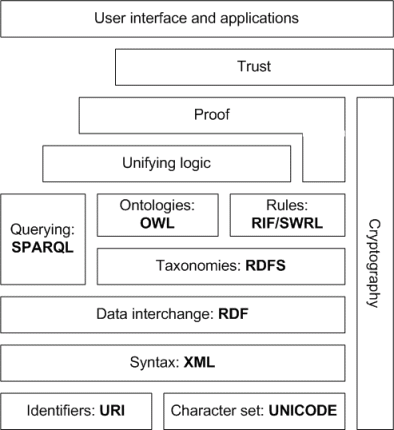
Over the years, as more corporate activity has been mediated by the internet, it has become possible to be more and more accurate in the information we can glean and process to good effect. Over the years we have published these findings by showing some of the outcomes.
Because of cloud computing the size and range of these data is no longer constrained, which means we can cover much more ground than ever before.
The PR industry is already beginning to gain advantageous from the evolution of the semantic web. Here are some examples of benefits that have already emerged:
- First, monitoring is really easy (dead tree clips are even possible).
- Being able to compare different forms of outputs, out-takes and outcomes is much simpler.
- Media, audience and message analysis is simple and the nature of the networks is revealed (a simple practical example is being able to find subject related bloggers by national audience penetration, level of interest and engagement).
- Influential statements and responses can be synthesised, weighted and viewed in daily, weekly or progressive monthly time frames and by audience demographic.
- We took a look at a comment by Sir Tim Berners-Lee to see if it was possible to create a newspaper from existing content online. It is. It can be very very specific. It is the kind of content that would be regarded as a manifestation of 'thought leadership' in the parlance of todays PR industry. It is striking, always on, brings news, thinking and research from great minds worldwide in minutes (well in seconds if you are a stock market trader) and it is an amazing by-product of semantic PR research.
So much for the present and a lot of this should be accompanied by a big dose of 'so what' if practitioners don't or won't use this intelligence.
Soon we will be able to answer much more profound questions not with facts but with insights. Questions like: Will the PR industry engage with the semantic web and the insights it can bring to bear.
Subscribe to:
Posts (Atom)