Friday, February 27, 2009

Managing the Unknown Internet Part 2

In most PR work there are risks and opportunities. To manage them we need to identify them.

This can be done by an individual, a focus group or management team or can be established from research. It’s a great opportunity for a brain storm with someone making notes!

In preparing a strategy for a programme it is worth looking at where there may be influences that can affect it.

In online public relations it is possible to second guess many of the potential influences. The recession of 2008/10, is a classic case in point. For a number of companies strategy had to change to maintain presence but at a much lower cost. Promotion budgets are slashed and PR had to take the strain. With reduced advertising, many publications just do not have the space for stories they would have run only months before. Online there were fewer constraints and so budgets have shifted.

In PR there are some pretty well established influences that affect practice
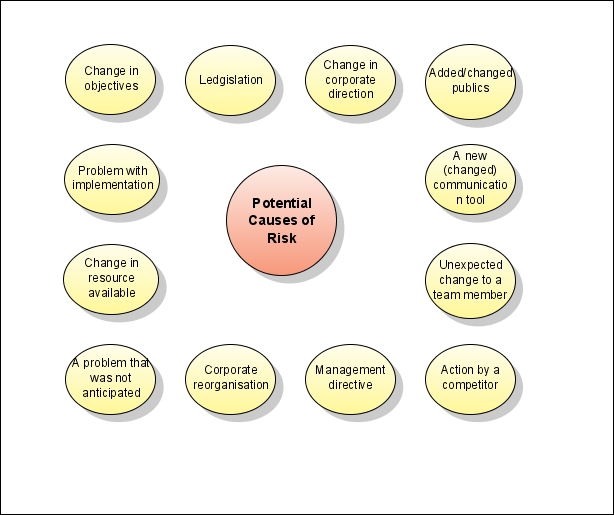


The range of known influences that can affect online PR programmes are extensive.


It is also possible to evaluate risk and asses its influence in terms of probability and impact.
An example might be confidential product information could leak out of the organisation and into the public domain because an employee has a blog.

Having described risks and potential for effects, the practitioner (evaluation team) will asses each element in terms of likelihood of occurrence and impact. It helps put the risk or opportunity into perspective. This is a technique used by many voluntary and public sector organisations. It is the kind of matrix that might be used to assess risk for a school outing and is also used in project management.
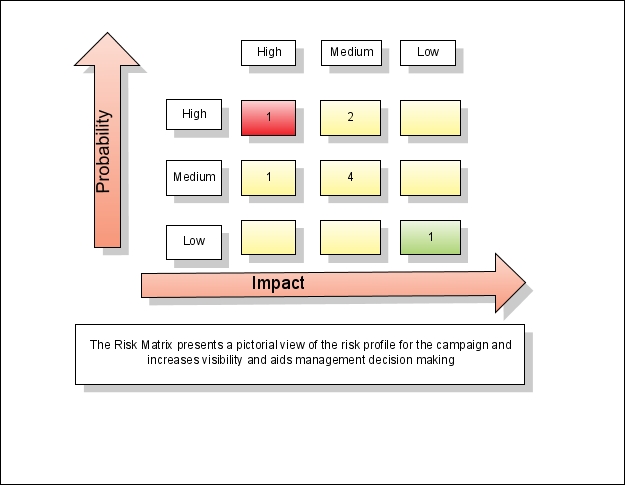


Assessing the impact of events which can be estimated before any action is taken and again after mitigating policies are proposed to see if the potential for risk is lowered (acceptable) prior to implementation or exposure.

The next part of the process is to create a mitigation (or contingency) plan, process or protocol to reduce either of both risk of likelihood or impact. This might be the introduction of, say, a company wide blogging policy or the use of data on home computers.

Once a mitigation plan has been worked out, a new assessment is made of the likelihood or impact to see if the proposed actions for mitigation has had an effect that makes the risk acceptable within the campaign.

The process is quite simple and effective and is valuable when attempting to identify competitive advantage versus doubts.

These methodologies can be used in making all manner of decisions including the extent to which the internet should be made available during working hours (knowing that most people have access on their cell phones anyway). This structures approach helps inform such decisions.

Using such a process through each part of the planning process reduces risk to a manageable level and also helps to make precise projections of expected outcomes.

Risk management is a process and can be applied to strategy as well as tactics.


Of course, for each risk there is an opportunity. By applying the same technique but looking for opportunities and means to optimise such opportunities, the practitioner can enhance the effectiveness of any approach to a campaign.

It is all too easy to imagine events in stark black and white answers. This is seldom the only solution and practitioners can work on contingency planning

There are a lot of techniques that can be applied to ameliorate risk, optimise opportunity and, written into the programme strategy using techniques adopted from other disciplines, PR can ensure greater certainty in online activities.
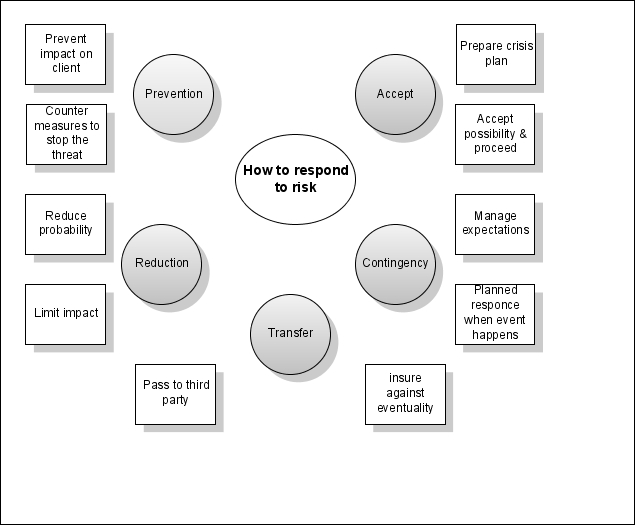


Disaster seldom comes unannounced for most organisations. There tend to be number indicators that presage the public event.

The key is to be able to identify the stages as they present themselves. They are:

Variation

All plans have expected outcomes, financial budgets and timescales. These are often identified using aids for project planning (see above).

Monitoring such plans will identify where plans are going awry. Often such occurrences are small. These are 'variations' to the plan. Good monitoring will give teams notice that remedial action has to take place and contingency can be built into the plan. An example might be a contingency sum in a budget and some flexibility in delivery time built in.

Foreseen uncertainties

There are some variations that are identifiable and understood that the team cannot be sure will occur or when an event it will occur. To mitigate foreseen uncertainties, the plan will need to include the capability to identify the event and a capability to deploy a pre-planned contingency programme. An example might be unscheduled maintenance of a computer that is running the campaign blog One big issue is website uptime with issues such as a slowing of response times of the organisation's web site or, disaster of all disasters, the web site being so overwhelmed that it stops responding (in retail, this is the equivalent of one in ten shops being closed).
When a web site goes down, it is a PR problem. It is not an IT department problem. Risk analysis is critical in identifying and mitigating these events. Practicing for such events has to be included in any plan. Who does what, when and how and if they are not available or facilities are down who else should be part of such a plan.

Unforeseen Uncertainty

This kind of event cannot be identified during project planning. There is no Plan B.

The team will be unaware of the event’s possibility or consider it so unlikely that there is no in-built contingency plan. To be able to manage such events a comprehensive monitoring and alerting process is critical.

“Unknown unknowns,” or “unk-unks,” as they are sometimes called, make people nervous because existing decision tools are not available. Unforeseen uncertainty is not always caused by spectacular events or issues. They can arise from the unanticipated interaction of many events, each of which might, in principle, be foreseeable. The best management practice here is attention to detail and constant re-evaluation of the plan and its application.

The model described here includes risk analysis at just about every point in planning. Mature management of PR will have to begin to include these more complex management techniques in the future and it takes out a lot of the management concerns that surround the use of social media.

Here are the key elements for reducing the impact of the unforeseen:

• Teams must go beyond mere crisis management and continually scan for emerging influences — either threats or opportunities. Practitioners should be scanning the horizon more than three months out to identify potential problems while they can still do something about them.
• Risk analysis must be an ongoing activity with no potential hazard excluded because it seemed wacky at the time.
• With unforeseeable uncertainty, a lot of time and effort must go into managing relationships with key publics, often getting them to accept unplanned changes. Knowing who and how to contact key publics is important. Good old fashioned public relations to maintain good and effective relationships count when the unforeseen happens.
• Top-management support, negotiation techniques, team-building exercises and the practitioner's leadership can help resolve conflicting interests.
• Trust is a core element in managing the unforeseen which means value systems and value system analysis is critical (ibid)
• Managing variance and planning for managing foreseen uncertainty assist managing the unknown because contingency planning will be part of the organisation's culture.

The unforeseen can be managed.

The US Institute of crisis management offers some insights into where to look for unforeseen uncertainty, listing the most common on its web site (http://www.crisisexperts.com)

In an era when the internet is bringing great change in communication (as well as the way organisations are organised and managed), being able to deploy these types of technique allows organisations to enter new areas of interactions with some confidence to gain optimum benefit at an acceptable level of exposure.

Managing the Unknown Internet

Public relations is a management discipline and as such has to apply management techniques to what it does. So far we have shown a number of such techniques when used to optimise campaigning. All too often we have also mentioned the need for risk management.

Even today, many management teams are wary of the internet and many see it as a threat. For some there is no doubt that it is a threat and needs management.

New channels for communication emerge and often with great speed, the internet is driven by many people and there is much presence that is not controlled by the organisation. Much of internet activity does not follow the usual linear models for management. The sequence of events can be as easily disrupted by the online community as the marketing of finance departments.

The lesson is obvious: plans have to be fluid. We need to be able to master the unknown. We have to grasp opportunities quickly and we need tools to help us make judgments – often at short notice.

The solution is to adopt practices from other disciplines in which “management of the unknown” is common. Some of the greatest benefits to modern living have become possible because we know how to manage where there is uncertainty.

There is a great deal of useful experience in this field, and for example, De Meyer, Loch and Pich[1] offer insights that can be used by relationship management practitioners. One can adapt these ideas for use in online public relations.

So what does uncertainty look like in the fast moving online environment? De Meyer et al offer four uncertainty types — variation, foreseen uncertainty, unforeseen uncertainty and chaos.

Internet traffic data, displayed in time series (a sequence of events, measured typically at successive times, spaced at (often uniform) time intervals such as daily or monthly), has a number of characteristic properties, widely known as "stylised facts", which are different to other kinds of time series:

· They tend to be long-tailed, i.e. there is a higher frequency of very extreme events than have a long life and tail off slowly.

· They tend to show long-range dependence, e.g. search engines will find content that is old and present it today, people will remember and bring content to the fore long after it was news to another group and so forth (the Internet has a 'long memory' and 'time shifts' information – and reputation).

· They exhibit volatility, i.e. the apparent variance (from the plan or anticipated outcome) is not a constant but tends to fluctuate irregularly, something the internet has in common with traditional media that can bring back old news to support a new story.

These are challenging concepts, but can be visualized by thinking about books or recordings sold through an outlet such as Amazon. Traditionally, a band might release a single, which was bought contemporaneously by a lot of people, making it a ‘hit’, before it slipped out fashion. Traditional record shops stocked the big sellers and knew it was not cost effective to maintain stocks when the song dropped out the charts. But the economies of scale offered by Amazon, allied by the infinite amount of virtual shelf space it commands, means that songs that most have forgotten are still available. Ok, they will sell very small quantities but, they are sales nonetheless and cost of storage and display is minimal on the website. This is the well noted ‘Long Tail’ effect[2].

The same long tail effect can be applied to news stories. Whereas once most people would read a story when it was splashed across the front page of a print newspaper and then discard it, such stories are now part of digital archive, quickly accessible to search engines. Each individual story may not be read by a huge volume of people on any one day, but its readership stretches down the long tail (the 'value of the story has a very long 'shelf life'). This too has implications for PR in that today the news never quite goes away. It may be forgotten by most readers, but Google has a long memory and is always ready to serve up scraps organisations might imagine had long vanished.

In other words we are not quite sure where and when our online programme will pop up or in which platform or channel.

The practitioner can use some well known techniques to second guess what will be fashionable or will work (and those that won’t) using risk and opportunity techniques well established in other disciplines[3].

One thing we know is that risk and opportunities changes are dependent on complexity. If a programme is very complicated there is more to go wrong and online PR, with its range of platforms channels and contexts, is quite complicated. But as we now know the opportunities for considerable incremental success is greater.

[1] Pich, M.T., Loch, C.H. and De Meyer, A. (2002) "On uncertainty, ambiguity and complexity in project management." Management Science, 48(8): 1008-1024

[2] Anderson, C. 2006 The Long Tail, Hyperion

[3] Risk Management literature include: (C. Chapman and S.Ward, “Project Risk Management” (Chichester, United Kingdom: Wiley, 1997), 7. R.L. Kliem and I.S. Ludin, “Reducing Project Risk” (Hampshire, United Kingdom: Gower, 1997), 10-25. Chapman, “Project Risk Management,” 10, 241.).

Monday, February 16, 2009

Wednesday, February 11, 2009

The New Regulatory Environment

There is some good that comes from the miserable event in Parliament yesterday.

The Treasury Select Committee did little to shed light but its work, I think, points to how we can look forward to the changes that are needed in a new regulatory framework.

Mervyn King can begin to look for answers instead of frightening the horses.

I cannot speak of the role of compliance officers and risk managers in banks. I cannot speak for the PR industry and the role of the publicists who advised bankers facing a Parliamentary committee. But I can consider what we can learn from the debacle.

What was evident is that there is a need for enhanced corporate transparency. Transparency that allows regulators such as the FSA to have mandatory visibility of necessarily regular advice from compliance offices, risk managers and relationship managers (PR people) to boards of big commercial enterprises like banks.

Advice that can, in addition, be made, to an extent, available at times when such institutions seek support from shareholders and the public purse to re-finance their activities.

Such internal managers can be charged with a mandatory role of advice designed to protect long term shareholder value.

This changes the role of these internal managers. It gives them a mandatory role as well as an internal one.

For PR, it means that the responsible practitioner has to be able to evaluate and explicate the work of companies as it affects and can affect internal and external relationships and thereby trust and reputation. It makes them responsible to the board in the interest of shareholders and other stakeholders.

There is a case for the FSA to be charged with the role of monitoring this internal advice and acting upon it but this changes the mandate for such regulators. The mandate has to be able to respond not just the the industry sector or government but, in globalised industry and commerce, a responsibility for ensuring that the sector is not acting against the interest of the public sphere, a theory that is well grounded in Europe and more so in the USA.

Of course there is more to this but something positive is available from the farce of the Treasury Select Committee activities so far.

Sunday, February 08, 2009

Did PR fail the banking industry? Arguably so says Edelman

Richard Edelman was the principle guest in a wide-ranging one-hour For Immediate Release live discussion on BlogTalk Radio on 7 February on the topic of trust from the communicator’s perspective.

He was asked about the need for organisations to have well managed relationships to enable trust to flourish and, given that relationships is the PR turf in management, did public relations fail the banking industry?

He responded that he was "... not sure that PR people sufficiently made mention of the downside to an entirely de-regulated environment because because people were making so much money. "

Richard Edelman said "I think that the job of the communicator within the organisation goes beyond press relations or social media outreach.

"I really think our job is at the table as advisers bridged to constituencies that the corporation does not have relationships with, whether NGO's or social active groups or whatever".

He speculated on whether PR failed in the crisis saying: "Arguably so, because I am not sure we exactly have a vision of what the surviving institutions are going to be.

"The need is still there to establish what the vision is of the financial institution of the future."

"Our job is to think dimensionally.

"It is a matter of policy.... that we have to advocate (and) not just be a crisis manager."

Given that Richard Edelman is the CEO of the largest independent PR firm in the world, these are significant statements. They show a level of uncertainty about the role of PR and imply criticism of the practice in the financial sector.

In addition, he is, not far from my perspective (if, necessarily, less strident).

I have argued:

"The world is going through financial turmoil because public relations practitioners were just not up to the job.

When one banker cannot trust another banker there is a breakdown of not just trust but relationships and an absence of meaningful, symmetrical communication. Who was the manager responsible within the organisation for trust, relationships and communication? Where are the PR practitioners 'expanding their influence within complex organizations'?


Can we now see senior members of the PR industry moving towards a view that relationships served by poor PR is, in itself toxic?

Having considered the many domains of PR practice (PDF) that "beyond press relations or social media outreach" and thinking through the knock on effect between the different disciplines, this is a matter for all practitioners.

There is more to come out of this and it needs to be an open debate in the PR sector. Not to discuss this openly will affect trust in the profession of public relations, which takes us back to the debate in the FIR programme.

Monday, February 02, 2009

Freezing out CIPR slackers

February 2nd 2009. Overnight the long forecast snow fell over London and the South East of England

There was disruption to roads railways and airports.

Websites vital to travelers ground to a halt.

The reputation of these organisations is harmed

As I write, members of the Chartered Institute of Public Relations face hearings in front of the Institute's disciplinary committee.

They are the Public Relations managers in The Highways Agency (http://www.trafficengland.com).

Other organisations that do not have professionally recognised members in their PR office, like South West Trains (http://www.southwesttrains.co.uk) whose web sites are down, will get what they deserve. Employing monkeys has its own rewards, I guess.

There are those whose organisations which have web sites that are very slow and in imminent threat of stopping all together.

This displays a wanton and flagrant abuse of the first clause of the Chartered Institute of Public Relations Code of Conduct.

It says: Maintain the highest standards of professional endeavour, integrity, confidentiality, financial propriety and personal conduct.

It shows lack of "Encouragement of professional training and development among members of the profession" which is clause six.

Worse, these people are failing to be "...aware of the limitations of professional competence: without limiting realistic scope for development, being willing to accept or delegate only that work for which practitioners are suitably skilled and experienced."

For a number of years and in each of the three books I have written on the subject (two for the Chartered Institute) I have made it quite clear that a slow or crashed website is a reputation issue more than anything else. UK PR bloggers (and others in other countries) have also made the same point.

To put an organisation in a position where its principle form for communicating with its publics is not available shows complete lack of professional competence.

I just hope that the CIPR is monitoring the situation and will make its position quite clear in the next few hours.

As a professional organisation, it is time to make a stand or loose more credibility in representing the interests of people claiming some form of expertise in client communication.