Monday, May 29, 2006

Getting the research right

I am grateful to Constantin Basturea  for bringing me up sharp because I was sloppy with my research. In  my post about eFootprints, I did not think to do combinations searches using Google's Trend tool. He did (and this was his more complete result). Fortunately his interventions did not diminsih the argument but that is not really good enough on my part.


Thank you Conatantin.


The graphic should look like this:


astra zeneca    astrazeneca    glaxo smith kline    glaxosmithkline   


The resuly is even more significant in that it shows how important it is to gain advantage when people seek a company out.


Powered by Qumana


Thursday, May 25, 2006

eFootprint the other organisation

We are quite clear that people carry a model of the world and their place in it round with them. They do not see the world as it is but from a personal perspective. In addition, these perspectives change depending on context or social role.

Today, there can be a new and different 'self. It is a 'self' that emerges in cyberspace as people interact on line. Some of this 'self' is created by the individual but it is added to as the Web links other content to and from the presence the individual has created or has been created by others about them. Add to this content in web sites, email, search engine data, blogs, podcasts, wiki's chat discussion lists, Usenet and a host of other on-line properties and the 'digital self' can be extensive.

It is not the real self of the person it is a construct (mashup) contributed by the person, other people and Internet technologies. It also juxtaposes history and current information and presents this person to the wider world.

As people get involved in social media, there is a combination of influences that affect the digital 'self'. The nature of hyperlinking and search engines is that as a person is becomes more linked to different Internet properties, the ranking by search engines is improved. In addition, the nature of social media created an Internet context about that person.

This translated to organisations too.

The 'corporate self' exists in cyberspace. Is a sociological corporate identity comprising properties like web sites and links to and from other web sites. This presence is often enhanced using techniques such as Search Engine Optimisation (a business growing at the rate of 100% per year, I note today) and RSS capability. In addition people tend to discuss organisations in the social media and link to the organisation and to each other. This enhances the ranking of the organisation by search engines and, additionally creates and adds to the context about it on-line.


Most organisations are best known by their on-line presence. It is how stakeholders discover information about them from their web sites, from search engines (example) and through discussion (example) and context created by third parties (example) and interactions (example).


The numbers of web site links into the organisations site is very important (see: example 1 and compare with this one example 2) as are social media links (see example 1 and compare with example 2)


This 'digital footprint' gives organisations competitive advantage with differing trends in searches by people:


astra zenica glaxosmithkline


These results are about the digital presence thy are not the companies involved. The difference is the real companies and the digital ones.


The effect of being involved with the social media is significant. It increases awareness and presence of companies. In particular it redresses the balance between companies with an existing big eFootprint by enhancing the eFootprint of the smaller organisation and adds inward links as people link to blog posts.

The organisations that engage in social media thereby gain competitive advantage.

This is a powerful reason for companies to examine social media strategies.

Graphic: Google Trends

Searching for image

From Search Engine Watch we learn that the image search offered by Google, Yahoo and other search engines rely on a range of clues to identify the subject of an image—things like filename, image ALT tags that describe the image, text immediately above or below an image (which is often a caption of sorts), and links pointing to images. With enough of these clues, a search engine can make a decent guess about the content of the image.

Another approach to image search involves analysing certain characteristics of an image, attempting to "see" the image in the same way humans do. And taking this approach, you can also ask a search engine to, in essence, show you images that have similar characteristics to the one you're currently viewing.

Tiltomo is an experimental search engine that works in just this fashion, allowing you to find similar images in two ways. You can search for images that have similar color and texture characteristics, or you can look for images with similar "themes," which adds an analysis of subject matter to the color/texture mix.

In PR semiotics is becomming significant which makes this announcement important.

Hooray for the Digital Tsunami

More digital tsunami news.

From the FT: MySpace, the fast-growing "social networking" site, is in talks to forge a internet search link with either Google or Microsoft.

The rapid growth of social networking sites such as MySpace and Facebook has threatened to tip the balance of power on the internet away from traditional portals and search engines. Their potential to become the places where many young people spend most of their internet time could make them the "gatekeepers", or the entry point for online activity.

For my money it is the portals that have most to loose.

But there are more battles comming. Yahoo! and eBay have joined forces in an advertising, payment and communications alliance aimed at thwarting Microsoft and Google, says the Guardian.

The deal consists of four components: bolstering advertising revenue; integration of eBay's online payment system PayPal across Yahoo!; a co-branded eBay toolbar; and the development of "click-to-call" advertising through Skype and Yahoo! Messenger.

Not a good time to be a phone retailer or bank especially as PayPal has just launched a service to allow you to pay other people from your cell phone (as wellas invoice by email, web page da de da).

The disintermediator

Google is seeking to take the pay-per-click model it refined for text ads and apply the approach to video.


This takes television advertising and puts it on the web in style. Bye Bye TV as we know it.

Google video ads first appear on Web pages as static screenshots in small television-screen like boxes. Only when a consumer clicks on the screen does the ad begin running inside the box - instead of jumping off the page as many video ads do - giving users control over how much or how little they view.

Wednesday, May 24, 2006

Mashup of the news


At 1200 GMT on 23rd May 2006 there were 35 different perspectives of news about Estonia derived from 58 media stories in GoogleNews. These were identified by my Latent Semantic Analysis engine automatically. In addition, the engine was able to create abstracts about these perspectives using relevant content from one or more of the media stories and is able to identify the news story that is the single most relevant to the perspective (if there is one).

What you are seeing here is a an alpha version of a Web 2.0 application for extracting intelligence from news coverage automatically. It makes sorting reading and evaluating news much faster. It creates visual maps of the news and backs this up with content resulting in files of the relevant content/context, a full index is here.

The significance of this kind of research is that it shows how we can extract 'intelligence' from web pages such as news stories and blogs, identify relevant and related concepts and then re-assemble the news based round these concepts into short stories for fast news briefing.

It makes reading 'the news' faster and identifies the critical issues of the day from different angles.

If you want to try this out for your subject (industry sector, company, brand etc.) let me know. There is development work yet to be done (and some more investment in software) but you will get an impression of the power of this kind of capability.

Picture: The literary cat.... can obviously see the news in the dark

Tuesday, May 23, 2006

Cutting the C * * p

So here is a 'modern day' social media press release. But you need software to get to the story. Its all too confusing.

The software reduced the page of 'blurb' to this:

News about SHIFT Communications: "SHIFT Communications believes that journalists and bloggers are now fully adapted to using the World Wide Web for research purposes. The "“Social Media Press Release"” merely facilitates their research by using the latest tools (social bookmarking, RSS, etc.) to provide background data, context and on-going updates to clients'’ news.

Sorta to the point don't you think?

Try it for yourself and see.

Piffle and podcasts


I don't feel in the least bit smug about this and certainly have difficulty aligning myself with Kelvin MacKenzie but the Rajar proposals are just plain daft. Radio is in bad shape and the numbers it is prepared to use to sell airtime is not worth the paper, and I mean paper, it is written on.

These data are needed by the PR industry for planning campaigns and evaluation and they are just rubbish. In addition, we are seeing considerable growth in both cellular broadcasting and, most notably podcasting.

The marketing industry may be satisfied that this is how it is prepared to operate in the interests of its clients but the PR industry should not. Until the media buyers are up in arms, Marketing will just have to live with another nail in its coffin.

The radio broadcast industry is not served by this Luddite approach to broadcasting data and the PR industry needs to think hard about how it can help planners resolve their broadcast targeting and monitoring needs.

Picture: Old Radio


There I was, trying to comment at the CIPR president's brand new blog and it all fell over.

Then it came back and now its swallowed my comment. Such a shame (perhaps the CIPR moderation takes time). The Chartered Institute of Public Relations is responding to the 'New Media challenge and I was going to offer some thoughts. Well, untill it is possible to connect, here it is:

Well done Tony.

The digital tsunami sweeps us all up in the end.

Of course, the Institute will have this properly planned.

In the same way it expects us all to plan communications initiatives. A true example of best practice. Undoubtedly there has been some really good lurking (its like getting the daily press clips but more important).

I guess the Institute is thrilled with the current comments about it in the social media and its competitive position against organisations like IABC (for example).

Then there is the review of CIPR Google Juice – (one above me in Google today – good going - now you are blogging, I hope it gets better).

The objectives based on this and other exhaustive research no doubt has lead to profound strategy and tactic development.

I too can be caught up in the excitement now the Institutes's web site is having RSS feeds on each page, podcasts of Council Meetings for members and quiver over policy development, training and best practice wiki's.

Then there is the thrill of new accessibility available from vendors like Skype (for free phone calls), Skype (for free Instant Messaging) like this Government does, to cut the cost of communication and enhance accessibility.

It will be so interesting to see CIPR members' blog roll. people like Simon Collister, who has good things to say about some courses and training in New Media and then there is Philip Young, and Stuart Bruce, Stephen Davies, Richard Bailey and many more.

It is all so exciting now it also includes a President's blog. Welcome to the (sometimes critical and occasionally challenging technologies) bloggersphere.

I have to say that some of the comments posted are even more ironic than mine. Anthony said: bodes well for the CIPR's leadership in coming years.

I just cracked up.

Picture: Tony Bradley

Monday, May 22, 2006

Online PR evaluation

Robin Gurney of Altex alerted me to this Free Pint post. It is a very good run-down of tools that are available for monitoring more than just newspaper clips.

Here are some of the search engines that Patrice K. Curtis recommends in her article.

IceRocket <http://www.icerocket.com/>-
Technorati <http://www.technorati.com/>-
Google <http://blogsearch.google.com/blogsearch>-
BlogPulse <http://www.blogpulse.com/> -
Blogger (Google-owned) <http://www.blogger.com/start>-
Bloglines <http://www.bloglines.com/>-
Feedster <http://www.feedster.com/>-
del.icio.us <http://del.icio.us/>-
Podcast Alley <http://www.podcastalley.com/>-
Podcast.Net <http://www.podcast.net/>-
Podzinger <http://www.podzinger.com/>

Monitoring in this digital age need not be scary stuff.

One would expect every PR person to be aware of such tools. After all, if you issue a press release to your favourite newspaper and it does not create Google Juice, it got lost in the post.


I would add 'The Daily Chase' and CyberAlert to the list to help my customers with thier on-line monitoring to ensure the sweep is as complete as possibe (news, Usenet and New Media - a bundle that costs justs over £450 per month – but less of the advertising already).

The issue that really faces us is the capability to extract, de-duplicate and and make sense of all this intelligence. There is far too much 'stuff' here to be read and digested and it would consume the life of any PR person to the detriment of pro-active work.

With Girish, the head of software development at the Springboard PR in Bangalore, I have been working on a capability that take any combination of RSS feeds and summarise the content under subject headings with access through to the original stories and posts (We keep a blog running on developments for those who have a technical interest).

The subject headings are derived as part of a Latent Semantic Analysis process in effect creating a newspaper 'on the fly'.

These are very Web 2.0 and are going to be valuable as we move from clippings and 'evaluation' towards intelligence gathering.
Picture: Mask Mashup by Bonnie Gillard


Sunday, May 21, 2006

A bad month for 70% of CIPR members

This month has not been a good month for UK Press officers.
The butter is melting on their bread. The P45 looms.
The CIPR research shows that 70% of in-house PR people are involved in 'media relations' and nearly as many write for the press. The figures are less for agency staff who spend more time on media planning and strategy.

I guess they might be a little concerned:


Online PR needs a focus and a champion Like, for example CIPR. Is its training programme delivering the on line goods?


Let me see......

June

1
Group event
North West group event
Manchester
2
Workshop
Client handling skills
5
1-day conference
Internal Communications
London
6
Workshop
Writing for the press
7
Workshop
Creating PR strategy
Edinburgh
7 & 8
Workshop
Introduction to PR
8
Workshop
Understanding the PR Profession
9
Workshop
Selling in your stories
13
Workshop
Writing techniques for e-communications
Which I have already commented about

13
Freshly Squeezed
Web words
CIPR HQ
14
Workshop
Writing techniques for e-communications

Manchester
14
Workshop
Creating PR strategy
15
Workshop
Internal communications
Leeds
15
Workshop
Strategic leadership
16
Workshop
Leadership in action
19
Workshop
Evaluating PR
20
Workshop
How to survive the PR jungle
21
Freshly Squeezed
The picture desk
CIPR HQ
22
Freshly Squeezed
Tips for the top
CIPR HQ
22
Group event
International group event
London
26
Workshop
Event management
27
Workshop
Writing techniques for e-communications
Edinburgh
27
Freshly Squeezed
Vibrant design
CIPR HQ
28
Workshop
Managing your PR team
29
Workshop
Fundamentals of PR strategy
30
Workshop

PR writing skills


Oh... (not quite 'Management Function' stuff) ... good. Three opportunities to discover how to write for an Intranet.


The brighter light on the CIPR horizon (including Simon, Stephen, Nicky, and Richard) is this one: It is the session at the CIPR's Northern Conference 2006 PR blogging workshop session which takes place on Thursday 6 July in Leeds.

Picture: Colin Farrington CIPR's Director General

My identity - my organisation's identity


Elizabeth Albycht is provokes us into thinking about the future of self.

Her perspective on participating in cyberspace is how it leads one to question identity, specifically identity as technologically mediated. With the growth of online social media (blogs, wikis, podcasts, social networks, forums, discussion boards, chat, photo and video sharing, social bookmarking, tagging, etc.) more and more people are actively creating digital identities (whether they realize it or not). And these identities are persistent slices of personality that others interact with and react to, which then can feed back into self. Managing identity therefore becomes a serious task and there are increasing numbers of tools for one to do so. So questioning identity in this environment becomes more critical.

Transposing this thinking from the personal to the organisational is a good mind game. The extent to which the 'real' organisation is disembodied from the 'online' organisation is interesting. Most people know organisations as a cyber organisation. That is what they see from the web site and the aura of digital comment. These are different entities.

The 'real organisations is a 'now' organisation. It is the organisation its people know now.

The online entity combines a view of its present state and its historical state which are presented as one.

Off line are real people and online are people who are cyborgs.

The Internet intrudes into organisations as well. Will this create a convergence of values? Between the other digital entities, such as customers, vendors, regulators? If not and to what extent can the corporate entity survive and prosper?

My view is that without convergent values organisations cannot prosper is this also true of individuals?

What does that mean for economic and social survival of populations.

There are economic and cultural issues attached to such issues. The people that do not have a 'joined up personal/digital persona will be disadvantaged.

Can mankind thinks this through.. can there be rational thinking about this? If not there is great and inherent danger that will affect us all.

Writing from Estonia, this is very pertinent where the population has very recent memories of both Nazi and Soviet occupation with the associated imposition of ideologies

Thursday, May 18, 2006

Social Media disrupts conference


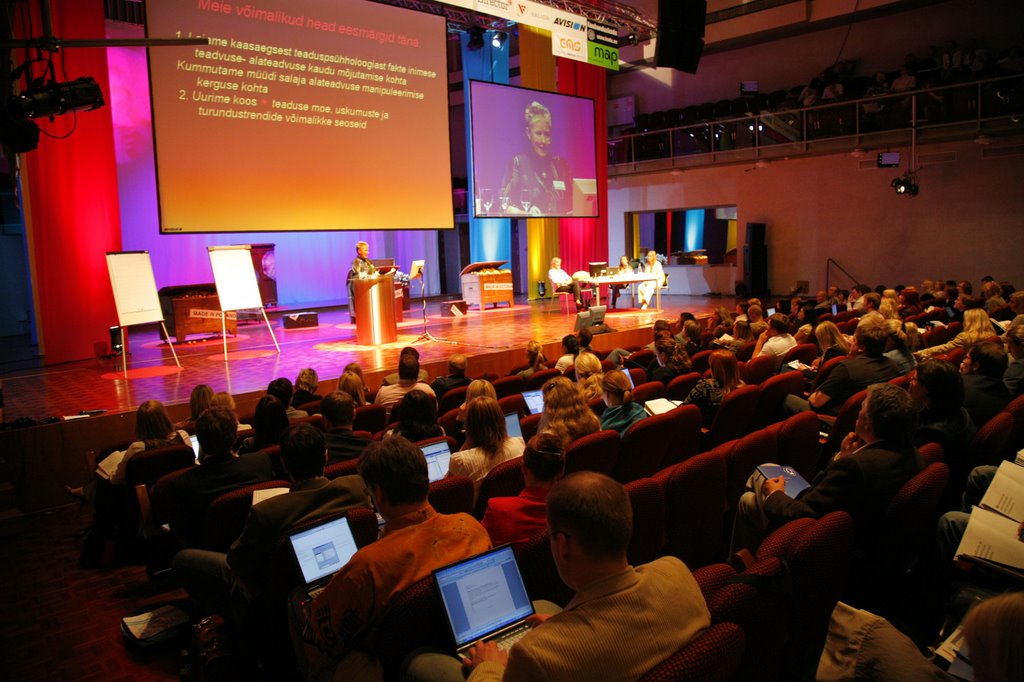
New Media is disruptive. It certainly is a critical part of the sessions here in Parnu at the 'Marketing Without Words' marketing conference in Estonia. New Media crops up in almost every conversation.

Mare Park (pictured), a psychologist presented a fascinating insight that offered insights that will be familiar here. She made it clear that there is a basic and fundamental need to approach customers using a wide range of 'touchpoints' which I have covered here before.

She also explained why context is relevant for advertising which goes a long way to explain why so much advertising spend is not hugely productive. There is a lot in this conference with its international contributors that
harks back to some of the past discussions at Leverwealth.
Now to find out from Robert East about 'How Bad is Negative Word of Mouth'


There is a
videocast of this conference too.

MARKETING WITHOUT WORDS


Here are 580 people at the 'Marketing Without Words' marketing conference in Estonia. Louise Kelly (pictured), of Foghound, Was almost immediately controversial. She talked of marketing as conversations and the need for engagement in new media as a marketing imperative. Here view of advertising is that it has a future in provoking conversation. I think we have quite a lot in common (in so far as any PR and Marketing person may).
This is a dynamic and aware audience. Tomorrow will be fun when I have both workshop and talk. New media is very a thread running through everything here.

Robin Gurney of Altex is here (He of Dvisions who worked with Alison Clark - Alison was one of the CIPR Internet Commission members ) and giving both a presentation and a workshop.


Wednesday, May 17, 2006

Who is not facing the digital tsunami?

"While Web 2.0 offers many new opportunities...... By 2008, the majority of Global 1000 companies will quickly adopt several technology-related aspects of Web 2.0, but will be slow to adopt the aspects of Web 2.0 that have a social dimension, and the result will be a slow impact on business," according to Gartner, Inc.

Well, I just do not believe their hope that the impact on business will be slow.

In Tallinn, you can pay to park your car using your cell phone (see picture for instructions). What happens is that you enter a code, your car number the payment is collected via your phone provider by a third party who pays the local authority, takes a slice and pays a slice to the phone company.


Also here, you can set up a premium cell phone number free. This means that people calling that number pay for the privilege. I am told that some school children create web sites with their homework on it and password protect the page. They then text their friends and offer the password to the protected pages from their premium number and thus make money by collecting the premium payments from fellow students who (well would you believe it!) copy the homework.

They are very enterprising kids!

It is not the biggest stretch of imagination to believe the same is taking place among University students and other social groups.

Here they are getting credits for Intellectual Properties and can spend them to pay for car parking.... or, it is rumoured by my friend, drinks at a bar and other products and services.

This means another economy has emerged. Its currency is cellphone credits. Its market is in the convergence of mobile phones and cyberspace. The social dimension is already at play

Now, there is no reason why cell phone companies should be the only beneficiaries. There is no reason why the communications intermediary should not be (well obviously, because its is its home) Skype users (or other similar organisation) using WiMax.

Let us imagine that a range of intermediaries emerge in different countries such that the enterprising Estonian student can get payment from a student in, say, Portugal. Let us imagine that a blog or MySpace is used to list valuable IP and so the market is notified by RSS.... It is not very far fetched at all.

The marketplace suddenly became international.

What happens if this trading is for tangible assets such as oil or shipping tonnage and does this have to be through any of the established agencies such as conventional banks (
and there are other kinds of bank)?

At a small business level (student) and big business level (shipping and oil) the economy can change very quickly.

“While it is straightforward to add specific technologies, such as Ajax or RSS to products, platforms and applications, it is more difficult to add a social dimension,” said David Mitchell Smith, vice president and Gartner Fellow.

The social dimention is Public Realations - this is not rocket science.

The impediments may be daunting for big business but for small businesses – lets say a student with a car in Tallinn - it has already happened.

In fact a whole new economy has already emerged. Did anyone notice? Where are the regulators... who is collecting the tax? Why is web 2.0 a threat?

The digital tsunami is invisible only if you look the other way.

Where it is all at - Tallin


I am in Estonia, the home of Skype.

Ahti Heinla, Priit Kasesalu and Jaan Tallin - all of them 32 years old and childhood friends programmed the original KaZaa code together with an Estonian and Swedish team. After enormous success, the founders sold KaZaa to Sharman Network, who still offers KaZaa downloads. The well-known North-European portal Everyday.com was also created by the same trio - Heinla, Kasesalu and Tallinn.

After selling KaZaa to Sharman Networks, Zennström and Friis decided to establish a new company and hired the same programmers who created KaZaa. The team got also an addition in a new Estonian programmer, named Toivo Annus. The new company created a highly popular software – Skype, which enables the user to make free telephone calls all over the world. The only condition necessary to talk is that the persons need to install Skype into their computers.

Springtime in Tallinn is magic.

Sunday, May 14, 2006

Chartered Institute of Public Relations.... Get it! Go for it!

It can be said that in the week that the President of the Chartered Institute of Public Relations begins to blog (well that was the rumoured plan last week), The Chartered Institute seems to be slipping backwards with its ICT efforts.

A President's blog is window dressing unless there is a lot more substance behind it. In other words it will be spin in its less welcome definition. I hope I am wrong.

Right now, I am underwhelmed by its response to developments in new media. It has not read its own publications on
what the Internet means for PR which has languished in the cellar for five years.

There is no apparent strategy, no initiative and a brick wall response when it comes to offering help.

It is not that the CIPR is not busy, active and doing a tremendous job. It is. My concern is that it is (and for a long time has been) ignoring the significance of Information and Communications Technologies and especially Social Media.

The CIPR initiatives so far extend to a course for members on 'the use of words in e-mail, the Internet or intranet because communicators and public relations practitioners need to be able to maximise their command of that use.' (absolute promise – that is what the CIPR site says – check it out!); The Diploma does not include ICT/New Media at all; Not a single CPD mentor is a blogger, podcaster or has a Usenet post (and few are well known for their use of technology); None of the CIPR trainers has a blog. Many do not have a web presence. The contributions about the Internet from expert members is little heeded by the Institute (e.g Louise Sibley's comments of a couple of years ago).

As the Chair of the 1999 PR Commission into the significance of ICT for PR and as the author of the CIPR's recommended book on the subject,
On-line Public Relations', I feel that, when it comes to using communications tools especially the ubiquitous press release the fluffy bunny tendency has a significant hold. This view is, I suspect, supported by a number of elder statesmen who, while enjoying the clubland feel the swanky new headquarters building in St. James's Square, do not see the media much further than the Tatler. With a glass of port in one hand, one envisage them reading this week's feature about actress Sophia Myles who is, writes columnist Sebastian Shakespeare, "More a spag bol and Guinness kinda girl than your usual star."

Compared this with the up-beat enthusiastic and enquiring professionals with an interest in all that is New Media at

Philip Young's conference and the contrast could not be greater. One notes that a video/podcast and comment about this event is already is available online using new media (and a little Web.2.0) – a classic example of New Communication at work (well done Neville).

Click here to Watch London: the Movie.


While it seems, the CIPR is ignoring ICT/New Media, practitioners are really up for it. So too are publics.

The CIPR must have noticed that between Phillip Young and Haymarket over 700 communicators have paid big fees to go to 'New Media' conferences this year. That is equivalent to nearly TEN percent of the membership of the Institute. Perhaps some of the delegates may not be members. One might enquire why? This is not going away.

A glance at the in-house vacancies on the

CIPR recruitment pages shows how important New Media ICT is. While one does not expect the PR consultancies to be expert in Social Media (this is normally the role of specialists like Stuart Bruce), the in-house practitioner is now expected to have expertise (see the requirements of a sample on the CIPR site below). Without it, job prospects decline and judging by the current list of vacancies advertised through the Institute, more than 50% of in-house vacancies advertised require ICT PR skills.

The critical issue for the Institute is that if it is not relevant to the communications competencies, needs and skills its members need, it will loose members' interest. Membership churn will exceed 12% pa, a critical number for all voluntary organisations.


So what is involved?


CIPR Members' clients have a number of persona and the one that is new (since 1995) is only found in cyberspace. It is different to anything past. To begin with it is durable, the Internet never forgets. It includes all that went before and is a mashup of fact fiction, reputation, and reality. It is mediated by Internet technologies through direct and indirect influence and the impact of events. A broad range of stakeholders extending well beyond competitors, vendors and other publics, directly and through association, but always, eventually (and without exception), are at work re-casting the corporate or product brand on-line.

Today, when the world's population seeks an organisation, it appears with a particular slant. It is a slant devised and presented, not by a person, newspaper or human community but by a search engine algorithm.

The bottom line is this: There is an image of organisations that is and resides in cyberspace. It is not the same, real, organisation CIPR members know. But to most people, this cyber organisation is the reality of what the organisation is. The reality, for most people, is a cyber-mirage.

What then is the role of the PR practitioner? Is it to bring about convergence between the digital mirage and the real? Is it to bring about a common truth between the online and the actual?

Just understanding what is at stake requires professional help, help to members who can then help their clients. The alternative is to let Member's organisations become as real and as surreal as a Playstation or Xbox game.


Is that good enough? Is it sustainable? How should or could it be managed? Can that be ethical? What research is available to aid practitioners?? The on-line Member's skills to bring this about are prodigious. Can the Institute develop member skills? Can it do it fast enough? How can the professional communications institutions respond in the interest of practitioners? Are such organisations different to the established (and Chartered) organisations?


I hope these are the questions that are vexing the Chartered Institute of Public Relations.
As the AGM nears, will Lionel Zetter (click here to see his significance in the bloggersphere) be up to this, the biggest issue in PR over the coming year?


FOOTNOTES
In-house jobs require ICT skills – of the in-house jobs advertised on the CIPR web site today, more than half require ICT skills including:

- knowledge of the full communications mix, particularly in terms of employee communication channels and tools.
- expect you to manage the logistics needed to deliver communication activities such as webcasts, web chats and meetings as well as coordinating their delivery
- provide online PR for our client base and we are looking for an experienced PR to help start it.
external communications include dealing with external media, updating of the company website.


Picture:
'More a spag bol and Guinness kinda girl than your usual PR' Sophia Myles on the front page of the Tatler

Saturday, May 13, 2006

Maveric research by Miliband

Should Government Ministers get help from the Civil Service to aid their blogging activities? Is there a good case to be made for Government Ministers to have personal or Departmental blogs. There is definitely a need for research.

David Miliband is a senior member of the UK Government and a blogger. He began blogging when working in the at the Office of the Deputy Prime Minister and is now offering his view as a Minister in the Department for Environment, Food and Rural Affairs on the same blog.

Mr Miliband says: “This blog is my attempt to help bridge the gap - the growing and potentially dangerous gap - between politicians and the public. It will show what I'm doing, what I'm thinking about, and what I've read, heard or seen for myself which has sparked interest or influenced my ideas. My focus will be on my ministerial priorities. The blog is paid for by the UK Government and is supported with Civil Servants providing expert help and assistance including, I discovered last week, editorial help.

This weblog is being evaluated by the independent, non-partisan Hansard Society, an independent, non-partisan educational charity, which exists to promote effective parliamentary democracy, as part of a Department for Constitutional Affairs pilot into use of information and communication technology by central government.

Researchers from the Hansard Society have been given permission to approach people who use this weblog - this will be through email and people who respond to the blog are not obliged to take part. This is not made clear in the terms and conditions you agree to if you respond to a Miliband post.

The pilot, we are told, will report in Summer 2006 and inform the way ICT is used to provide a platform for dialogue between citizens, elected representatives and political institutions.

There are a number of issues involved in this project.

The first is that is it right for a Government to sponsor a Minister? This has two parts. First is it right for a Government to pay for this research as a live experiment, as opposed to the normal channels that the Government uses for research? The second being, should the Government sponsor the promotion of an individual Member of the Government using a blog or would it be more transparent for the Government Department to provide the blog? In this case the blog followed the Minister as he changes roles in the recent re-shuffle. Will it follow him out of office? Is this, then the authentic voice of David Miliband.

The background to all this was provided by Ross Ferguson and Milica Howell in a Hansard publication Political Blogs – Craze or Convention?

Perhaps this is 'research' of the kind that is done by 'spin doctors' to attempt to make a point but without the normal and robust checks and balances one would find in the kind of academic research which would normally attract the governemen'ts usual research funding, ESRC.

Perhaps the reason that this 'research' has to be conducted by the Department/s and or Hansard is that there are no provisions for this kind or research available through ESRC.

I will stop beating arround the bush - ESRC parameters for research specifically exclude ant reserach into human commumication.

My be this is why research by the Communications institutions and academics in communications research institutions have not been included in the experiment. You see, if this is how powerful Ministries get research done outside the channels that most academic have available, can we envisage more research, paid for by the public purse but not accountable through 'the normal channels'.

A new Neuclear device for example.

Or, perhaps, just perhaps, the research angle is a smoke screen and this was a way that a Government Minister could run a blog. Its not as though politicians don't have blogs, it just that it is pretty difficult for Ministers of the Crown.

What, one might ask can a Minister in a 'transparent' government say in a blog that cannot be said by a Civil Servant in the press office? Do Mr Miliband's blog posts get cross posted to the Departmental 'official channels' if not why not is this a case of haves and have not's.

Indeed if there is editorial help, where does it reside? Is it among the faceless professionals (such as The Prime Minister's Official Spokesman (PMOS) whose name is available to the press but not the public and who could not claim to any understanding of 'transparency' it seems. So that is unlikely.

There are so many questions.

An interesting social and political thingy... but not research, I suggest.

I am much less sanguine about this initiative than others. On the one hand, it has a seriously heavy hand of not very well joined up Government about it and on the other, it looks like Ministerial glad handing.

Picture: David Miliband


Friday, May 12, 2006

Hook it all up to broadband

The range of communications channels vailable to practitioners is huge and today we get an incling of how they can be available for a whole family and for a wide range of devices in the home.

The wireless home is
becoming a reality for millions of consumers according to a new survey of 2000 Internet users from Strategy Analytics' Connected Home Devices Service. 20% of broadband subscribers across the USA and Europe now use Wi-Fi to share their Internet connection between PCs and other devices, according to the report just released: 'Home network adoption: Wi-Fi emerges as mass market phenomenon'. According to the report, 7% of all households now have a wireless network.'Rising ownership of laptop PCs and other portable Internet devices will make Wi-Fi the dominant home networking choice for most broadband subscribers'.Strategy Analytics' broadband user survey is based on online interviews with 2000 home Internet users in eight countries (US, France, Germany, UK, Denmark, Finland, Norway, Sweden).

Imagine: your PC, laptop, Xbox, Skype phone, Television, radio etc all opperating from your wifi in the garage. Well, its here and now and is how I am able to blog this post from my son's kitchen (I am staying overnight in London).

Thursday, May 11, 2006

What effect does the press have?

Well, in many cases it has considerable influence. Study after study shows that press coverage will affect the way people will react to products and services and their promotion and purchase. The empirical evidence is overwhelming so I was surprised to see that, according to Professor David Larcker, of Stanford Business School, the media outrage about fat cat executive pay is falling on deaf ears.

"Say the press does hammer away on some company. The question then becomes, 'So what?'" he said.

"Most companies don't seem to care enough to substantially change their pay practices. They might shift the mix of compensation a bit - from cash payments to stock options, for example - but in terms of the total compensation, press exposure doesn't really seem to matter." Says Larcker (Pictured).

I think I would rather see more evidence about cause and effect in the 'press' and also some idea of the influence of the Internet including some of the web sites and, of course the social media.

Wednesday, May 10, 2006

A manifesto and a franchise

Neville Hobson alerted me to this post by Loic Le Meur. It is a closely argued criticism of Quaero, the French search engine. But it is much more than that. It is a manifesto for the new economy, a description for the disintermediated franchise and the alarm bell for politicians and business folk who have not yet seen the digital tsunami as it sweeps them up into the most exhilarating and terrifying time of their lives. Such fun to watch!

Trusting brands to divorce lawyers

Would you trust your brand to your a divorce lawyer? If the answer is no, then why is it managed by the marketing department?

Divorce lawyers have an interest in relationships. Specifically relationships with people seeking a divorce. A divorce is the irrevocable end of a relationship.

A Marketing department is interested in relationships. Specifically relationships with people in the value (by which I mean money) chain. A product or service, once purchased is the irrevocable endgame in the value chain.

But it is not the endgame for the organisation or the customer.

So Marketing invented 'customer relationship management'. This tends to be systematised aftersales marketing offering service, maintenance, spare parts, product peripherals, surveys, spam, pop-ups and call centre earache. The customer remains in the value chain until they fall out of the irrevocable endgame in the value chain because they stop buying. This is not customer relationship management, its selling.

It is the antithesis of the Craigslist, a company, reports the Sunday Times with a higher ROI, better earnings per share, and ratios that Glaxo, BP, General Motors and even Toyota can only dream about. Where a major corporation would like to get 7% net profit on turnover, Graigslist gets 300% net on turnover.

But then, major corporations have big marketing departments.

Craig has relationships.

His brand has an ethic and his model reaches out to deliver his brand values to the network, in the network, for the network and to recruit a network of relationships so that word of mouth delivers his stunning profitability and ROI. Other examples of organisations built on brand reputation include Skype, Google and Zopa etc.

I do not know why Stanford University has decided to promote "An Approach to the Measurement, Analysis, and Prediction of Brand Equity and Its Sources," which was published in the September 2005 Management Science journal but it did yesterday. In it V. "Seenu" Srinivasan, the Adams Distinguished Professor in Management at the Graduate School of Business with Korea University Business School Professor Chan Su Park, and Yonsei Business School Professor Dae Ryun Chang, have come up with a mathematical model and a market research method that allows managers to figure out how much more the company will earn if it invests in various kinds of branding activities.

Srinivasan and his colleagues developed an operational definition of exactly what "brand equity" is. "Having a better product or a larger sales force is not brand equity," he explains. "Brand equity is that incremental value that accrues to a product when it is branded."

This is common to other views such as those of Professor Leslie de Chernatony at University of Birmingham.

Simple brand awareness is one source of brand equity. Srinivasan says: "If you can get your name to pop up in people's minds when they think of the product category, you've won a big part of the battle."

Srinivasan and his colleagues also identified two other sources of brand equity: a consumer's perception that a brand is better than it really is ("attribute-based" equity), and nonattribute-based equity, for instance, a consumer's preference for a brand based on the cachet of owning it. "If you're successful in these three aspects, an added benefit is that stores will feel a customer pull to carry your product, and so your availability -- and hence sales -- will increase," Srinivasan says.

In doing calculations on cellular phone brands in Korea, Srinivasan found that simple awareness -- getting the brand's name to pop up in consumers' minds -- generates the largest return, followed by consumers' responding to the cachet of owning the brand (nonattribute-based equity). Attribute-based equity trails in third place. "This means that a brand's 'image' provides a stronger incentive for buying even than the perception that it is a better product," he explains. "But greater awareness of your brand is the major component driving brand equity."

From this we have thee elements that seem to be very important to brands. All three are value based but, for the most part, this value has little to do with money.

If we examine the Srinivasan hypothesis from a "Marketing" perspective there are three things to do: Shout, so that people remember the name of the brand. Tell customers they are getting a bargain and tell customers they are 'cool'.

Of course you need a big advertising and sales promotion budget to do this but as we all know... 'Advertising sells'.

What if we were to look at the Srinivasan hypothesis from a relationship (PR 3.0) perspective?

In the first instance, public relations has a significant advantage in gaining attention. It can work empathetically in many channels for communication without being intrusive and off-putting too gain attention when people are receptive and in the right frame of mind to be influenced. In a process of sharing values, the network is brought into play.

This process has the advantage that it keeps the 'brand' at top of mind because it is part of the consumer's value set and, additionally, relationship network and have a powerful emotional impact that is missing from advertising and typical sales promotion activities.

PR has used this approach with traditional print media for a long time. It works because of an emotional link between reader and publication and now we have the added channels for communication at our disposal.

In achieving "attribute-based" equity, and “nonattribute-based equity”, PR continues participation in the networked conversation. It never stops.

It continues to gain attention, as the network uses embed messages and makes the brand memorable.

The practice of public relations has to work to offer many cognitive devices using a range of social networks and channels for communication and content suited to a range of contexts.

The mono culture typical in many approaches to marketing communications (giving rise to expressions such as 'being on message') is inadequate and often counter productive.

People mistrust the robot response of 'on message' politicians.

People need context. Cognitive psychologists say that we carry a model or personal image of the world, relationships and other concepts around with us. We have several such models and apply the most relevant to the context of the moment (which I call a 'social frame'). For both understanding and acceptance PR creates and maintains its messages in contexts.

It is this context that provides the 'attribute based equity'. We know that the social frame of the individual creates personal contexts which include these extra-brand values.

The PR process offers tokens and values in an appropriate social frame which adds the campaign 'messages' to the understanding or personal model of the recipients in relevant context, the best channel and appropriate time . When this is done in such a way that both the organisation and the recipients gain an added value or understanding, the PR campaign will have been effective.

As the senses provide information we adjust these perceptions to arrive at cognitive consistency, (and resolve cognitive dissonance).

Meanwhile we now know that relying on the typical Marketing ploy of a few 'core messages' has dubious effect if it does not produce synaptic modulation. The secret of non-attribute-based equity is in the wider context of the network. Part of pride of ownership comes in that context when we can both be of a group and involved in social interaction – a condition that offers our brain huge rewards.

The significance of PR's multiple domains is that these skills can be applied in tandem to reach publics in a way no other management discipline can.

Public Relations is (can be) multi dimensional in a way the marketing cannot be. But it can create the awareness in context, the multiple touch and empathy that is needed to generate brand equity in a way that Marketing is incapable of approaching.

Picture: The Divorce Forum

Tuesday, May 09, 2006

Mashup for News and PR

As part of a series of posts I intent to identify why I think the digital tsunami is important and look at how practice can change and adapt.

Here, I want to describe a new approach to news.

We are now getting used to getting our news online. We discover that a PR programme for one country is frequenctly covered in newspapers in another country and that publics view coverage that is generated anywhere in the world. There is no longer 'national news'.

In addition, we find that there is too much news and reading it and managing it both too time consuming and cannot be managed fast enough to be more than an overview.

Furthermore when we issue statements or respond to on-line content the news agenda is so fast moving that providing background briefing, added value content and context for our work takes a long time and is out of date in a very short time.

Internet mediated news is global, fast and dynamic.

What we need is a capability that can monitor everything that is being published in mediated and un-mediated channels for communication. We need our news extracted as themes and then presented with the most pertinent comments first. We also need to get to the sources quickly when the need is critical.

There is an expression for this approach. Its called 'mashup'. It is available and it (well almost, works).

With such capability, the practitioner can see the context of news, keep their organisation alert to the most important news and engage with their external constituency with contributions that will influence the culture of the topic in hand.

PR people can be up to date, informed, comprehensive and at the centre of debate or consumer interest.

Such is the speed and progress of the digital tsunami, a solution is being tested now. It is in pre-beta development but readers of this blog can see it at work here (when the experimental server is working – click on a blob!).

What it does is identify the most significant sentences in news texts and orders them in such a way that the most significant sentence is at the top of the resultant news brief. It cuts the time it takes to read the news. And it offers news because of its semantic significance. Some people are using it to create blog posts.

The benefits seem simple enough but what of the threats. One can, at best speculate but some thoughts spring readily to mind.

In the first place, this could replace newspapers. Journalist's comments on web sites (or blogs) can be mashed up to create 'newspapers' that can be distributed using a wide range of channels for communication. The competitive impact will be effective. Competitors using such capability can engage in relationship building well ahead of those using traditional 'Marketing' tools and can match the mood of the moment with relevant content across many channels. A practitioner using such a capability will be noted for their current knowledge and the prescience of their insights. They will be sought after commentators.

With a quarter of Gross Domestic Product growth within the EU and 40% of productivity growth ascribed to Information and Communications Technologies (ICT), this is a way that PR can tap into the digital tsunami.

Picture: Winds of Change

Monday, May 08, 2006

The digital tsunami and Public Relations

A quarter of Gross Domestic Product growth within the EU and 40% of productivity growth can be ascribed to Information and Communications Technologies (ICT).

This means that, once one puts aside primary industries like agriculture, extraction industries such as coal and aggregates, nearly all the important activity in our economy is based on intellectual properties.

The Public Relations industry has to be a participant in ICT if it want to be a part of this growth an productivity improvement.

I gave a definition of Public Relations that adapts from Edward B. Tylor's definition of culture. Of course from a Durkeim perspective there are some interesting variants (which, I would suggest are at odds with the idea that we are different people in different contexts – a more modern, psychological perspective).

This approach is not new. The European Commission set up the Forum in 1995 in order to create a new and authoritative source of reflection, debate and advice on the challenges of the Information Society. The Information Society, it concluded, could give birth to a Second Renaissance, with a new flowering of creativity, scientific discovery, cultural development and community growth. The elements that are specific to Public Relations being creativity, cultural development and community growth. The Commission also chose Taylor's view culture and its significance to exploring the new Renaissance. In our interactive commons, it may be time to review those findings to aid Public Relations facing the Information and Communications Technology tsunami.

In such turmoil we have to find an overarching description of a practice that has many domains in order that we can take a long view and can strategically address the changes we face.

In a recent exchange on Richard Bailey's blog there was a discussion about marketing communications and Corporate PR. My view is that Public Relations is now far too important to be associated with Marketing. The debate is about the future of Marketing and the role of Marketing Communications (e.g. PR) in the so called 'marketing mix'.

My point was that if we define marketing PR, we have to define marketing. Every definition to-date has been overtaken by events. Even marketing itself has been disintermediated.

Being associated with a management fad that is about to be torn to bits is plain silly. There is a role for market relationship promotion (MRP) but that is not the same as marcoms.

I then went on to say:

If all other than marcoms PR is Corporate PR we have to define what an organisation is. If, as I propose it is a nexus of relationships, then PR is a very broad and flexible kirk indeed.

What Amazon did to W H Smith and Dell did for the PC is the thin end of the wedge. We now have true online banks that disintermediate traditional banking (Lending and Borrowing), disintermediated telcos (now that we can get broadband as WiMax and cellular bandwith) an so on. The pace of change is fast and getting faster.

The nexus of relationships is truly powerful. Marketing and so called 'marketing PR' just gets swept aside in digital the tsunami. The conversation wins.

This means we have to be much more robust in describing what Public Relations really is.

One can see the evolution in the debate about what we do and what we can do in two recently published academic papers:

In 'Furnishing the Edifice': Ongoing Research on Public Relations As a Strategic Management Function (Journal of Public Relations Research, 2006, Vol. 18, No. 2, Pages 151-176), James E. Grunig moves in this direction a long way and I take it further in my paper “Towards relationship management: Public relations at the core of organisational development” (Journal of Communication Management ISSN: 1363-254X Volume: 10 Issue: 2 pp – 226).

These papers are evidence of work that is months old. But the change too rapid to wait for responses in academia. I no longer believe that we have time to wait for academic journals to provide the academic underpinning needed.

Picture: Digital Tsunami